
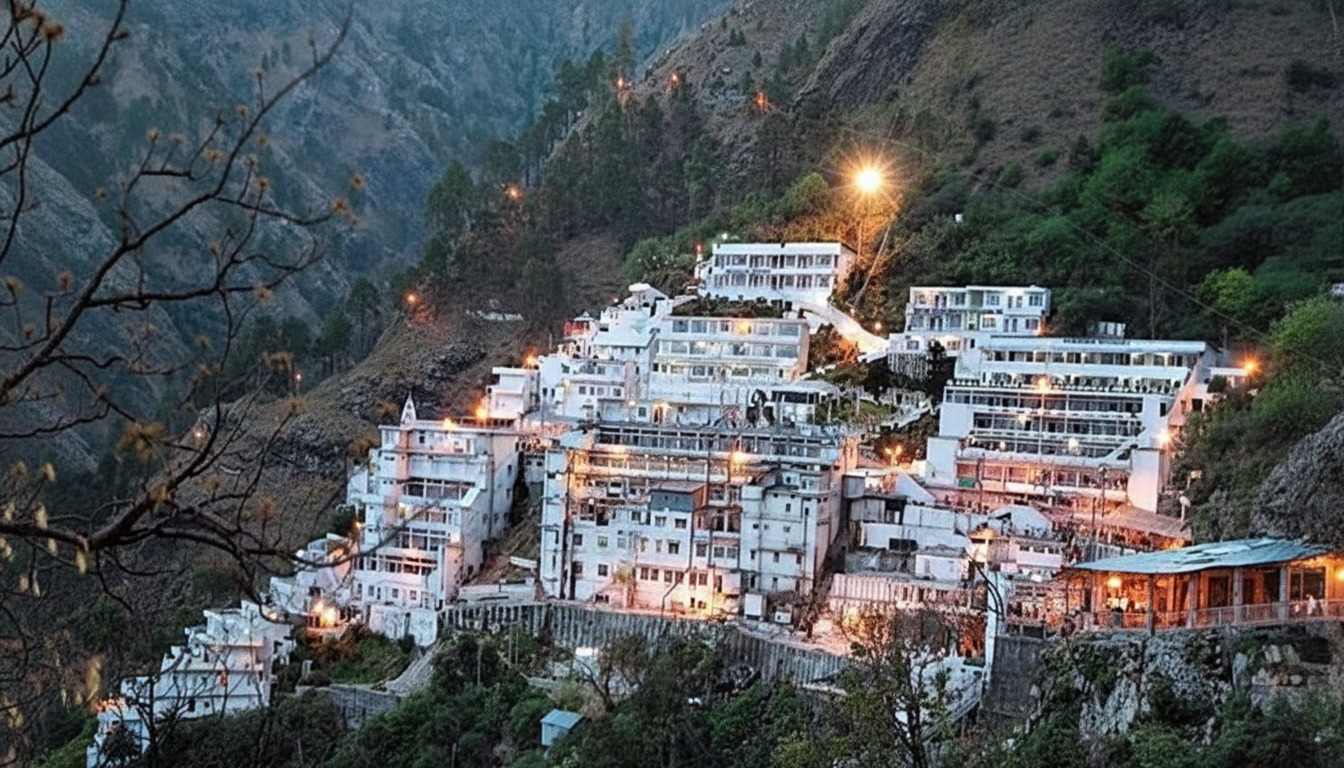
About Vaishno Devi Temple, Katra, Jammu and Kashmir
Vaishno Devi Temple, formally the Shri Mata Vaishno Devi Shrine, is a cave shrine in the Trikuta Hills near Katra. The pilgrimage ends at Bhawan, where devotees enter the Holy Cave for darshan of the three natural Pindies worshipped as Maha Kali, Maha Lakshmi and Maha Saraswati.
The route to the cave passes through places associated with the Vaishno Devi tradition, including Banganga, Charan Paduka and Ardhkuwari, before reaching Bhawan and, traditionally, Bhairon Ghati.
Story of Vaishno Devi Temple
The sacred history of Vaishno Devi is preserved mainly through religious tradition. The Shrine Board records several versions of the shrine's origin, with one widely followed tradition associating the discovery of the Holy Cave with Pandit Shridhar, a devotee from Hansali near present-day Katra.
According to this tradition, Vaishnavi appeared at a Bhandara organised by Shridhar and later disappeared into the Trikuta Hills while being pursued by Bhairon Nath. Shridhar is then said to have been guided in a vision to the Holy Cave, where he found the three natural Pindies.
The modern history of the shrine is more clearly documented. Before 1986, its administration involved the Dharmarth Trust and Baridars. The Shri Mata Vaishno Devi Shrine Board was constituted in 1986, and the 1988 Shrine Act placed the administration of the shrine and its endowments under the Board.
The present pilgrimage route is therefore a combination of an older sacred geography and a modern pilgrimage system. The Shrine Board has developed the track, shelters, accommodation, medical facilities, water supply and other services from Katra to the Holy Cave while continuing to preserve the cave as the centre of worship.
Deities and Sacred Form of Vaishno Devi
The Holy Cave is different from a conventional temple sanctum. There is no installed idol representing Vaishno Devi; the central objects of worship are the three natural Pindies that form the sanctum of the cave.
The Shrine Board identifies the three Pindies as manifestations of Maha Kali, Maha Lakshmi and Maha Saraswati. They emerge from a single natural rock formation but differ in colour and texture.
The cave itself is therefore part of the sacred form of the shrine. Bhawan, the larger pilgrimage complex around the cave, provides the facilities through which pilgrims reach and enter the sanctum.
The Holy Cave
The Holy Cave lies at about 5,200 feet above sea level. The natural cave is the religious centre of the shrine, while the surrounding Bhawan complex accommodates the large number of pilgrims who come for darshan.
The physical structure seen by visitors today includes developed access passages and facilities, but the Pindies remain in the natural cave as the focus of worship.
Bhawan
Bhawan is the main shrine complex at the end of the ascent from Katra. Accommodation, cloak rooms, medical facilities and other pilgrim services are provided here.
For the devotee, however, Bhawan remains important because this is where the Holy Cave and the Pindies are located.
What Makes Vaishno Devi Temple Sacred for Devotees
Vaishnavi and the Trikuta Hills
According to the religious tradition of the shrine, Vaishnavi was a manifestation associated with the three Divine Energies of the Goddess. She undertook spiritual practice and eventually travelled north to the Trikuta Hills.
Another tradition recorded by the Shrine Board associates Vaishnavi with an encounter with Lord Rama during his exile. Rama directed her towards the Trikuta Hills and told her to continue her penance there.
These accounts belong to the religious tradition surrounding the shrine. They are not presented as archaeological evidence for the history of the cave.
Pandit Shridhar
The Pandit Shridhar tradition explains how the Holy Cave became known as the principal shrine of Vaishno Devi.
Shridhar is said to have organised a Bhandara at which Vaishnavi appeared. After she disappeared, he continued to worship her and was later guided to the cave in a vision. There he found the natural three-headed rock form now known as the Pindies.
The Shrine Board regards this as a traditional account of the discovery of the shrine.
Banganga
Banganga is the first major sacred point after Katra. According to tradition, Vaishnavi stopped here during her journey through the Trikuta Hills and created the stream associated with the name Banganga.
The site is also an important checkpoint in the modern yatra. Pilgrims must complete the required registration before proceeding beyond the designated check point.
Charan Paduka
Charan Paduka is traditionally associated with the footprints of Vaishnavi.
It is one of the early sacred stops on the route and sits between Banganga and Ardhkuwari.
Ardhkuwari and Garbh Joon
At Ardhkuwari, Vaishnavi is traditionally believed to have continued her penance inside the narrow cave known as Garbh Joon.
The nine months associated with her stay in the cave form an important part of the pilgrimage tradition. Ardhkuwari therefore has a religious role that goes beyond being a midway stop on the route.
Bhairon Nath
The story of Bhairon Nath explains why the pilgrimage traditionally continues beyond the Holy Cave.
According to the shrine tradition, Bhairon Nath followed Vaishnavi from her ashram to the Trikuta Hills. She passed through Banganga, Charan Paduka and Ardhkuwari before reaching the Holy Cave.
When he continued to pursue her, Vaishnavi confronted him outside the cave and beheaded him. His head is said to have fallen on the hilltop now called Bhairon Ghati.
After his death, Bhairon Nath recognised his error and asked for forgiveness. Vaishnavi granted him a boon that devotees would visit him after darshan of the Holy Cave, completing the pilgrimage with Bhairon darshan.
Shaktipeeth Traditions
Vaishno Devi is sometimes described as a Shaktipeeth in devotional and pilgrimage literature. The Shrine Board notes that traditions differ regarding which part of Sati is associated with the site.
The association is therefore best presented as a religious tradition, rather than as a single uncontested scriptural or historical fact.
Other Regional Traditions
The Shrine Board also records traditions connecting the surrounding sacred landscape with the Pandavas and with Guru Gobind Singh. These accounts form part of the wider sacred history of the Trikuta region and remain distinct from the documented administrative history of the shrine.
Annual Festivals & Rituals at Vaishno Devi Temple, Katra, Jammu and Kashmir
Darshan of the Holy Pindies Celebrations at the Temple
The central act of worship is darshan of the three Holy Pindies inside the cave. The Shrine Board states that the Holy Shrine remains open throughout the year, although movement into the sanctum and access arrangements are regulated according to the prevailing system.
Atka Aarti Celebrations at the Temple
Atka Aarti is performed in front of the Holy Cave twice a day, once in the morning and once in the evening. The ritual is conducted before the Pindies and is attended by devotees. Detailed timings and participation arrangements are current operational information and belong on the dedicated Darshan page.
Havan and Poojan Celebrations at the Temple
Daily Havan and Poojan are performed in the Yagyashala with Vedic mantras. These ceremonies form part of the continuing religious activity of the shrine and are separate from the general act of darshan.
Chaitra and Sharad Navratri Celebrations at the Temple
Navratri is among the most important festival periods at Vaishno Devi. The Shrine Board observes both Chaitra Navratri and Sharad Navratri with special religious programmes. The Board has also organised Shat Chandi Maha Yagya during Navratri, together with Vedic recitation and other rituals. Because these are major pilgrimage periods, route and crowd arrangements can differ from ordinary days.
Diwali Celebrations at the Temple
Diwali is also observed at the Holy Shrine with special worship and festive arrangements. Festival dates and current programmes change each year and should be checked before travel.
Bhairon Darshan Celebrations at the Temple
In the established Vaishno Devi tradition, darshan at Bhairon Nath follows darshan at Bhawan and completes the pilgrimage.
Sacred Places to Visit Near Vaishno Devi Temple
Banganga : Banganga is the first major sacred point after Katra and is associated with Vaishnavi's journey through the Trikuta Hills.
Charan Paduka : Charan Paduka is associated with the sacred footprints of Vaishnavi and forms part of the traditional route towards Bhawan.
Ardhkuwari : Ardhkuwari is associated with Garbh Joon and Vaishnavi's nine-month meditation. It is also one of the principal midway points of the modern pilgrimage route.
Himkoti : Himkoti lies on the alternate route between Ardhkuwari and Bhawan. It is an important halt on the modern pilgrimage track and has been developed with facilities for pilgrims.
Sanjhichhat : Sanjhichhat is the point where the main upward gradient ends before the final approach to Bhawan. It has pilgrim facilities and a helipad used for the Shrine Board's helicopter connection.
Bhawan : Bhawan is the main shrine complex at the end of the route from Katra. The Holy Cave and the three Pindies are located here.
Bhairon Ghati : Bhairon Ghati lies beyond Bhawan at a higher altitude. Bhairon Nath Temple is associated directly with the final episode of the Vaishno Devi legend.
Shiv Khori : Shiv Khori is a separate cave shrine dedicated to Lord Shiva in Reasi district. It is not part of the Vaishno Devi route but can be visited as another major pilgrimage site in the district.
Baba Dhansar : Baba Dhansar is another Shaiva pilgrimage site in Reasi district, known for its shrine, natural surroundings and waterfall.
Plan Vaishno Devi Darshan
For current yatra registration, detailed darshan planning, route options, Atka Aarti arrangements, transport services and Naman Darshan's independent guided assistance, continue to the dedicated Vaishno Devi Darshan page. Naman Darshan provides independent guided assistance and visit coordination. It is not the Shrine Board and does not guarantee special or priority entry.
Common Questions About Visiting Vaishno Devi Temple
Visitor Information
Entry Fee
No conventional entry ticket – Separate charges apply for selected services and facilities.
Darshan Timing
Address
Shri Mata Vaishno Devi Shrine Board, Katra, District Reasi, Jammu & Kashmir – 182301, India
Notable Events
1986: The Shri Mata Vaishno Devi Shrine Board took over management of the shrine. • 1988: The Jammu & Kashmir Shri Mata Vaishno Devi Shrine Act established the statutory framework for management of the shrine and its endowments. • 1990s: The Shrine Board developed the pilgrimage track, pilgrim accommodation, sanitation, water facilities and medical services on the route. • 1999: The alternate track between Ardhkuwari and Bhawan was opened, providing a wider route with a gentler gradient. • 2018: The passenger ropeway connecting Bhawan and Bhairon was opened, providing an alternative to the traditional ascent to Bhairon Ghati. • 2020s: The Shrine Board continued infrastructure, sanitation, accommodation and route-improvement work across the Katra–Bhawan–Bhairon pilgrimage corridor. • 2026: The Shrine Board continues to publish current operational notices, service information and infrastructure works, so individual facilities and access arrangements remain subject to change.
How to Reach the Temple
By air: Jammu Airport is the principal airport for the pilgrimage. Katra is approximately 50–60 kilometres from Jammu, depending on the road route.
By rail: Shri Mata Vaishno Devi Katra railway station is the most convenient railhead for the pilgrimage. Jammu Tawi is another major railway connection.
By road: Katra is connected to Jammu and other parts of Jammu & Kashmir by road, with bus and taxi services available.
From Katra to Bhawan: Katra is the base for the Yatra. Pilgrims must register and collect the RFID Yatra Access Card before starting the pilgrimage.
The pilgrimage route: The main route from Katra to Bhawan is approximately 13 kilometres and passes through Banganga, Charan Paduka, Ardhkuwari, Himkoti and Sanjhichhat before reaching Bhawan.
Beyond Bhawan: Pilgrims traditionally continue to Bhairon Ghati after darshan at the Holy Cave. The passenger ropeway currently connects Bhawan with Bhairon Nath Temple.
Kolkata, West Bengal