
Naman

Generic selectors
Exact matches only
Search in title
Search in content
Post Type Selectors
🔴 LIVE Darshan

Vrindavan Yatra Package

Available Packages

×

Book Your Trip

Enter your details to receive a quote on WhatsApp.

The Divine Express

Duration: 1 Night / 2 Days
  • Day 1: Morning Darshan at Banke Bihari, afternoon at Radha Vallabh, and evening at the grand Prem Mandir.
  • Day 2: Morning Aarti at ISKCON, visit the sacred Seva Kunj, and shopping at Loi Bazaar.

The Soulful Escape

Duration: 2 Nights / 3 Days


  • Day 1: Banke Bihari Darshan, Radha Raman Temple, and evening light show at Prem Mandir.
  • Day 2: Explore Nidhivan, ISKCON Temple, and a sunset boat ride with Aarti at Keshi Ghat.
  • Day 3: Visit Shri Krishna Janmabhoomi (Mathura Birthplace) and Dwarkadhish Temple before departure.

Overview

Vrindavan, located in the Mathura district of Uttar Pradesh, is one of the most sacred destinations in India. It is celebrated as the place where Lord Krishna spent his childhood and performed his divine Lilas (pastimes).

Here is a brief overview of what makes Vrindavan unique:

The Spiritual Center

Vrindavan is not just a town but a center of Bhakti (Devotion). It is home to over 5,000 temples, ranging from ancient stone structures to grand modern marble complexes. The atmosphere is defined by the constant chanting of “Radhe Radhe,” the sound of temple bells, and the fragrance of incense.

Iconic Landmarks

  • Banke Bihari Temple: The heart of Vrindavan, where the deity is worshipped in a “child-like” form.

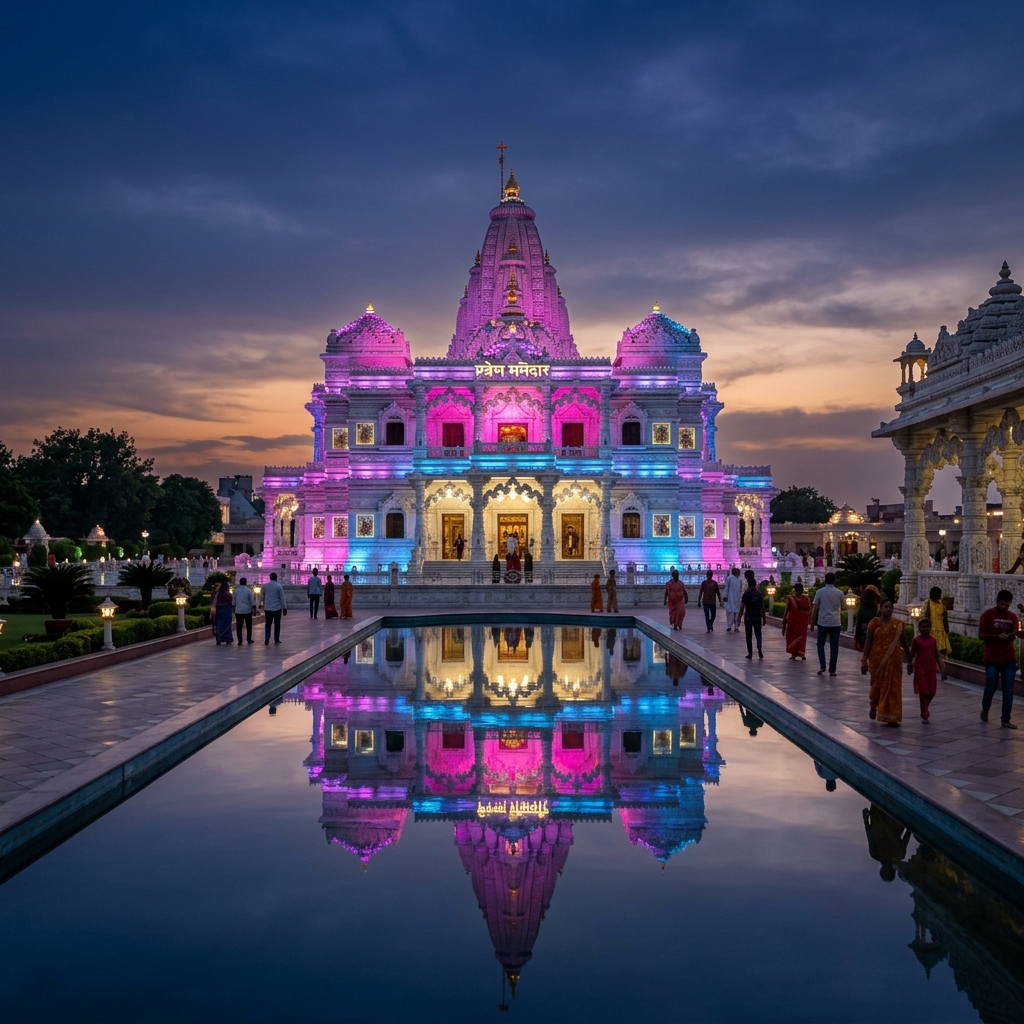
  • Prem Mandir: A stunning white marble temple famous for its intricate carvings and musical fountain shows.

  • ISKCON (Krishna Balaram Mandir): Known for its international community and soul-stirring 24-hour Kirtans.

  • Nidhivan: A mystical forest where it is believed the trees turn into Gopis at night to perform the Raslila with the Lord.

History

The history of Vrindavan is a fascinating journey from a forgotten, dense forest to the vibrant spiritual epicenter it is today. Its timeline can be divided into three distinct eras: the Ancient/Lila Era, the Medieval Rediscovery, and the Modern Development.

1. The Ancient Era: The Age of Krishna

According to Vedic scriptures and the Puranas, Vrindavan was part of the ancient Vraja Mandala.

  • The Sacred Forest: The name “Vrindavan” comes from Vrinda (Tulsi/Holy Basil) and Van (forest). Historically, it was a massive forest of Tulsi plants where Lord Krishna performed his Lilas roughly 5,000 years ago.

  • The First Temples: It is believed that Krishna’s great-grandson, Vajranabha, established the first few temples in the region to preserve the memory of Krishna’s pastimes after the Lord departed from Earth.

  • Loss over Time: Following the ancient era, the region was eventually reclaimed by nature. Over centuries of shifting dynasties and foreign invasions, the exact locations of the sacred sites were largely forgotten and covered by dense jungle.

2. The Medieval Era: Rediscovery (16th Century)

The modern identity of Vrindavan began in the 1515 CE with the arrival of Chaitanya Mahaprabhu, a saint from Bengal.

  • The Search: Chaitanya Mahaprabhu traveled to Vraja with the sole purpose of locating the “lost” places of Krishna’s life. It is said that through divine intuition, he identified sites like Radha Kund and Shyam Kund.

  • The Six Goswamis: He instructed his primary disciples, known as the Six Goswamis of Vrindavan, to settle there. They lived ascetic lives, excavated the holy sites, and wrote the foundational literature of Gaudiya Vaishnavism.

  • Royal Patronage: During the reign of the Mughal Emperor Akbar, Vrindavan saw a golden age of construction. Akbar was impressed by the devotion of the saints and granted land and red sandstone for the construction of grand temples like the Govind Dev Temple (built by Raja Man Singh of Amer).

3. The Era of Struggle and Resilience (17th – 18th Century)

The peaceful development was interrupted during the reign of Aurangzeb.

  • Iconoclasm: Aurangzeb ordered the destruction of many Hindu temples. The upper floors of the Govind Dev temple were dismantled, and many original deities (idols) were moved to safer locations like Jaipur and Nathdwara to protect them.

  • Rebuilding: As Mughal power waned, local Rajput kings and wealthy merchants from Bengal helped restore the town, building many of the “ghats” along the Yamuna and the smaller temples that line the narrow streets today.

4. Modern Vrindavan (19th Century – Present)

In the last 150 years, Vrindavan has transformed into a global spiritual hub.

  • The Seven Goswami Temples: The town centered its spiritual life around the seven original temples established by the Goswamis.

  • Global Recognition: In the 1970s, Srila Prabhupada founded the ISKCON movement, bringing Vrindavan to the attention of the Western world. This sparked a wave of international pilgrims and the construction of massive marble temples like Prem Mandir and the Vrindavan Chandrodaya Mandir (currently under construction, set to be the world’s tallest religious skyscraper).

Scroll to Top