
Kanwar Yatra — Safe Darshan & Route Planning with Naman Darshan
Everything a kanwariya needs to plan the journey — dates, routes, live alerts, personalized microplans, and on-ground safety assistance.
What is Kanwar Yatra? History & Significance
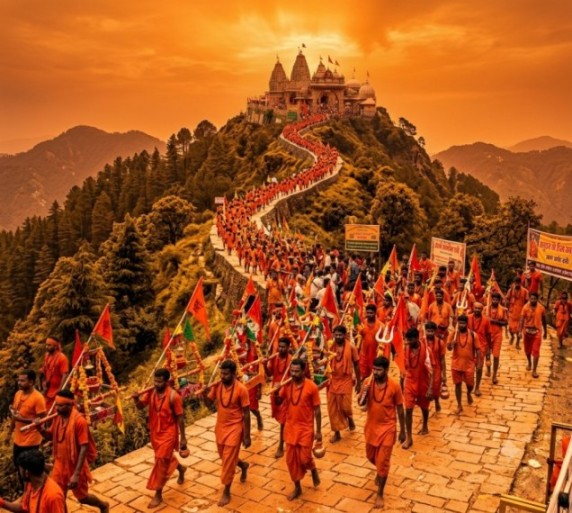
Kanwar Yatra is one of Hinduism's largest annual pilgrimages, observed every month of Shravan (July–August) in the Hindu calendar. Devotees — popularly called kanwariyas — walk from their hometowns to the nearest Ganga ghat, collect sacred water in clay or brass pots hung from a decorated bamboo pole (the kanwar), and carry it back on foot to perform jalabhishek: the ritual anointing of a Shiva lingam. The tradition is rooted in the legend of Samudra Manthan, the cosmic churning of the ocean, when the god Shiva drank the deadly Halahala poison to protect all creation. Offering Ganga jal — the holiest of waters — to the Shiva lingam is an act of devotion, gratitude, and atonement.
The yatra draws the greatest crowds during Sawan Shivratri, when the offering of Ganga jal is considered most auspicious. Participants wear saffron or white, chant "Bol Bam" throughout the journey, and often cover more than 100 kilometers on bare feet. Among the most revered forms of the yatra is the Dak Kanwar, where a devotee walks the entire route — from ghat to temple — without stopping, sometimes completing over 100 km in a single stretch of 24–36 hours. The kavad must not touch the ground from the moment the water is collected until it is offered.
Note: This information is advisory and aligned with official sources. Final entry, timings, and policies are set by local administration and temple authorities. We never promise queue-jumping or guaranteed entry.
Who Should Undertake Kanwar Yatra?
Kanwar Yatra is open to any Hindu devotee, but it is a physically demanding pilgrimage and not equally suited to everyone. Use this as a general guide — not a substitute for medical advice or guidance from your group leader or sampraday.
| Profile | Suitability | Notes |
|---|---|---|
| Healthy adults (18–50) wanting the full walking experience | Well suited | Build up walking stamina beforehand; attempt Dak Kanwar only with prior experience. |
| First-time or occasional walkers | Suited, with planning | Choose a shorter route (e.g., Sultanganj–Deoghar, 105 km) and walk with an organized group. |
| Older adults or chronic conditions | Vehicle kanwar recommended | Fully valid devotionally; kavad must still not touch the ground. Consult a doctor first. |
| Pregnant women | Consult a doctor first | Participation norms vary by tradition; medical clearance advised. |
| Children | With adult supervision only | Best suited to shorter local routes or symbolic participation. |
| Unable to travel at all | At-home or local-temple jalabhishek | Equally valid devotionally. |
Kanwar Yatra 2026 Dates — Shravan Maas Calendar
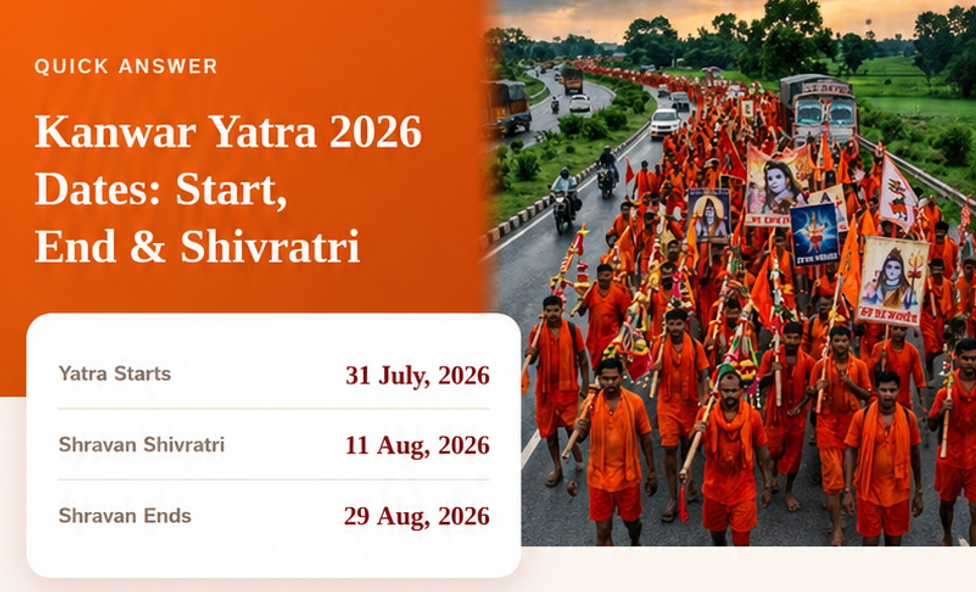
Kanwar Yatra 2026 spans the full month of Shravan in Vikram Samvat 2083. The most auspicious day for jalabhishek is Sawan Shivratri. All dates below are given in both the Gregorian and Vikram Samvat calendar systems.
| Yatra Begins | 30 July 2026 |
| Shravan Shivratri | 11 August 2026 |
| Shravan Ends | 29 August 2026 |
| Calendar followed | Purnimanta (North) |
Major Kanwar Yatra Routes 2026 — Overview
Kanwar Yatra routes fan out from Ganga ghats across northern India. The table below lists the most traveled routes. Each route has a dedicated full guide with maps, rest camps, medical posts, and road closure schedules.
| Route | Distance | Guide |
|---|---|---|
| Haridwar → Delhi | 220 km | View guide → |
| Haridwar → Meerut | 110 km | View guide → |
| Sultanganj → Deoghar | 105 km | View guide → |
| Haridwar → Neelkanth | 15 km | View guide → |
Rules & What to Carry
Carry a valid ID at all times during the yatra.
Kanwar height restrictions apply on most official routes.
Sharp objects and weapons are strictly prohibited.
Loudspeakers are permitted only within set decibel limits.
Full samagri list, item descriptions, and where to buy: Samagri
Explore by Topic
Use the links below to go deeper on any aspect of Kanwar Yatra 2026.
Dates & Calendar
Full Shravan 2026 calendar with auspicious muhurtas, Ekadashi and Shivratri dates.
Dates →Route Guides
Detailed route maps, rest camp locations, road closure schedules, and safety contacts.
Routes →Samagri Checklist
Complete puja item list — what to carry, quantities needed, and where to buy.
Samagri List →Temple Guide
Darshan timings, queue management, dress code, and offerings accepted at key temples.
Temples →At-Home Jalabhishek
Can't travel? Step-by-step guide to performing jalabhishek at your nearest mandir or home.
At-Home JalabhishekStays & Dharamshalas for Kanwar Yatra 2026
Compare and book verified accommodations near major Kanwar Yatra points like Haridwar (starting point) and Deoghar / Baidyanath Dham (destination).
Stays in Haridwar
Find clean hotels, ashrams, and community dharamshalas near Har Ki Pauri and bathing ghats in Haridwar.
Stays in Deoghar
Book convenient stays adjacent to Baba Baidyanath Dham temple for smooth jalabhishek and rest.
Kanwar Yatra 2026 — Frequently Asked Questions
These are the most-searched questions about Kanwar Yatra 2026, answered plainly.
The yatra begins on 30 July 2026, with Shravan Shivratri falling on 11 August.
Yes. Anyone can join the Kanwar Yatra, provided they are physically fit and follow the pilgrimage's rules and traditions.Is it safe to do the Kanwar Yatra alone?Yes, but traveling with a group is recommended. If you go alone, follow official routes, stay alert, and follow local safety guidelines.
Any Hindu devotee who observes the required vrats and is physically fit for the walk can join. There is no formal registration for most routes, though some state governments run camp enrollment for support services. Women may participate; norms around menstruation vary by tradition — confirm with your group or destination temple.
A Dak Kanwar is a devotee who walks the entire route — from the Ganga ghat to the Shiva temple — in one continuous stretch without stopping, often covering 100+ km in 24–30 hours. Dak kanwariyas are given right of way; major roads along their routes are closed to vehicles.
Many camps along major routes provide free food and basic shelter, run by local trusts and organisations. Personal costs include transport to the ghat, the kavad and samagri (roughly Rs. 200–2,000), and any meals purchased along the route.
Yes. A vehicle kanwar is valid — especially for those unable to walk due to age or health. The kavad is kept in the vehicle and must still not touch the ground. Some traditions require a symbolic walk at the start and end.
State governments deploy medical camps, ambulances, and police every few kilometres on major routes such as Haridwar–Meerut and Sultanganj–Deoghar. Carry basic first aid and hydrate consistently.
You can perform jalabhishek at your nearest Shiva temple or at home during Shravan. Procure Ganga jal, set up or visit a Shiva lingam, and offer the jal with bel patra and dhatura flowers.
Note: This information is advisory and aligned with official sources. Final entry, timings, and policies are set by local administration and temple authorities. We never promise queue-jumping or guaranteed entry.
Can't make the yatra this year?
Offer Ganga jal from your nearest temple — or perform jalabhishek at home during Shravan Maas 2026.
The devotion is the same. The distance is different. Do Jalabhishek from Home →