
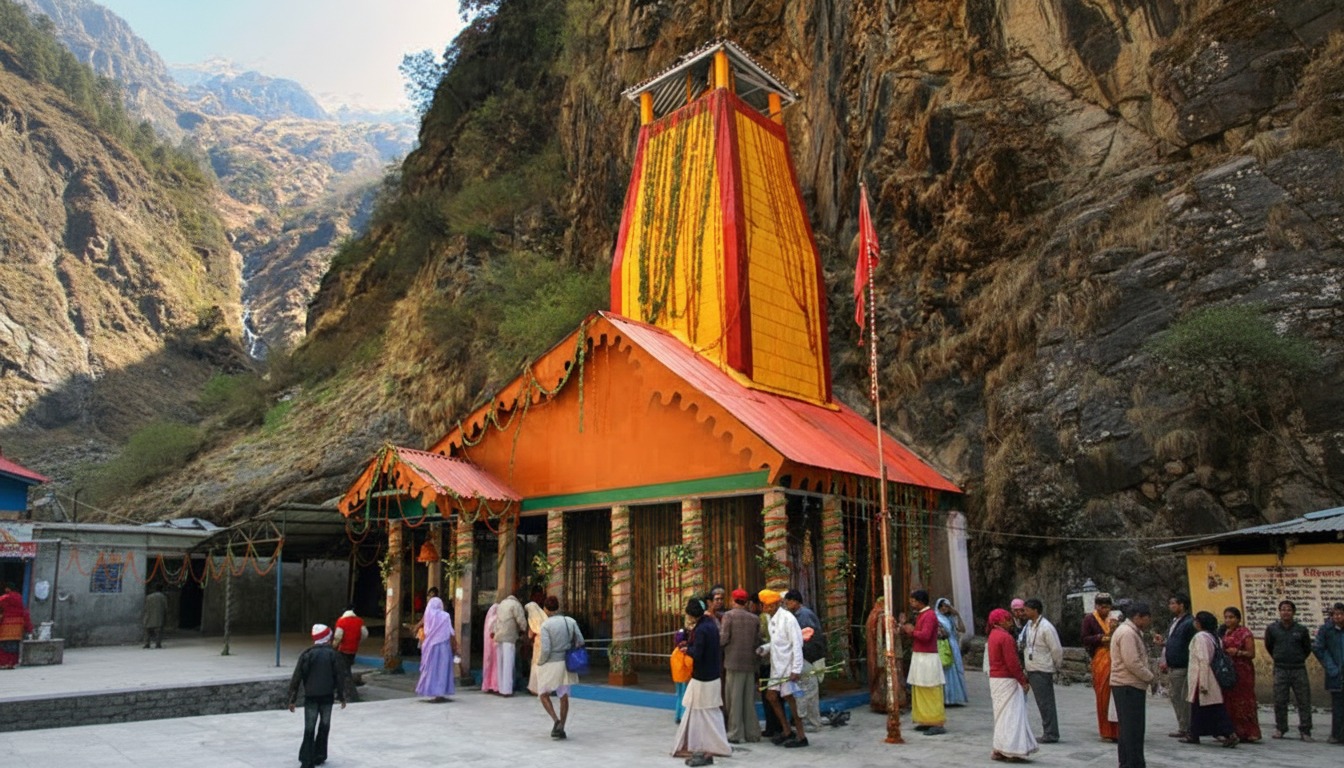
About Yamunotri Temple, Yamunotri, Uttarakhand
Yamunotri Temple is dedicated to Goddess Yamuna and is one of the four shrines of Uttarakhand's Chota Char Dham. It stands in the Garhwal Himalayas at about 3,293 metres, beside the source region of the Yamuna River.
The shrine is known for the black marble image of Yamuna, the sacred Divya Shila, and the hot waters of Surya Kund, where devotees traditionally prepare rice and potatoes as an offering. Yamunotri also has a distinct seasonal tradition: after the temple closes for winter, the goddess's image is taken to Kharsali, where worship continues until the shrine reopens.
Story of Yamunotri Temple
The sacred importance of Yamunotri is older than the temple building seen today. The site is associated in Hindu tradition with Goddess Yamuna and with the ancient sage Asit Muni, while the present shrine belongs to the 19th-century history of Tehri Garhwal. The formal temple is commonly dated to 1839, when it was built under the patronage of Tehri ruler Sudarshan Shah.
The temple was later damaged and rebuilt, including reconstruction associated with Maharani Gularia of Jaipur. Snow, earthquakes and other mountain conditions have repeatedly affected the structure, so the present shrine is the result of successive rebuilding rather than a single uninterrupted structure.
Yamunotri is a compact Himalayan temple built in stone, with a small sanctum and mandap and a distinctive conical tower. Its coloured exterior, with yellow and red used prominently, has become closely associated with the visual identity of the shrine. The main image of Goddess Yamuna is a black marble form, with a white image of Ganga traditionally described beside her.
The setting is part of the temple's architecture and religious identity. The shrine stands close to the Yamuna, with Surya Kund and Divya Shila immediately associated with the approach to the sanctum. The mountain location, narrow valley and surrounding peaks have also shaped the modest scale and form of the temple.
What Makes Yamunotri Temple Sacred for Devotees
Goddess Yamuna, daughter of Surya
According to Hindu tradition, Goddess Yamuna is the daughter of Surya, the Sun God, and the twin sister of Yama, the god associated with death. This relationship gives Yamunotri a particular place in pilgrimage tradition, and devotees regard the river as a divine mother rather than only as a physical river.
A traditional belief holds that bathing in the waters of Yamuna helps protect devotees from an untimely or painful death. This is a religious belief and should be understood within the devotional tradition associated with the goddess.
The Asit Muni tradition
One of the best-known traditions of Yamunotri concerns Sage Asit Muni, who is believed to have lived and performed his austerities here. According to the legend, he bathed daily in both the Ganga and Yamuna.
When old age made the journey to Gangotri difficult, tradition says that a stream of the Ganga appeared near Yamunotri so that the sage could continue his daily practice. The story remains part of the sacred identity of the place.
Yamuna, Kalind and the mountain source
The Yamuna is also known as Kalindi in Hindu tradition, a name connected with Kalind Parvat. The higher glacial source of the river lies beyond the temple in the Yamunotri Glacier and Champasar region. That source is difficult to reach, so the temple at Yamunotri serves as the principal place of worship for pilgrims.
Another local legend connects Bandarpunch with Hanuman. According to the tradition, Hanuman cooled his burning tail in the icy waters after the burning of Lanka, giving the mountain its name.
Kharsali and the winter worship of Yamuna
Yamunotri's religious cycle continues even after the high-altitude shrine closes for winter. On the closing occasion of Yama Dwitiya or Bhai Dooj, the goddess is ceremonially taken to Kharsali, where devotees continue to worship her during the winter months.
Kharsali therefore forms an important part of Yamunotri's sacred geography. The seasonal movement of the deity links the high-altitude temple with a lower, more accessible winter shrine.
Annual Festivals & Rituals at Yamunotri Temple, Yamunotri, Uttarakhand
Daily Worship and Aarti Celebrations at the Temple
Daily worship at Yamunotri is organised around the deity of Yamuna and the temple's regular puja cycle. Morning and evening aarti form part of the daily worship, while darshan takes place around the temple's ritual schedule.
Divya Shila and Surya Kund Celebrations at the Temple
Before offering prayers to Goddess Yamuna, devotees traditionally worship the Divya Shila, the sacred stone near Surya Kund. The sequence gives the temple approach its own ritual character. Surya Kund is a natural hot spring beside the shrine. Rice and potatoes are traditionally tied in cloth and placed in its hot water to cook; the cooked food is then offered as prasad and may be taken back by devotees.
Akshaya Tritiya and the Opening of the Temple Celebrations at the Temple
The annual temple season begins around Akshaya Tritiya, when the Yamunotri shrine opens after winter. The opening is accompanied by religious ceremonies and the return of the goddess to the high-altitude temple.
Yamuna Jayanti and Yamuna Saptami Celebrations at the Temple
Festivals connected with the goddess Yamuna are observed as part of the temple's religious calendar. Yamuna Jayanti marks the birth of the goddess in Hindu tradition, while Yamuna Saptami is another important observance associated with her worship.
Bhai Dooj and the Winter Closure Celebrations at the Temple
The annual cycle closes around Yama Dwitiya, the day associated with Bhai Dooj. The temple then closes for the winter and the goddess's image is taken to Kharsali, where worship continues until the next opening season.
Sacred Places to Visit Near Yamunotri Temple
Surya Kund : Surya Kund is the best-known thermal spring beside the temple. Its hot water is traditionally used to cook rice and potatoes for offering as prasad.
Divya Shila : Divya Shila is a sacred stone near Surya Kund and is traditionally worshipped before devotees offer puja to Goddess Yamuna.
Kharsali : Kharsali is the winter seat of Goddess Yamuna. The village is also known for its Shani temple and its connection with the seasonal worship of the deity.
Janki Chatti : Janki Chatti is the main road-access point for the present Yamunotri pilgrimage. The final journey to the temple begins here, with the route continuing on foot or by traditional assisted modes such as ponies and palanquins.
Hanuman Chatti : Hanuman Chatti was the older starting point for the Yamunotri trek and remains an important stop on the route. The confluence of the Hanuman Ganga and Yamuna is located here.
Saptarishi Kund : Saptarishi Kund is a high-altitude glacial lake associated with the upper Yamuna region. It is not part of the ordinary temple visit and requires a more difficult mountain journey.
Plan Yamunotri Temple Darshan
For current darshan planning, route preparation, date-specific timings and Naman Darshan's Guided Darshan Assistance, continue to the dedicated Yamunotri Temple Darshan page.
Common Questions About Visiting Yamunotri Temple
Visitor Information
Darshan Timing
Address
Yamunotri Temple, Yamunotri, Yamnotri Range, Uttarkashi, Uttarakhand 249141, India
Notable Events
Before the present temple – Yamunotri was already recognised as a sacred site associated with Goddess Yamuna and the traditions surrounding Sage Asit Muni. • 1839 — 19th-century temple construction – The formal temple is commonly dated to 1839 under the patronage of Tehri ruler Sudarshan Shah. • 19th century — Reconstruction – The temple was later rebuilt after damage, with Maharani Gularia of Jaipur associated with the reconstruction tradition. • 20th century — Repeated rebuilding – Earthquake and weather-related damage continued to affect the shrine, contributing to successive repairs and reconstruction. • Modern pilgrimage route – With the motorable road extended to Janki Chatti, the final temple approach became shorter than the older Hanuman Chatti route, which remains part of Yamunotri's pilgrimage history. • 2026 — Annual pilgrimage season – The Uttarakhand Tourist Care portal lists 19 April 2026 as the Yamunotri Dham opening date. The closing date follows the traditional seasonal calendar and should be checked against the official announcement for the relevant year.
How to Reach the Temple
By air: The nearest major airport is Jolly Grant Airport in Dehradun. From the airport, pilgrims continue by road towards Barkot, Hanuman Chatti and Janki Chatti.
By rail: Dehradun, Rishikesh and Haridwar are the main rail-connected gateways used for the Yamunotri journey. From these cities, the onward journey is by road.
By road: Road access continues to Janki Chatti, the principal starting point for the final Yamunotri trek. Regular taxis, buses and shared vehicles operate towards the pilgrimage route.
By trek: From Janki Chatti, pilgrims continue approximately 5–6 kilometres to the temple. The route can be covered on foot, while ponies and palanquins are available for assisted travel.
Via Hanuman Chatti: Hanuman Chatti was the traditional starting point before road access was extended farther towards Janki Chatti. It remains an important stop on the Yamunotri route.
Yadadri Bhuvanagiri, Telangana