
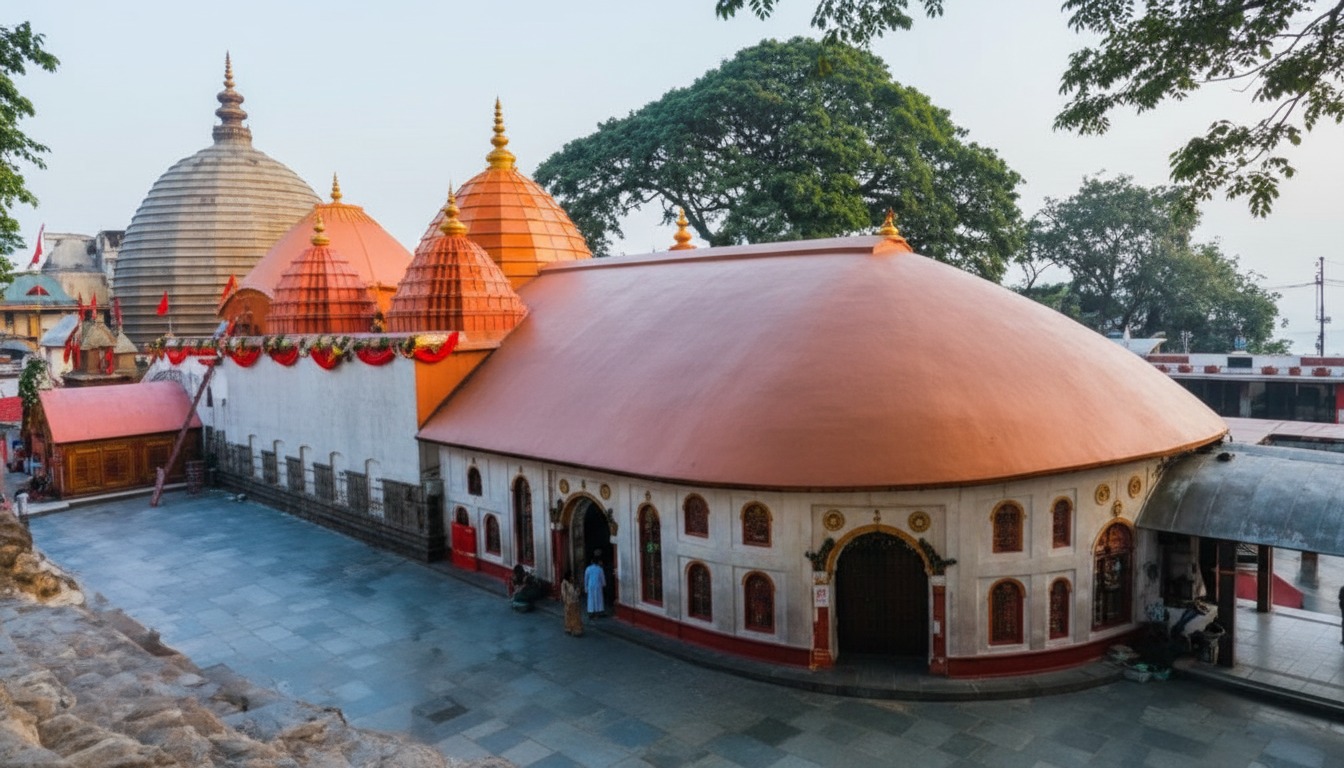
About Kamakhya Temple, Guwahati, Assam
Kamakhya Temple is dedicated to Goddess Kamakhya and stands on Nilachal Hill in Guwahati, Assam. It is one of the major Shakti Peethas of the Hindu tradition and an important centre of Shakta and Tantric worship.
The principal form of the goddess is not a conventional idol. In the sanctum, Kamakhya is worshipped as a sacred yoni-shaped stone associated with a natural underground spring. The temple is also known for Ambubachi Mela, its distinctive Nilachal architecture and the group of Mahavidya and Shiva shrines spread across Nilachal Hill.
Story of Kamakhya Temple
The history of Kamakhya begins before the present temple building. The early history of the shrine is difficult to separate completely from oral traditions and religious texts, but references to Kamakhya occur in ancient and medieval Shakta and Tantric literature. Epigraphic evidence for the goddess appears by the 9th century, while archaeological remains on Nilachal indicate that the site had earlier phases of construction.
The temple that stands today belongs largely to the reconstruction undertaken in the 16th century. The Koch rulers restored the shrine, and the rebuilding was completed in 1565 under King Nara Narayan with the involvement of his brother Chilarai. The reconstruction used surviving material from the earlier temple and produced the distinctive form now recognised as Nilachal architecture.
The history of the rebuilding is not described identically in every source. A popular tradition attributes the earlier destruction to Kalapahar, while historical scholarship has questioned that account because of the chronology and has proposed other possibilities. The important historical point is that the old shrine was restored in the Koch period and later expanded under the Ahom rulers.
The Ahom kings continued to support Kamakhya and added to the complex over the following centuries. The Natmandir, an important part of the present temple, was added under Ahom king Rajeswar Singha in 1759. The result is a temple complex in which older stone remains, Koch-period reconstruction and later Ahom additions exist together.
Kamakhya also became more prominent as a pilgrimage centre during the later history of Assam and Bengal. Its importance today comes not only from the present building but from the continuity of worship on Nilachal Hill and the wider network of shrines surrounding the principal temple.
Deities and Architecture of Kamakhya Temple
The principal deity is Goddess Kamakhya, worshipped in the sanctum as a sacred yoni-shaped stone rather than as a conventional sculpted image. The stone is situated inside a cave-like garbhagriha and is naturally kept moist by an underground spring.
This form of worship is central to Kamakhya's identity. The yoni is understood within the Shakta tradition as the symbol of the feminine principle and the generative power of creation. The sanctum is therefore different in character from temples where the principal deity is represented by a standing, seated or anthropomorphic image.
The present temple follows the Nilachal style of architecture, which developed during the Koch reconstruction. Its main dome combines elements associated with North Indian Nagara architecture with the rounded form introduced during the rebuilding of the shrine. The resulting bulbous superstructure became an important architectural type in Assam.
The temple complex is organised through a series of connected spaces. These include the garbhagriha, the antarala, the jagamohan, the bhogmandir and the natmandir. Each space has a different role in the movement, worship and ritual life of the temple.
The Natmandir is especially important in the history of the present complex. Added during the Ahom period, it also contains older sculptural material and inscriptions associated with the reconstruction of the shrine.
Kamakhya is not limited to the main temple building. Nilachal Hill contains shrines associated with the Dasa Mahavidyas, five important Shiva temples and several other deities and sacred ponds. These shrines form a connected sacred landscape around the principal peetha.
What Makes Kamakhya Temple Sacred for Devotees
Kamakhya and the Shakti Peetha tradition
One of the central traditions of Kamakhya begins with the story of Sati and Shiva. After Sati's death at the sacrifice of her father Daksha, Shiva is described in the Puranic tradition as carrying her body while performing his destructive dance. Vishnu then used the Sudarshana Chakra to separate the body, and the places associated with the fallen parts became sacred Shakti Peethas.
Kamakhya is traditionally identified with the place where Sati's yoni fell. Different Shakta texts do not give identical lists or descriptions of the Peethas, however, and the details vary between traditions. The association of Kamakhya with the yoni should therefore be presented as a central religious tradition rather than as an archaeological event.
The Kamadeva tradition
Another important legend connects Kamakhya with Kamadeva, the god of desire. According to the temple tradition, Kamadeva lost his beauty after being burned by Shiva's wrath. He was directed to the sacred yoni at Nilachal and worshipped the goddess there.
After receiving her grace, Kamadeva recovered his former form. The story is traditionally connected with the names Kamarupa, the ancient name of the region, and Kamakhya, the goddess associated with desire.
This is a religious explanation preserved in the traditions of the shrine. It is not a historical account of how the region received its name.
Kamakhya and the older traditions of Kamarupa
The religious history of Kamakhya is broader than the later Brahmanical temple tradition. Textual and historical discussions of the shrine also connect it with the earlier peoples of Kamarupa and with regional forms of mother-goddess worship.
This layered history helps explain why Kamakhya developed into an important centre of Shaktism and Tantra. The shrine contains traditions that were absorbed and continued within a larger Hindu religious framework rather than following only one form of worship.
Tantric traditions at Kamakhya
Kamakhya is closely associated with Tantric Shaktism, and the temple remains one of the important centres of this tradition. The goddess is approached through rituals that emphasise Shakti, creation, transformation and the relationship between the feminine principle and Shiva.
Tantric worship is not represented by one single ritual performed by every visitor. The temple's wider religious system includes different forms of puja, offerings and specialised practice carried out according to established traditions.
The sacred landscape of Nilachal
The sacred geography of Kamakhya extends beyond the main sanctum. The hill contains the shrines of the Dasa Mahavidyas — Kali, Tara, Tripura Sundari, Bhuvaneshwari, Bhairavi, Chhinnamasta, Dhumavati, Bagalamukhi, Matangi and Kamala — along with Shiva temples and other shrines.
This wider arrangement is important to understanding Kamakhya. The temple is not simply a single shrine on a hill; Nilachal itself is treated as a sacred landscape in which multiple forms of the Goddess and Shiva are worshipped together.
Annual Festivals & Rituals at Kamakhya Temple, Guwahati, Assam
Daily Worship at Kamakhya
The temple follows a daily sequence of worship that includes the ritual bathing of the pithasthana, Nitya Puja, food offerings and evening worship. Public access is organised around these rituals, so the hours available for darshan are not separate from the temple's internal religious schedule.
The temple's official programme currently lists public access during morning and afternoon periods, with changes on special religious occasions. Exact darshan conditions should therefore be checked before travel.
Ambubachi Mela
Ambubachi Mela is the most distinctive annual festival of Kamakhya. It is based on the belief that the Goddess undergoes her annual period of menstruation during the monsoon.
The temple remains closed to devotees during the principal days of the observance. After the ritual period is completed, the temple reopens following the prescribed ceremonies and the festival continues with the return of devotees to the shrine.
The festival also connects Kamakhya with older agricultural ideas about fertility and the renewal of the earth. Its meaning within the temple is therefore closely related to the shrine's wider emphasis on Shakti, creation and the feminine principle.
Deodhani Mela and Manasa Puja
During Manasa Puja, observed for three days around the Shravan Sankranti, the Natmandir becomes the setting for the Deodhani or Devadhwani tradition.
The Deodhani dance is performed by devotees known locally as Deodhas, Ghora or Joki and is associated with the spiritual presence of a deity. It remains one of the distinctive ritual traditions connected with Kamakhya.
Durga Puja
Durga Puja is an important part of the temple calendar, but its observance at Kamakhya has its own ritual pattern. The official Devalaya describes the celebration as a fortnight-long Pakhua Puja, extending from Krishna Navami to Shukla Navami of the month of Ashwin.
The festival includes special bathing rituals, offerings and bali according to temple tradition. These observances distinguish the Kamakhya celebration from the more widely familiar form of Durga Puja seen elsewhere in Bengal and Assam.
Kumari Puja
Kumari Puja forms part of important worship at Kamakhya, particularly during major festivals. A young girl is ritually worshipped as a manifestation of the Goddess.
The practice expresses the Shakta understanding of the feminine principle and connects the living human form with the Goddess worshipped at the temple.
Bali and temple offerings
Animal offering, or bali, is part of the documented ritual history of Kamakhya. The practice is carried out in accordance with temple traditions and is particularly visible during certain major observances.
Bali is one part of the temple's wider ritual system and should not be treated as synonymous with ordinary darshan or as a requirement for every devotee.
Sacred Places to Visit Near Kamakhya Temple
Dasa Mahavidya Temples
The temples of the ten Mahavidyas form an important part of the sacred landscape of Nilachal Hill. Together they show the wider Shakta tradition surrounding Kamakhya rather than treating the main shrine as an isolated temple.
Bhuvaneshwari Temple
Bhuvaneshwari is one of the important Goddess shrines associated with Nilachal Hill. The temple forms part of the wider pilgrimage circuit around Kamakhya.
Kameshwar Temple
Kameshwar is one of the Shiva shrines on Nilachal and belongs to the group of temples that express the close relationship between Shiva and Shakti in the sacred geography of Kamakhya.
Siddheshwar Temple
Siddheshwar is another Shiva shrine associated with Nilachal Hill. It can be visited as part of a wider exploration of the hill's temple complex.
Umananda Temple
Umananda Temple stands on Peacock Island in the Brahmaputra and is dedicated to Lord Shiva. The temple was built during the Ahom period and contains stone carvings associated with several Hindu deities.
Navagraha Temple
Navagraha Temple stands on Chitrachal Hill and is dedicated to the nine planetary deities, represented through nine Shiva lingas. It is another important religious site in Guwahati's wider temple landscape.
Basistha Ashram
Basistha Ashram lies in the hills to the south of Guwahati and is associated with Sage Vasistha. The ashram stands at the meeting point of three streams and is another important pilgrimage site connected with the religious geography of Assam.
Plan Kamakhya Temple Darshan
For current darshan planning, queue information, entry requirements and Naman Darshan's date-specific Guided Darshan Assistance, continue to the dedicated Kamakhya Temple Darshan page.
Common Questions About Visiting Kamakhya Temple
The main deity is Goddess Kamakhya. Unlike temples where the principal deity is represented by a conventional idol, Kamakhya is worshipped in the sanctum through a sacred yoni-shaped stone associated with a natural underground spring.
The central form of worship at Kamakhya is the yoni-peetha rather than an anthropomorphic image. The form represents the generative and creative principle of Shakti within the religious tradition of the shrine.
According to the Shakti Peetha tradition, Kamakhya is associated with the place where the yoni of Sati fell. Different religious texts vary in their lists and descriptions of the Peethas, so this should be understood as a sacred tradition.
Kamakhya is especially known for its yoni-peetha, Shakta and Tantric traditions, Nilachal architecture and Ambubachi Mela. The wider Nilachal Hill also contains the temples of the ten Mahavidyas and several Shiva shrines.
Ambubachi Mela is the annual festival associated with the belief that Goddess Kamakhya undergoes her menstrual period. The temple closes during the principal ritual days and reopens after the prescribed ceremonies.
The present temple was reconstructed during the Koch period and was completed in 1565 under King Nara Narayan with the involvement of Chilarai. The Ahom rulers later expanded and renovated the complex.
Nilachal style developed through the reconstruction of Kamakhya Temple. It combines a ratha-based temple form with a distinctive bulbous dome influenced by both Indian temple architecture and the building techniques used by craftsmen from the Bengal region.
Nilachal Hill contains the ten Mahavidya shrines, several Shiva temples including Kameshwar and Siddheshwar, and other smaller shrines and sacred ponds.
Visitor Information
Entry Fee
A general queue is available through the temple administration. – Special-entry arrangements and rules can change; detailed planning belongs on the Darshan page.
Address
Maa Kamakhya Devalaya, Nilachal Hill, Guwahati – 781010, Assam, India
Notable Events
Ancient and early medieval period
Kamakhya appears in regional religious literature and later historical discussions identify the shrine with the sacred landscape of Kamarupa.
9th century
Epigraphic evidence provides an early historical reference to the goddess Kamakhya.
16th century
The old shrine was restored under the Koch rulers, with the present reconstruction completed in 1565 under Nara Narayan and Chilarai.
17th–18th centuries
The Ahom rulers continued to support the temple and its surrounding sacred complex, adding and renovating shrines.
1759
The Natmandir was added during the reign of Ahom king Rajeswar Singha.
Modern period
Kamakhya developed into an important pilgrimage centre associated with Shakta and Tantric traditions, while the annual Ambubachi Mela became one of the best-known religious gatherings in Assam.
How to Reach the Temple
By air:
Lokpriya Gopinath Bordoloi International Airport is the main airport serving Guwahati. From the airport, taxis and local transport connect with the city and the Nilachal Hill area.
By rail:
Kamakhya Railway Station is the nearest railway station to the temple. Guwahati Railway Station is the city's major railhead and is also connected to the temple by road.
By road:
Guwahati is connected to neighbouring cities and states by road. Local buses, taxis and cabs can be used to reach the foothill and temple area.
Within Guwahati:
The final approach to Kamakhya involves the hill road leading up to Nilachal. Crowd-control arrangements and traffic movement may change during Ambubachi Mela and other major festivals.