
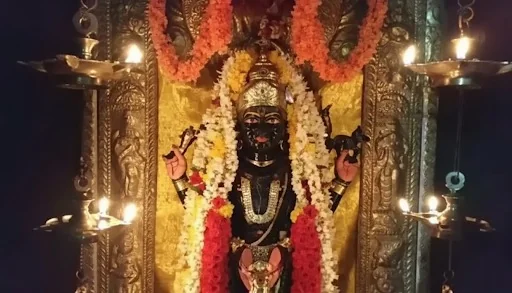
About Swarnakarshana Bairavar Temple, Kelambakkam, Tamil Nadu
Swarnakarshana Bairavar Temple is a shrine dedicated to Sri Swarnakarshana Bairavar in Thaiyur near Kelambakkam, on the southern side of Chennai. The temple is centred on Swarnakarshana Bairavar, a form of Bhairava associated with Lord Shiva.
The shrine is especially known for its unusual collection of Bhairava and related images. The temple includes the main Swarnakarshana Bairavar with Vijaya Chitramba, the eight Ashta Bhairavas with their Shakti consorts, 64 Bhairava images, Ashta Dikpalas and several other distinctive shrines within the complex.
Story of Swarnakarshana Bairavar Temple
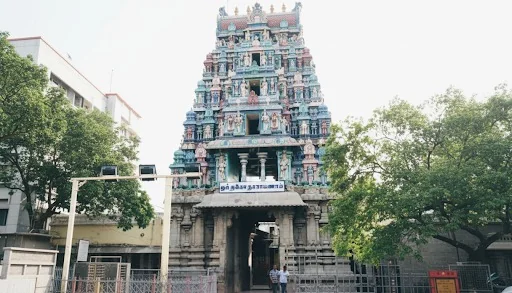
Swarnakarshana Bairavar Temple does not have the long historical record found at many ancient Tamil Nadu temples. The available public accounts describe the Kelambakkam shrine as a relatively new structure, and a 2021 field account records it as a newly built Bhairava temple. A precise founding or consecration year is not clearly documented in the reliable public sources reviewed.
The main shrine houses Sri Swarnakarshana Bairavar with Goddess Vijaya Chitramba, also known as Swarna Bhairavi, seated beside him. The temple's own description gives special importance to this form of Bhairava and places him at the centre of a larger 64-Bhairava tradition. The main image and its consort form the focus of the inner shrine.
The architectural interest of the temple lies in its iconographic arrangement. The eight Ashta Bhairavas, each with a consort and associated mount, appear around the outer walls of the main shrine. The temple also displays 64 Bhairava forms on the vimana and mandapa, making the Bhairava theme visible throughout the complex rather than limiting it to the main sanctum.
Other shrines and installations give the temple its distinctive character. The temple lists Sri Swarna Vinayagar, Maha Samrajya Lakshmi, Kubera with his family, the four Vedas with their consorts, Sri Ucchista Ganapathi and Sahasralingam. A separate sacred-water area is associated with the eight Ashta Dikpalas. These installations are part of the temple's present identity and are more clearly documented than any long historical chronology.
What Makes Swarnakarshana Bairavar Temple Sacred for Devotees
Swarnakarshana Bairavar and the 64 Bhairavas
According to the temple's own tradition, Swarnakarshana Bairavar is regarded as the chief among the 64 Bhairavas. In the broader Bhairava tradition, eight principal forms are known as the Ashta Bhairavas, and the larger grouping is associated with the eight directions.
The eight forms represented at the temple are Asitanga, Ruru, Chanda, Krodha, Unmatta, Kapala, Bhishana and Samhara Bhairava. Their presence around the main shrine gives the temple a more specific Bhairava focus than an ordinary single-deity shrine.
Swarnakarshana Bairavar and Swarna Bhairavi
Swarnakarshana Bairavar is worshipped with Vijaya Chitramba, also called Swarna Bhairavi in the temple's own material. The pairing of Bhairava and Bhairavi is central to the way the shrine presents the deity.
The name Swarnakarshana is traditionally understood in connection with the attraction of gold and material abundance. Devotees may therefore approach this form of Bhairava with prayers concerning prosperity, financial stability and protection. These are matters of religious belief and should not be presented as guaranteed material results.
Ashta Dikpalas
The temple gives a prominent place to the eight Dikpalas, the directional deities of Hindu cosmology: Indra, Agni, Yama, Nirriti, Varuna, Vayu, Kubera and Ishana.
Their shrine is connected with the temple's theertham and reflects the idea of the eight directions being guarded by their respective deities. The temple also associates this worship with Vastu traditions. Such associations belong to the temple's religious framework rather than to a scientific claim about buildings or property.
The Bhairava and Shani tradition
Bhairava worship is traditionally linked with time, protection and the regulation of negative forces. The temple's own account also presents Bhairava in relation to Shani, describing Bhairava as a spiritual authority associated with the planet.
This connection belongs to the wider religious tradition around Bhairava and Shani worship and forms part of the devotional understanding of the shrine.
Annual Festivals & Rituals at Swarnakarshana Bairavar Temple, Kelambakkam, Tamil Nadu
Daily Worship Celebrations at the Temple
Regular puja and darshan form the normal temple routine. The exact sequence of daily rituals is not publicly listed in detail on the temple's website, so a fixed ritual timetable should not be assumed.
Theipirai Ashtami Celebrations at the Temple
The most clearly reported recurring special observance is Theipirai Ashtami, the eighth day of the waning moon. Current visitor reports describe special abhishekam or worship on Ashtami, making it one of the principal occasions for devotees of Bhairava.
Tuesday Worship Celebrations at the Temple
Some current local listings also report special worship for the main deity on Tuesdays, particularly in the evening. Since the timing of these observances is not consistently published by the temple itself, devotees should confirm the day's programme before travelling.
Bhairava Worship Celebrations at the Temple
Ashtami occupies an important place in Bhairava worship more broadly, and the Kelambakkam temple's own material gives particular attention to this tradition. The presence of the Ashta Bhairavas and their consorts also makes the temple's regular worship different from a shrine dedicated only to one form of Bhairava.
Sacred Places to Visit Near Swarnakarshana Bairavar Temple
Kandaswamy Temple, Thiruporur : Arulmigu Kandaswamy Temple at Thiruporur is a major Murugan temple in Chengalpattu district and is one of the established Shaiva-Murugan pilgrimage centres in the region.
Nithya Kalyana Perumal Temple, Thiruvidanthai : Nithya Kalyana Perumal Temple at Thiruvidanthai is a Vishnu temple recognised by Tamil Nadu HR&CE as a Divya Desam. It gives a Vaishnava destination to a pilgrimage centred around the Bhairava shrine.
Mahabalipuram : Mahabalipuram is one of Tamil Nadu's best-known heritage areas, with Pallava-era monuments and temples along the Coromandel Coast. It can be combined with a Kelambakkam-area temple visit when planning a wider south Chennai and Chengalpattu itinerary.
Thirukazhukundram : Thirukazhukundram is another established temple destination in the Chengalpattu region, centred on the hilltop Vedagiriswarar Temple and its Shaiva traditions.
DakshinaChitra : DakshinaChitra is a cultural heritage centre near Muttukadu that presents traditional houses, crafts and performing arts from South India. It provides a cultural complement to the temple-focused part of a Kelambakkam visit.
Plan Swarnakarshana Bairavar Temple Darshan
For current darshan planning, queue guidance and Naman Darshan's guided assistance for this temple, continue to the dedicated darshan option and verify the date-specific temple schedule before travel.
Common Questions About Visiting Swarnakarshana Bairavar Temple
Visitor Information
Darshan Timing
Address
Sri Swarnakarshana Bairavar Temple, Eri Ethirvayal, Thaiyur, Kelambakkam, Tamil Nadu 603103, India
Notable Events
Recent temple establishment – Available public sources describe the Kelambakkam shrine as a relatively new temple. No reliable public source reviewed for this page establishes a precise founding or consecration year. • 2021 — Temple documented as a new Bhairava shrine – A detailed field account published in October 2021 recorded the temple as a newly built shrine and documented its distinctive collection of Bhairava, Bhairavi, Dikpala and other images. • Current temple complex – The temple's present published material records an expanded iconographic programme that includes the main Swarnakarshana Bairavar, Ashta Bhairavas, 64 Bhairava representations, Ashta Dikpalas, Swarna Vinayagar, Maha Samrajya Lakshmi, Kubera, the four Vedas and other specialised installations.
How to Reach the Temple
By road: The temple is in Thaiyur near Kelambakkam and can be approached from the Vandalur–Kelambakkam Road and the wider OMR network. The final approach is through local roads rather than directly from the main highway.
By air: Chennai International Airport is the main airport serving the area. From the airport, continue by road toward south Chennai and Kelambakkam.
By rail: Tambaram is a practical major railway point for the southern Chennai side. From there, continue by taxi or local road transport toward Kelambakkam and Thaiyur.
Within Kelambakkam and Thaiyur: Because the shrine is set away from the main road, a cab or private vehicle is generally more practical for the last part of the journey. Use the temple's current map location before travelling, especially on special worship days.
SEO Title: Alampur Jogulamba Temple: History, Shakti Peetha & Guide
Meta Description: Explore Alampur Jogulamba Temple in Telangana, its history, Jogulamba deity, Shakti Peetha tradition, architecture, rituals, festivals and sacred places.
Alampur, Jogulamba Gadwal District, Telangana