
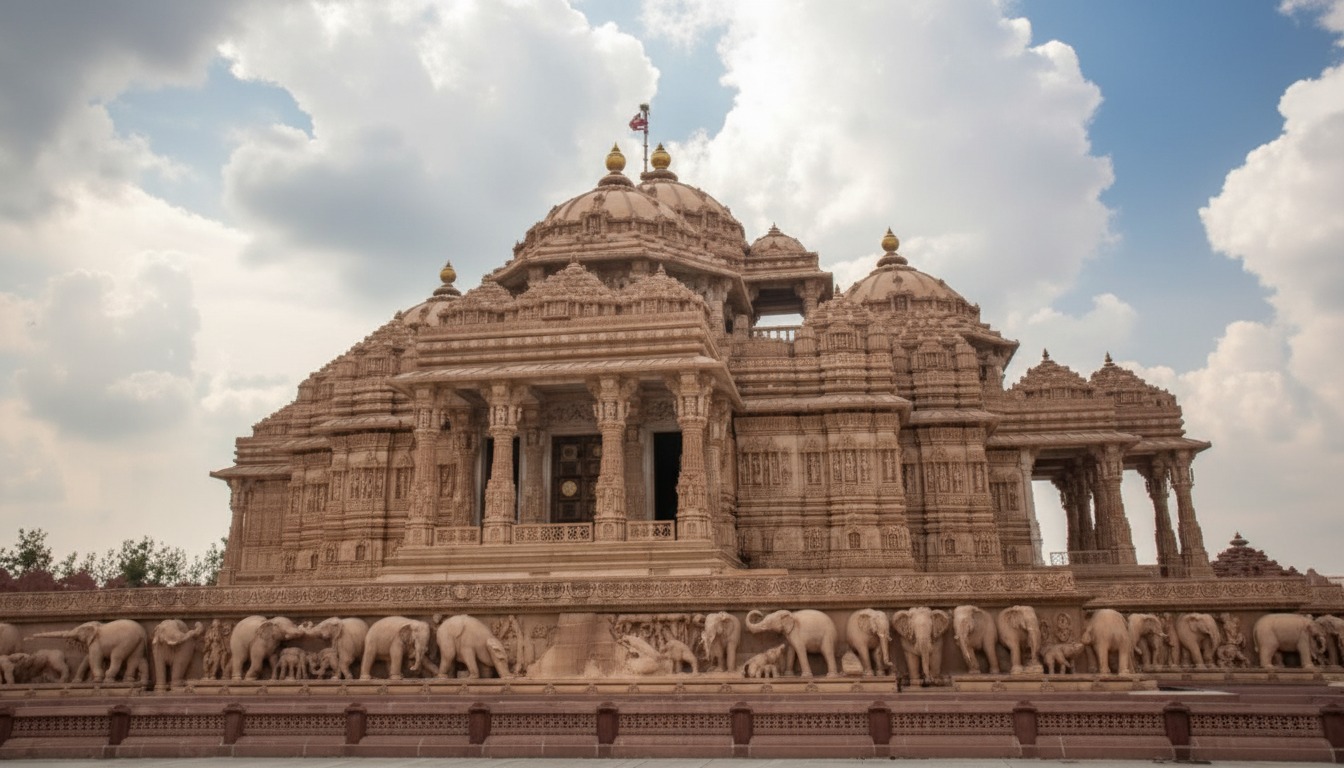
About Swaminarayan Akshardham New Delhi, Delhi
Swaminarayan Akshardham New Delhi is a Hindu mandir and spiritual-cultural campus dedicated to Bhagwan Swaminarayan. The Akshardham Mandir at its centre was inaugurated on 6 November 2005.
The mandir brings together worship, sacred murtis and traditional Indian temple architecture. Its history is closely connected with Yogiji Maharaj’s vision for a mandir on the banks of the Yamuna and Pramukh Swami Maharaj’s efforts to bring that vision to New Delhi.
Story of Swaminarayan Akshardham New Delhi
The story of Akshardham in New Delhi began well before the present mandir was built. BAPS activities in Delhi developed during the mid-20th century, and Yogiji Maharaj visited the city several times. In 1968, he expressed his wish to build a shikharbaddh mandir on the banks of the Yamuna.
Finding suitable land became a long process. Efforts continued through the following decades, with Pramukh Swami Maharaj maintaining the focus on the Yamuna site. The land was formally acquired by BAPS in April 2000, and the foundation and construction work followed.
The Akshardham Mandir was completed as part of a larger spiritual and cultural campus and was inaugurated on 6 November 2005. The project was inspired by Yogiji Maharaj and created under the guidance of Pramukh Swami Maharaj, with the work of sadhus, artisans and volunteers.
Akshardham is therefore a modern temple, not an ancient temple structure. Its significance comes from the continuation of the Swaminarayan tradition through a contemporary mandir built according to traditional Hindu architectural principles.
Deities and Architecture of Swaminarayan Akshardham
The central shrine, or Garbhagruh, is dedicated to Bhagwan Swaminarayan. He is accompanied by the guru succession of the BAPS tradition: Gunatitanand Swami, Bhagatji Maharaj, Shastriji Maharaj, Yogiji Maharaj and Pramukh Swami Maharaj.
Other shrines in the mandir are dedicated to Shri Sita-Ram, Shri Radha-Krishna, Shri Lakshmi-Narayan and Shri Shiv-Parvati. The arrangement places Bhagwan Swaminarayan at the centre while also giving space to widely worshipped Hindu deities.
The mandir follows traditional Indian Hindu architectural principles and was constructed without the use of ferrous metal. Its carved sandstone and marble surfaces carry figures of deities, rishis, sadhus, devotees and scenes associated with the Swaminarayan tradition.
The main structure is about 141 feet high, 316 feet wide and 356 feet long. It contains 234 carved pillars, nine ornate domes, 20 quadrangle spires and more than 20,000 sculpted figures.
Inside, the mandir is organised into nine mandapams, or thematic spaces. Their carvings present deities, devotees and episodes from the life and spiritual tradition of Bhagwan Swaminarayan.
The exterior also has an important place in the temple's visual language. The Mandovar carries carved figures of rishis, sadhus, devotees and avatars, while the Gajendra Peeth at the base of the mandir presents elephants in relation to nature, human life and the divine.
What Makes Swaminarayan Akshardham New Delhi Sacred for Devotees
For followers of the Swaminarayan tradition, Akshardham is not simply a temple building. The word Akshardham refers to the divine abode of God, and the New Delhi mandir is understood within the tradition as a place of worship and devotion.
Bhagwan Swaminarayan is the central deity of the mandir. The presence of the guru succession alongside him reflects the importance of the guru in the BAPS spiritual tradition and its understanding of devotion, service and spiritual development.
The temple's religious message also extends beyond the central shrine. The official Akshardham tradition places emphasis on prayer, service, non-violence, compassion and self-improvement. These ideas appear through the mandir's carvings as well as through the wider spiritual and cultural spaces of the complex.
Charanarvind and the Welcome Gates
The approach to the complex begins with a series of gates and devotional spaces. The Charanarvind represents the holy footprints of Bhagwan Swaminarayan and provides a traditional focus for reverence before entering the main areas of the campus.
The Bhakti Dwar is known as the Gate of Devotion, while the Mayur Dwar is decorated with carved peacocks. These spaces introduce the devotional character of the mandir before visitors reach the central shrine.
Abhishek Mandap
The Abhishek Mandap is dedicated to the worship of Neelkanth Varni, the teenage-yogi form of Bhagwan Swaminarayan. Devotees may participate in the abhishek ritual by offering holy water while prayers are recited.
The practice is devotional in character and should be understood as part of the living worship tradition of Akshardham rather than as a tourist attraction.
Narayan Sarovar
The mandir is surrounded by Narayan Sarovar, a sacred water body associated by the Akshardham tradition with holy waters from pilgrimage places connected with Bhagwan Swaminarayan.
The surrounding water and the temple's carved surfaces are part of the larger sacred setting of the mandir.
Annual Festivals & Rituals at Swaminarayan Akshardham New Delhi, Delhi
Akshardham is an active mandir where devotees come for darshan and regular worship. Daily worship includes darshan and arti, while the Abhishek Mandap provides a separate form of devotional participation.
The precise daily worship schedule can change and is best checked on the current visitor and darshan information rather than treated as a fixed feature of the Temple page.
Festivals also form part of the living Swaminarayan tradition at Akshardham. Diwali and Annakut are observed in New Delhi, with devotees offering food to the deities as part of the festival tradition.
Other major Hindu and Swaminarayan observances are marked through devotional gatherings, prayers and special programmes. The New Delhi complex has also hosted larger religious observances, including a Vishwashanti Mahayagna on Vijaya Dashami.
Festival arrangements, access and timings can differ from ordinary visiting days, so current information should be checked before travelling for a particular celebration.
Sacred Places to Visit Near Swaminarayan Akshardham New Delhi
Humayun's Tomb
Humayun's Tomb is one of Delhi's major Mughal monuments and a UNESCO World Heritage Site. Its architecture offers a very different historical and architectural setting from the traditional Hindu architecture of Akshardham.
India Gate
India Gate is one of New Delhi's best-known landmarks and can be included in a wider central Delhi itinerary after visiting Akshardham.
Lotus Temple
The Lotus Temple is a Bahá'í House of Worship known for its lotus-shaped architecture and emphasis on prayer and meditation.
Purana Qila
Purana Qila is one of Delhi's historic fort complexes and offers a different perspective on the city's architectural and political history.
National Zoological Park
Located near Purana Qila, the National Zoological Park can be included by visitors planning a broader day around the eastern and central Delhi area.
Plan Swaminarayan Akshardham Darshan
For current darshan timings, entry planning and Naman Darshan's guided visit assistance, continue to the dedicated Swaminarayan Akshardham Darshan page.
Common Questions About Visiting Swaminarayan Akshardham New Delhi
Swaminarayan Akshardham New Delhi was inaugurated on 6 November 2005.
The central deity is Bhagwan Swaminarayan. The Garbhagruh also includes the guru succession of the BAPS Swaminarayan tradition.
The mandir has shrines dedicated to Shri Sita-Ram, Shri Radha-Krishna, Shri Lakshmi-Narayan and Shri Shiv-Parvati.
No. The present Akshardham Mandir in New Delhi is a modern temple inaugurated in 2005. It was built in a traditional Hindu architectural style and is rooted in the Swaminarayan religious tradition.
Akshardham means the divine abode of God. In the Swaminarayan tradition, the New Delhi mandir is a place of worship where devotion, prayer, service and spiritual values are expressed through the temple and its sacred spaces.
The Abhishek Mandap is a devotional space where visitors can participate in abhishek worship of Neelkanth Varni, the teenage-yogi form of Bhagwan Swaminarayan.
No. New Delhi and Gandhinagar are separate Akshardham complexes. This page refers specifically to Swaminarayan Akshardham in New Delhi.
Visitor Information
Darshan Timing
Address
Swaminarayan Akshardham, NH 24, Pramukh Swami Maharaj Marg, New Delhi – 110092
Notable Events
1950: Yogiji Maharaj makes his first recorded visit to Delhi.
1968: Yogiji Maharaj expresses the wish to build a shikharbaddh mandir on the banks of the Yamuna.
1982: A formal application is made to the Delhi Development Authority for suitable land.
2000: Land on the Yamuna banks is formally acquired by BAPS and the first mahapuja is performed.
2001: The first sculpted stone for the Akshardham Mandir is ceremonially placed.
2003: The murti-pratishtha ceremony is performed for the shikharbaddh BAPS Swaminarayan Mandir.
2005: Bhagwan Swaminarayan's murti is installed and the Akshardham complex is publicly inaugurated on 6 November.
How to Reach the Temple
By Metro: Akshardham Metro Station is the nearest metro station and is within walking distance of the complex.
By Road: The complex is located on NH 24 at Pramukh Swami Maharaj Marg, near Akshardham Setu.
By Air: Indira Gandhi International Airport is approximately 21 kilometres from the complex, subject to the route and traffic conditions.
By Rail: New Delhi's major railway stations, including New Delhi Railway Station and Hazrat Nizamuddin Railway Station, provide onward road and metro connections to Akshardham.
For festival days and large events, traffic restrictions, entry points and access arrangements may differ from ordinary days.