
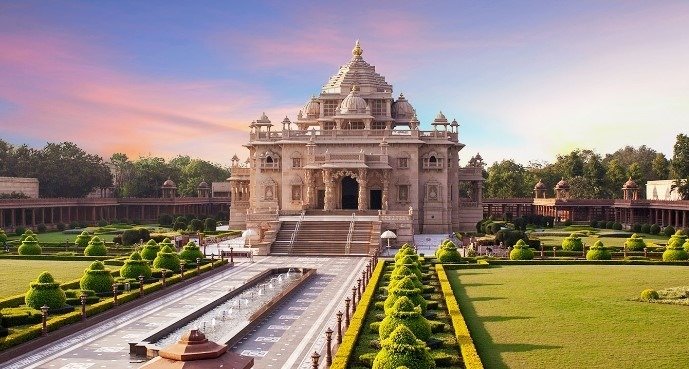
About Swaminarayan Akshardham Gandhinagar, Gujarat
Swaminarayan Akshardham Gandhinagar is dedicated to Bhagwan Swaminarayan and was inaugurated in 1992 during the centenary celebrations of Yogiji Maharaj. The complex grew from Yogiji Maharaj's vision for a mandir in Gandhinagar and was developed under the guidance of Pramukh Swami Maharaj.
The Akshardham Mandir stands at the centre of the complex. Around it are the exhibition spaces, Abhishek Mandapam, gardens and other cultural facilities through which the life and teachings of Bhagwan Swaminarayan and the values of Hindu tradition are presented.
Story of Swaminarayan Akshardham Gandhinagar
The story of Akshardham Gandhinagar begins with Yogiji Maharaj. During a visit to Gandhinagar in 1970, he expressed the wish that a majestic mandir should rise in Sector 20 and inspire spiritual values. The site that later became Akshardham was identified with that vision.
By 1978, land had been acquired and a modern cement-and-concrete design had been considered. The project then turned towards traditional stone architecture. The intention was to create a mandir that would last for generations rather than one designed only for contemporary construction.
Pramukh Swami Maharaj performed the foundation-laying ceremony in 1979. During the following years, the project developed from a mandir into a larger spiritual and cultural complex.
In 1986, BAPS sadhus travelled abroad to study museums and exhibitions, including the ways in which historical and spiritual subjects could be presented through modern technology. This research informed the exhibitions later created at Akshardham.
By 1988, plans included exhibition halls, surrounding buildings, a research facility and the colonnade around the mandir. In 1991, artisans, artists, sadhus, consultants and volunteers worked on the final construction, stone carving, exhibitions, landscaping and other preparations.
Akshardham Gandhinagar was inaugurated in 1992. The BAPS timeline records the inauguration on 2 November 1992 during Yogiji Maharaj's birth-centenary celebrations, while the official Akshardham mandir page gives 30 October 1992 for the mandir's inauguration.
The complex's history also includes the terrorist attack of 24 September 2002. The entire complex was ceremonially reopened fourteen days later following prayers and religious observances. The event became an important part of Akshardham's modern history and of the public response centred on peace and restraint.
Deities and Architecture of Swaminarayan Akshardham Gandhinagar
The principal deity of Akshardham is Bhagwan Swaminarayan, worshipped within the BAPS Swaminarayan tradition as the supreme form of God.
The Garbhagruh, or inner sanctum, houses Bhagwan Swaminarayan together with the guru parampara of the sampradaya: Gunatitanand Swami, Bhagatji Maharaj, Shastriji Maharaj, Yogiji Maharaj, Pramukh Swami Maharaj and Mahant Swami Maharaj. Around the Garbhagruh are altars dedicated to Sita-Ram, Radha-Krishna, Lakshmi-Narayan and Parvati-Mahadev.
The mandir is built from approximately 6,000 tonnes of pink sandstone. Its design follows principles of traditional Hindu architectural texts, or shilpa shastras, and its construction does not use ferrous metal.
The structure is approximately 108 feet high, 131 feet wide and 240 feet long. Its architectural elements include 97 carved pillars, 17 ornate domes, 220 stone beams, 57 stone screens and 256 statues of spiritual personalities.
The carvings on the pillars and other surfaces form part of the mandir's religious language. They depict deities, devotees and other figures from Hindu artistic traditions rather than serving only as decorative work.
Swaminarayan Darshan
The first floor of the mandir houses Swaminarayan Darshan, an exhibition of paintings presenting the life of Bhagwan Swaminarayan from 1781 to 1830.
Prasadi Mandapam
The basement contains the Prasadi Mandapam, where objects associated with Bhagwan Swaminarayan are preserved. Within the Swaminarayan tradition, these objects are regarded as prasadi because of their association with him.
The mandir therefore brings together three distinct forms of religious presentation: the living worship of the murtis in the Garbhagruh, the visual narration of Bhagwan Swaminarayan's life, and the preservation of objects connected with his life and devotional tradition.
What Makes Swaminarayan Akshardham Gandhinagar Sacred for Devotees
The name Akshardham refers, within the Swaminarayan tradition, to the divine abode of God. The mandir in Gandhinagar is understood within this tradition as a place where devotion, worship and spiritual knowledge come together.
Bhagwan Swaminarayan
Bhagwan Swaminarayan, born Ghanshyam in 1781, spent part of his early life as the young ascetic Neelkanth Varni. According to the Swaminarayan tradition, Neelkanth left home at the age of 11 and travelled for seven years before arriving in Gujarat.
The journey is remembered not simply as travel but as a period of austerity, pilgrimage and spiritual search. That part of his life continues to shape the religious presentation of Akshardham.
The Guru Parampara
The guru parampara has a central place in the theology represented at Akshardham. The Garbhagruh depicts the succession of gurus revered in the BAPS Swaminarayan tradition and places their devotion and service to Bhagwan Swaminarayan at the centre of the mandir's religious presentation.
This is particularly important to understanding why the Garbhagruh contains both the principal deity and the guru lineage rather than Bhagwan Swaminarayan alone.
Abhishek Mandapam
The Abhishek Mandapam is a separate devotional space where devotees may perform abhishek of Bhagwan Swaminarayan in the youthful form of Neelkanth.
The ritual consists of offering water to the sacred image while offering prayer. The official Akshardham tradition associates the practice with prayer for spiritual progress, strength, loved ones and peace.
Nilkanth Vatika
Nilkanth Vatika is centred on a 49-foot bronze murti of Neelkanth Varni. The murti depicts the teenage yogi standing in meditation with one leg raised and his arms lifted upwards.
The form refers to the austerities associated in Swaminarayan tradition with Neelkanth Varni's pilgrimage, including his stay at Muktinath. The murti was consecrated in November 2024 and is now one of the major sacred spaces of the Gandhinagar complex.
The Meaning of the Wider Complex
The exhibitions, gardens and cultural presentations surrounding the mandir extend the same spiritual themes into a different form. The official exhibitions present values including service, humility, compassion, non-violence, spiritual awareness, honesty, unity and peace through stories from the life of Bhagwan Swaminarayan and Hindu tradition.
These spaces are part of Akshardham's cultural and educational role, while the mandir remains the centre of worship.
Annual Festivals & Rituals at Swaminarayan Akshardham Gandhinagar, Gujarat
Daily Worship
The mandir follows a daily pattern of darshan and arti. The current official visitor schedule lists morning and evening arti, while special days and festivals can bring different arrangements.
Abhishek
Abhishek of Neelkanth is one of the devotional practices open to visitors at Akshardham. The ritual is centred on offering water to the sacred image while praying.
Diwali and Annakut
Diwali and Annakut are important annual observances at Akshardham Gandhinagar.
During the Festival of Lights, the complex has traditionally been decorated with thousands of traditional lamps. Annakut follows Diwali and centres on the devotional offering of food before the murtis.
The form and timing of these celebrations vary from year to year, and special festival arrangements can affect ordinary visitor timings.
Janmashtami and Other Observances
Janmashtami and other Hindu and Swaminarayan observances are also marked at Akshardham. Their arrangements are not necessarily the same each year, so festival-day visitors should check the current official notice.
Sat-Chit-Anand Water Show
The Sat-Chit-Anand Water Show is separate from temple worship. It presents the story of Nachiketa from the Kathopanishad through water, light, projection, laser, fire and sound.
Its subject comes from Hindu philosophical tradition and adds a cultural and educational dimension to the wider Akshardham complex.
Sacred Places to Visit Near Swaminarayan Akshardham Gandhinagar
Adalaj Stepwell
Adalaj Stepwell is a 15th-century stepwell known for its carved stonework and the combination of Hindu and Indo-Islamic architectural elements. It lies between Gandhinagar and Ahmedabad and is one of the principal heritage sites associated with the area.
Dandi Kutir Museum
Dandi Kutir in Gandhinagar presents the life and teachings of Mahatma Gandhi through an immersive museum experience centred on the Dandi March and India's freedom movement.
Indroda Nature Park
Indroda Nature Park includes dinosaur and fossil displays, botanical areas and wildlife-related spaces. It is one of Gandhinagar's major educational and recreational attractions.
Trimandir, Adalaj
Trimandir at Adalaj brings Jain, Shaiva and Vaishnava traditions together within a single religious complex and provides a different perspective on Gujarat's multi-tradition religious landscape.
Sarita Udyan
Sarita Udyan is a green recreational area along the Sabarmati and can be included as a quieter stop while exploring Gandhinagar.
Plan Swaminarayan Akshardham Gandhinagar Darshan
Naman Darshan provides independent assistance and coordination. It is not the temple administration and does not guarantee VIP, priority or special entry.
Common Questions About Visiting Swaminarayan Akshardham Gandhinagar
The principal deity is Bhagwan Swaminarayan. The Garbhagruh also represents the guru parampara of the BAPS Swaminarayan tradition, while other altars are dedicated to Sita-Ram, Radha-Krishna, Lakshmi-Narayan and Parvati-Mahadev.
Akshardham Gandhinagar was inaugurated in 1992 during the centenary celebrations of Yogiji Maharaj. The BAPS milestone timeline records 2 November 1992, while the official mandir page gives 30 October 1992 for the mandir's inauguration.
The complex was created from Yogiji Maharaj's vision for a mandir in Gandhinagar and developed under Pramukh Swami Maharaj. Its mandir, guru parampara, sacred spaces, exhibitions and devotional activities present the life and teachings of Bhagwan Swaminarayan.
The mandir follows traditional Hindu architectural principles associated with the shilpa shastras. It is constructed from pink sandstone without ferrous metal and measures approximately 108 feet high, 131 feet wide and 240 feet long.
The Abhishek Mandapam is a devotional space where visitors can participate in abhishek of the youthful yogi form of Bhagwan Swaminarayan, Neelkanth.
Nilkanth Vatika is a sacred space centred on a 49-foot bronze murti of Neelkanth Varni. The murti was consecrated in November 2024 and represents the youthful ascetic form of Bhagwan Swaminarayan.
It is a separate cultural presentation based on the story of Nachiketa from the Kathopanishad. Water, light, projection, laser, fire and sound are used to present the story.
Mandir entry and darshan are currently free. The exhibitions and water show have separate charges, while the Abhishek Mandapam operates through its own current donation arrangement.
The regular visitor schedule currently lists Monday as the weekly closing day. Special religious occasions can change the normal schedule.
Visitor Information
Entry Fee
10:00 AM – Current official schedule; subject to change. 7:30 PM – Current official schedule. 10:30 AM–5:30 PM – Separate admission applies. Free – No prior appointment currently required.
Darshan Timing
Address
Swaminarayan Akshardham, Sector 20, 'J' Road, Gandhinagar – 382020, Gujarat, India
Notable Events
1970: Yogiji Maharaj expressed his vision for a majestic mandir at the Gandhinagar site.
1978: The proposed construction moved from cement and concrete towards traditional stone architecture.
1979: Pramukh Swami Maharaj performed the foundation-laying ceremony.
1986: BAPS sadhus undertook international study of museums and exhibition techniques to help shape the cultural components of Akshardham.
1988: Plans for exhibition halls, research facilities, surrounding buildings and the mandir colonnade were developed.
1991: Construction, stone carving, exhibitions, landscaping and other final preparations reached their major completion phase.
1992: Swaminarayan Akshardham Gandhinagar was inaugurated.
24 September 2002: The Akshardham complex was attacked by terrorists.
7 October 2002: The complex was ceremonially reopened fourteen days after the attack.
2017: New murtis representing the guru parampara and other Hindu deities were consecrated at Akshardham.
11 November 2024: The 49-foot bronze murti at Nilkanth Vatika was consecrated.
How to Reach the Temple
By air: Sardar Vallabhbhai Patel International Airport in Ahmedabad is the nearest major airport. The official Akshardham visitor information currently lists the distance at approximately 21 km.
By rail: Gandhinagar is connected by rail with Ahmedabad and other parts of Gujarat. Local taxis and other transport are available for the journey to Sector 20.
From Ahmedabad Railway Station: The official Akshardham visitor information lists approximately 32 km and around 45 minutes, depending on traffic.
By road: Gandhinagar is connected to Ahmedabad and other parts of Gujarat by road. Taxis, buses, private vehicles and local transport can be used to reach Sector 20.
Within Gandhinagar: Auto-rickshaws, taxis and local transport connect the temple area with the city's railway stations and other sectors.
Travel time should be planned with some margin when the visit includes an exhibition or water-show schedule.