
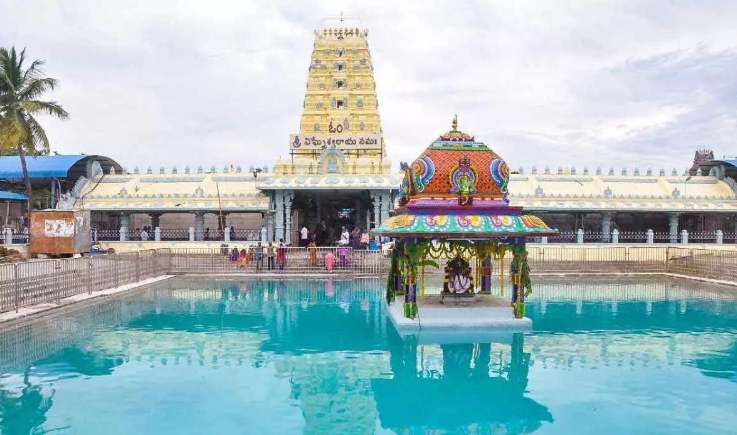
About Sri Varasiddhi Vinayaka Swamy Temple, Kanipakam, Chittoor District, Andhra Pradesh
Sri Varasiddhi Vinayaka Swamy Temple at Kanipakam is dedicated to Lord Ganesha. The temple is known for its swayambhu form of Vinayaka, worshipped in a water-filled well, and for the tradition of affirming truth in the presence of the deity.
The shrine is associated with Chola-period temple building, later Vijayanagara expansion and an annual Brahmotsavam that begins with Vinayaka Chavithi. Its distinctive sanctum and the stories connected with the well and the nearby Bahuda River have made Kanipakam an important centre of Ganesha worship in Andhra Pradesh.
Story of Sri Varasiddhi Vinayaka Swamy Temple
Published accounts associate the temple’s early structure with the Chola ruler Kulottunga Chola I, with later expansion under Vijayanagara rulers. The temple’s history is commonly traced to the 11th century, while a major phase of expansion is often dated to 1336. These dates provide the broad historical outline of the shrine; the full sequence of its construction and later additions is not established equally clearly in the readily available public sources.
The presiding deity is Sri Varasiddhi Vinayaka Swamy, a form of Lord Ganesha worshipped as swayambhu, or self-manifested. The image is enshrined in a well where water remains around the deity. Unlike a Ganesha image installed on a conventional raised pedestal, the sacred form at Kanipakam is closely connected with the well in which it was discovered. The image’s unusual setting is central to the temple’s identity.
The temple’s architecture follows the South Indian Dravidian tradition. The complex faces east, with a seven-tier Raja Gopuram at the main entrance and a Pushkarini in front. A Dhwajastambham and Balipeetham stand along the approach to the main shrine. The inner sequence includes the Mukhamandapa and Arthamandapa, leading toward the sanctum, which is itself associated with the water-filled well.
Other features form part of the wider temple precinct, including a shrine of Sri Veeranjaneya Swamy, a form of Vinayaka associated with Siddhi and Buddhi, the Navagraha Mandapam and the Addala Mandapam. Together, these spaces support the temple’s daily worship and the movement of devotees through the complex.
What Makes Sri Varasiddhi Vinayaka Swamy Temple Sacred for Devotees
The discovery of the Swayambhu Vinayaka
According to the temple’s sthala purana, three brothers who were mute, deaf and blind cultivated a small piece of land near Kanipakam. They depended on a well to draw water for their fields. When the water ran low, one brother entered the well to deepen it and struck a hard object with his tool.
The story says that blood began to emerge from the stone and turned the well water red. The brothers then regained their abilities, and villagers who gathered at the site identified the form as Lord Vinayaka. Attempts to dig deeper did not reveal the base of the image, so it was worshipped where it had appeared. This account is a sacred tradition associated with the temple, rather than a documented archaeological record.
The belief that the deity continues to grow
A distinctive belief at Kanipakam holds that the image of Sri Varasiddhi Vinayaka has increased in size over time. Temple accounts point to an older silver kavacha, or protective covering, that is said no longer to fit the image as it once did. The belief is closely associated with the temple’s living tradition and should be understood as a devotional account.
Sri Varasiddhi Vinayaka as the upholder of truth
The deity is also known in local tradition as Satya Pramāṇāla Devudu, understood as the Lord before whom truth is affirmed. Temple accounts describe a custom in which people involved in a dispute take a special oath in the deity’s presence. The custom reflects the role of religious faith and personal accountability in the local tradition; it should not be confused with a formal legal process.
The Bahuda River tradition
Another local story concerns the brothers Sankha and Likhita, who were on a pilgrimage. According to the account, Likhita took a mango without permission, and his elder brother Sankha insisted that the act be punished. After Likhita lost both arms, a later dip in the river near Kanipakam was said to have restored them. The river came to be associated with the name Bahuda, linked in the tradition to the word for arms.
The story forms part of the sacred geography surrounding Kanipakam. It is a religious explanation associated with the river, not a verified account of how its name was historically established.
The sacred water of the well
The water surrounding the deity is an important part of worship at Kanipakam. Temple tradition includes offering this water to devotees as teertham. Its significance comes from it
Annual Festivals & Rituals at Sri Varasiddhi Vinayaka Swamy Temple, Kanipakam, Chittoor District, Andhra Pradesh
Daily worship and offerings
Daily worship includes prayers and ritual offerings to Sri Varasiddhi Vinayaka Swamy. Abhishekam and other sevas form part of the temple’s worship cycle, while the sacred water associated with the well is part of the temple’s devotional practice. Darshan may be affected by the ritual sequence, so exact seva timings should be checked separately.
Vinayaka Chavithi
Vinayaka Chavithi, also known as Ganesh Chaturthi, is one of the principal observances at Kanipakam. The festival celebrates Lord Ganesha and marks the beginning of the temple’s annual Brahmotsavam.
Annual Brahmotsavam
The Brahmotsavam is celebrated over 21 days, beginning with Vinayaka Chavithi. During the festival, the processional deity is taken through the temple streets on different vahanams, or ceremonial vehicles. The programme may include processions such as Radhotsavam, Pushpapallaki and Teppotsavam.
Sankatahara Ganapati Vratham
Sankatahara Ganapati Vratham is a worship observance dedicated to Lord Ganesha and is associated with the Chaturthi that falls during the waning phase of the lunar month. It forms part of the wider ritual tradition of Ganesha worship at Kanipakam. Current dates and participation details should be confirmed with the temple.
Sacred Places to Visit Near Sri Varasiddhi Vinayaka Swamy Temple
Varadaraja Swamy Temple
Varadaraja Swamy Temple is a Vishnu shrine in the Kanipakam area. It can be included in a local temple visit alongside Sri Varasiddhi Vinayaka Swamy Temple.
Manikanta Swamy Temple
Manikanta Swamy Temple, associated with Lord Ayyappa, is another nearby shrine listed among the places to visit around Kanipakam. It provides an additional stop for devotees exploring the area’s temple traditions.
Sri Venkateswara Temple, Tirumala
Sri Venkateswara Temple at Tirumala is a major pilgrimage destination in the wider region. Visitors combining Kanipakam with Tirupati and Tirumala should plan the journey as a separate part of their itinerary rather than assume the temples are within the same local area.
Plan Your Visit to Sri Varasiddhi Vinayaka Swamy Temple
NamanDarshan is a technology platform that arranges darshan and related services on your behalf through independent service providers.
Common Questions About Visiting Sri Varasiddhi Vinayaka Swamy Temple
The temple is best known for its Swayambhu form of Lord Ganesha, worshipped in a water-filled well. It is also associated with a tradition of affirming truth before the deity and with the annual Brahmotsavam.
According to temple tradition, three brothers who were mute, deaf and blind discovered the form of Vinayaka while working in a well. The water was said to turn red and the brothers regained their abilities. Villagers then recognised the form as Swayambhu Vinayaka and began worshipping it at the site.
Published accounts commonly associate the temple’s early structure with the Chola ruler Kulottunga Chola I in the 11th century. Later expansion is often associated with Vijayanagara rulers and dated to 1336.
Swayambhu means self-manifested. According to the temple’s origin tradition, the deity was discovered within a well and was not installed there through an ordinary consecration of a sculpted image.
NamanDarshan is a technology platform that arranges darshan and related services on your behalf through independent service providers. We are not the temple or its management, and the temple's rules always apply.
Visitor Information
Darshan Timing
Address
Swayambhu Sri Varasiddhi Vinayaka Swamy Vari Devasthanam Kanipakam, Irala Mandal, Chittoor District, Andhra Pradesh 517131, India
Notable Events
11th century — Early temple history
Published accounts associate the temple’s early structure with Chola ruler Kulottunga Chola I. The exact sequence of the shrine’s earliest building phases requires more detailed inscriptional confirmation.
1336 — Vijayanagara-era expansion
The temple is commonly described as having been expanded under Vijayanagara patronage. This date is widely repeated in published temple and tourism material.
Around 1945 — Silver kavacha offering
A temple account published by Sapthagiri records a silver kavacha offered to the deity around this period. The claim that the covering later no longer fitted is part of the temple’s tradition concerning the growing image.
Present day — Devasthanam administration
The temple is administered under the Andhra Pradesh Endowments Department. Current rules, sevas and festival arrangements should be taken from the Devasthanam’s latest notices.
How to Reach the Temple
By air:
Tirupati Airport is the nearest airport commonly listed for Kanipakam, at approximately 80–90 km by road. Allow extra time for the onward journey, depending on traffic and the route used.
By rail:
Chittoor Railway Station is the nearest convenient railway station, approximately 12 km from the temple. Taxis, autos and local transport can be used for the onward journey.
By road:
Kanipakam is about 11 km from Chittoor and around 68 km from Tirupati, according to published district and tourism information. Buses and road transport connect Kanipakam with nearby towns and the Tirupati area.
Within Kanipakam:
The temple is close to the village’s bus stop and local services. The approach may be busier