
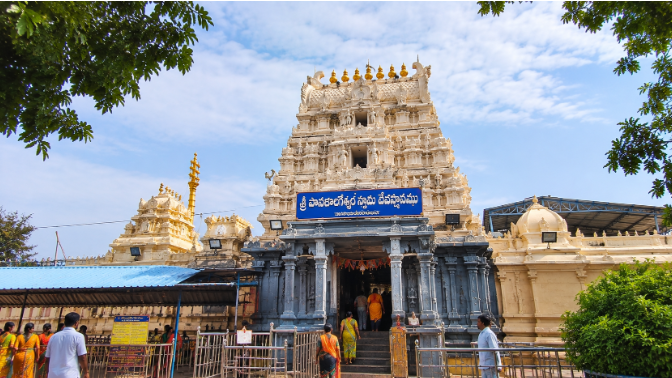
About Sri Panakala Lakshmi Narasimha Swamy Temple, Mangalagiri, Andhra Pradesh
Sri Panakala Lakshmi Narasimha Swamy Temple stands on Mangalagiri Hill near Vijayawada in Andhra Pradesh. It is dedicated to Lord Narasimha, the man-lion form of Lord Vishnu, worshipped here through a distinctive form in which the deity's open mouth is visible in the sanctum.
The temple is known for Panakam, a drink made from jaggery and water that devotees offer directly to the deity. The hill shrine forms part of Mangalagiri's wider sacred landscape, which also includes the Lakshmi Narasimha Swamy temple at the foot of the hill and the Gandalaya Narasimha shrine near the summit.
Story of Sri Panakala Lakshmi Narasimha Swamy Temple
Sri Panakala Lakshmi Narasimha Swamy Temple stands on Mangalagiri Hill in Andhra Pradesh and is traditionally counted among the eight sacred Mahakshetras associated with Lord Narasimha. The shrine is known for its ancient worship traditions and for the unusual form in which the deity is worshipped. The wider Mangalagiri pilgrimage includes the Panakala Narasimha shrine on the hill, the Lakshmi Narasimha Swamy Temple at its foot and the Gandala Narasimha shrine near the summit.
The hill shrine is built around a natural cave sanctum, where the deity is visible as a widely opened mouth rather than a complete conventional idol. The temple complex also reflects different periods of patronage. Its 153-foot, eleven-storey Raja Gopuram was built under Raja Vasireddy Venkatadri Nayudu in the early nineteenth century, while the Mukha Mandapa is traditionally associated with the Vijayanagara ruler Krishnadevaraya in 1520. Inscriptions along the steps also point to the site's long history of worship and patronage.
What distinguishes the shrine is the offering of Panakam, a drink made from jaggery and water. During worship, the priest pours the offering into the deity's open mouth, traditionally using a conch. According to the temple tradition, the Lord accepts about half of the drink and the remainder flows back to be distributed as prasadam. Devotees also describe hearing a gurgling sound during the offering; these details form part of the shrine's living religious tradition.
The Panakam offering is traditionally understood as a way of cooling Lord Narasimha's fierce form. A belief associated with the temple says that the offering changes across the four yugas, with Panakam belonging to the present Kali Yuga. This distinctive practice remains central to worship at Mangalagiri and is the reason the deity is widely known as Panakala Narasimha Swamy.
What Makes Sri Panakala Lakshmi Narasimha Swamy Temple Sacred for Devotees
Mangalagiri as a Mahakshetram
Mangalagiri is traditionally recognised as one of the important sacred places associated with Lord Vishnu and Lord Narasimha. The hill's religious importance is expressed through the belief that the deity manifested here in ancient times. This sacred account is central to the shrine's identity, although it is distinct from the dates available for later structures and inscriptions.
The tradition of offerings through the yugas
A tradition preserved in the temple's account describes different offerings associated with successive yugas: nectar in Krita Yuga, ghee in Treta Yuga, milk in Dvapara Yuga and Panakam in the present Kali Yuga. In this account, the present offering connects the shrine's daily worship with a much older religious understanding of the deity.
The Pandavas and Tothadri
Local religious tradition also associates the hill, known in some accounts as Tothadri, with the Pandavas during their exile. One version says Bhima recommended the worship of Lord Narasimha at the site. Such stories form part of the sacred history of Mangalagiri and should be understood as devotional traditions rather than as dated historical records.
Three Narasimha shrines on the hill
Mangalagiri's religious landscape includes three distinct Narasimha shrines. Panakala Narasimha is worshipped at the hilltop shrine, Lakshmi Narasimha Swamy at the foot of the hill, and Gandalaya Narasimha near the summit. The shrines are related through their association with Lord Narasimha, but they have distinct settings and forms of worship.
Annual Festivals & Rituals at Sri Panakala Lakshmi Narasimha Swamy Temple, Mangalagiri, Andhra Pradesh
Daily Panakam Offering
The daily Panakam offering is the defining ritual of the hilltop shrine. Devotees offer jaggery water to Panakala Narasimha as part of worship. The offering is available during the shrine's public hours, subject to the temple's current ritual schedule.
Brahmotsavam and Kalyana Mahotsavam
The annual Brahmotsavams are an important part of Mangalagiri's temple calendar. The wider Lakshmi Narasimha Swamy temple complex holds special celebrations, including Kalyana Mahotsavam, the ceremonial wedding of the deity. The details of festival rituals and their locations can differ between the hilltop and foot-hill shrines.
Narasimha Jayanti
Narasimha Jayanti marks the appearance of Lord Narasimha and is observed with special worship at Narasimha temples. The precise programme at Mangalagiri should be confirmed through current temple notices.
Vaikuntha Ekadashi
Vaikuntha Ekadashi is an important observance in the Vaishnava calendar. Special worship and increased attendance may affect arrangements at Mangalagiri's temples, so visitors should check the current programme before travelling on the festival date.
Sacred Places to Visit Near Sri Panakala Lakshmi Narasimha Swamy Temple
Sri Lakshmi Narasimha Swamy Temple, Mangalagiri
Located at the foot of the hill, this shrine is the lower temple in Mangalagiri's three-shrine Narasimha tradition. It is known for its large eleven-storey Raja Gopuram and its own daily worship and festival programme.
Amaravati
Amaravati is a historic town in the Krishna River region, known for its Buddhist heritage and the Amaravati archaeological site. It can be included in a wider visit to the cultural and religious places around Mangalagiri and Vijayawada.
Vijayawada and Kanaka Durga Temple
Vijayawada is a nearby city and a convenient transport base for Mangalagiri. The Kanaka Durga Temple, on Indrakeeladri Hill, is one of the city's major pilgrimage sites and can be visited as part of a broader temple itinerary.
Plan Your Visit to Sri Panakala Lakshmi Narasimha Swamy Temple
NamanDarshan is a technology platform that arranges darshan and related services on your behalf through independent service providers.
Common Questions About Visiting Sri Panakala Lakshmi Narasimha Swamy Temple
The hilltop shrine is known for its distinctive open-mouth form of Lord Narasimha and the offering of Panakam, a drink made from jaggery and water. The offering and its associated tradition are central to the temple's identity.
Panakam is a traditional drink made from jaggery and water. At Mangalagiri, devotees offer it directly to Panakala Narasimha as part of worship.
According to temple tradition, the deity receives part of the offering and the remainder returns as prasadam. This is a sacred belief associated with the ritual, not a claim that should be presented as scientifically verified.
Yes. The wider sacred landscape includes Panakala Narasimha on the hill, Lakshmi Narasimha Swamy at the foot of the hill and Gandalaya Narasimha near the summit. Each shrine has its own location and worship arrangements.
NamanDarshan is a technology platform that arranges darshan and related services on your behalf through independent service providers. We are not the temple or its management, and the temple's rules always apply.
Visitor Information
Darshan Timing
Address
Sri Panakala Lakshmi Narasimha Swamy Temple Panakala Narasimha Swamy Temple Road, Mangalagiri, Guntur District, Andhra Pradesh 522503, India
Notable Events
1520 — Vijayanagara-period record and Mukha Mandapa tradition
A stone inscription near the temple steps is dated to 1520. The temple website also attributes the Mukha Mandapa to Sri Krishnadevaraya in that year.
1538 — Grant inscription associated with Sadasiva Raya
A further inscription near the Garudalvar area at the lower shrine is described as recording grants during the reign of Sadasiva Raya of the Vijayanagara Empire.
1807–1809 — Construction of the lower temple's Raja Gopuram
Raja Vasireddy Venkatadri Nayudu is associated with the construction of the eleven-storey, approximately 153-foot tower at the foot-hill Sri Lakshmi Narasimha Swamy temple. This milestone belongs to the lower shrine, not the hilltop Panakala sanctum.
1820 — Golden conch recorded in temple history
The temple website records that Sri Raja Sarabh Bhogendra Maharaja gifted a golden conch to the temple.
These milestones document inscriptions, architectural additions and recorded gifts. The shrine's association with Krita Yuga belongs to its religious tradition and is not a dated historical event.
How to Reach the Temple
By air: Vijayawada Airport at Gannavaram is the nearest airport commonly used for Mangalagiri. The temple website lists it at approximately 20 kilometres away; road distance and travel time depend on the route.
By rail: Mangalagiri railway station is the nearest local station listed by the temple website. Vijayawada Junction is another major rail option for travellers arriving from other cities.
By road: Mangalagiri lies between Vijayawada and Guntur and is connected by road to both cities. The temple website lists the shrine at approximately 12 kilometres from Vijayawada and 19 kilometres from Guntur.
Within Mangalagiri: The Panakala Narasimha shrine is on the hill and can be reached by road or steps. Visitors planning to see the lower Lakshmi Narasimha temple or the summit shrine should allow extra time because these are separate locations with their own access arrangements.