
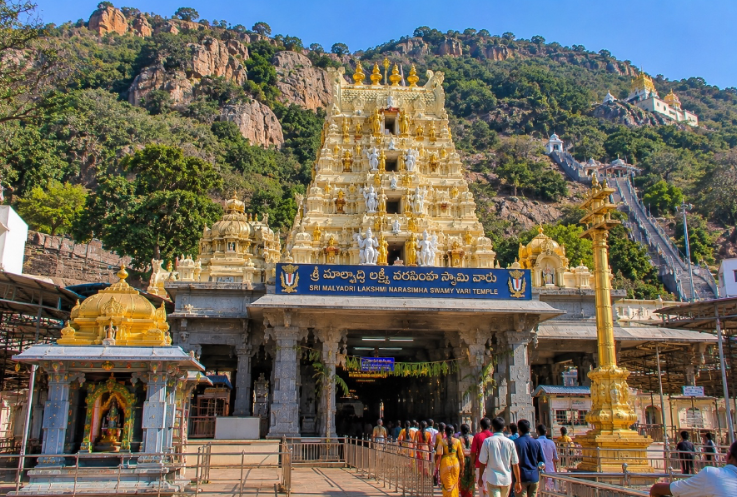
About Sri Malyadri Lakshmi Narasimha Swamy Temple, Malakonda, Prakasam District, Andhra Pradesh
Sri Malyadri Lakshmi Narasimha Swamy Temple stands on Malyadri hill at Malakonda in Prakasam district, Andhra Pradesh. Lord Narasimha is worshipped here with Goddess Mahalakshmi, and the sanctum is set within a naturally formed cave on the hill.
The temple is known for its Saturday-only public darshan and the tradition of Jwala Narasimha, the fiery form of the Lord associated with Sage Agastya’s penance. The seven theerthams of Malyadri and the belief that devas and rishis worship the Lord on the other six days are also central to the shrine’s local tradition.
Story of Sri Malyadri Lakshmi Narasimha Swamy Temple
A securely documented foundation date has not been established for the temple. Its early history is preserved mainly through the Sthala Purana and local worship traditions, rather than a confirmed chronology of rulers, inscriptions or construction. The shrine stands on Malyadri hill, where the natural cave forms the setting for the worship of Lord Lakshmi Narasimha.
The presiding deity is Sri Lakshmi Narasimha Swamy, a form of Lord Vishnu with Goddess Mahalakshmi. Devotional descriptions of the image show Narasimha holding the conch and Sudarshana Chakra, with Mahalakshmi seated on the Lord’s thigh. The shrine is also associated with the name Jwala Narasimha, which refers to the fiery form in which the Lord is said to have appeared before Sage Agastya.
The physical setting is different from a large temple complex built around tall gopurams and multiple stone halls. The sanctum is set within a naturally formed cave on the hill, and the approach passes through rocky ground and a narrow gap between large boulders. The hill also has smaller sacred places, including a Shiva shrine associated with a lingam beneath a large rock, a shrine to Mahalakshmi and the rock formation known locally as Godugu Banda.
The temple’s importance rests on this combination of the cave shrine, the local Sthala Purana and a distinctive pattern of worship. The government district profile identifies Pancharatra Agama as the system followed for temple worship. It also records that public darshan is available on Saturdays, the practice for which Malyadri is especially known.
What Makes Sri Malyadri Lakshmi Narasimha Swamy Temple Sacred for Devotees
How Malyadri Hill is Said to Have Originated
One account in the Sthala Purana begins with Lord Vishnu and Goddess Mahalakshmi discussing the presence of sacred places on earth. In this tradition, Vishnu’s Vanamala, the divine garland, takes the form of a hill so that the Lord and Mahalakshmi can reside there. Other devotional accounts describe Garuda selecting the hilltop as a suitable place for the divine presence. The hill became known as Malyadri, and the story explains its sacred identity within local tradition.
The account is a religious explanation of the site’s origin, not a dated historical record. Details differ among devotional retellings, but the association between Vanamala and Malyadri remains an important part of the temple’s Sthala Purana.
Sage Agastya and Jwala Narasimha
The Sthala Purana says that Sage Agastya performed penance on Malyadri. Pleased with the sage’s devotion, Lord Narasimha appeared in a red, flame-like form. This manifestation became known as Jwala Narasimha.
According to the tradition, Agastya asked the Lord to remain on the hill so that people could worship him there. The story connects the presence of Jwala Narasimha with the continuing worship at Malakonda and explains why the hill is regarded as a sacred place of Narasimha.
Why Public Darshan Is Associated with Saturdays
The Saturday-only darshan tradition is explained through the same story of Sage Agastya. According to local belief, the sage requested that the devas and rishis be able to worship the Lord during six days of the week, with Saturday reserved for human devotees.
The temple’s weekly opening pattern is therefore more than a practical schedule in local religious understanding; it is tied to the tradition of how the Lord agreed to remain at Malyadri. Visitors should still confirm the current opening and closing hours before travelling.
The Seven Theerthams of Malyadri
The Sthala Purana names seven theerthams on the hill:
Narasimha Theertham, also referred to as Malyadri Theertham
Varuna Theertham
Kapila Theertham
Agastya Theertham
Shankara Theertham
Jyoti Theertham
Indra Theertham
These theerthams form part of Malyadri’s sacred geography and are associated with the sages and divine figures named in the tradition. Their religious significance should be distinguished from the question of which points are physically accessible to visitors today; local guidance is advisable before attempting to reach any site on the hill.
Vows and Pradakshina
Some devotional accounts describe devotees undertaking pradakshina on five or nine Saturdays as a religious vow. A separate local belief associates worship over three consecutive Saturdays with prayers for children.
These practices belong to devotional tradition. They should not be presented as a guarantee of a particular outcome or as a substitute for medical advice.
Malyadri and the Nava Narasimha Tradition
Some regional devotional listings describe Malyadri among the Nava Narasimha kshetras. The sources reviewed do not consistently explain a single standardised list, so this designation is best understood as a devotional classification rather than a universally agreed historical label.
Annual Festivals & Rituals at Sri Malyadri Lakshmi Narasimha Swamy Temple, Malakonda, Prakasam District, Andhra Pradesh
Worship According to Pancharatra Agama
The government district profile identifies Pancharatra Agama as the system followed for worship at Malyadri. The temple’s rituals are organised within this tradition, while public darshan follows the shrine’s distinctive weekly opening pattern.
Saturday Worship
Saturday is the regular public darshan day at the temple. Devotees travel to Malakonda to worship Sri Lakshmi Narasimha Swamy, and the day can be considerably busier than an ordinary weekday in the surrounding area. The belief that devas and rishis worship during the other six days is part of the temple’s Sthala Purana.
Narasimha Jayanti
Narasimha Jayanti, associated with the Vaishakha Shukla Chaturdashi tithi, is the principal annual festival identified in the sources reviewed for this temple. The observance commemorates the appearance of Lord Narasimha and is marked by special worship.
The exact festival arrangements and public darshan schedule should be confirmed for the relevant year, particularly because the regular opening tradition is linked to Saturday.
Pradakshina as a Devotional Vow
Pradakshina, or circumambulation, is undertaken by some devotees as a vow over a series of Saturdays. The number of Saturdays and the form of the vow can vary by devotional practice. These observances should be understood as acts of worship, not as guaranteed remedies for personal difficulties.
Sacred Places to Visit Near Sri Malyadri Lakshmi Narasimha Swamy Temple
The Seven Theerthams
The seven theerthams named in the Sthala Purana—Narasimha, Varuna, Kapila, Agastya, Shankara, Jyoti and Indra—are part of Malyadri’s traditional sacred landscape. Confirm locally which sites can be reached safely during a visit.
The Shiva Shrine
A Shiva lingam is associated with a cave beneath a large rock on the hill. Local tradition regards this shrine as a place where the worship of Shiva and Vishnu exists within the same sacred landscape.
Godugu Banda
Godugu Banda, commonly described as the “umbrella rock,” is a notable rock formation associated with Malakonda. It is part of the hill’s local religious geography and should be understood as a natural landmark rather than an elaborate architectural structure.
The Mahalakshmi Shrine
Goddess Mahalakshmi is worshipped with Lord Narasimha at Malyadri, and devotional descriptions also refer to a shrine associated with the goddess on the hill. Her presence is central to the identity of Sri Lakshmi Narasimha Swamy.
Plan Your Visit to Sri Malyadri Lakshmi Narasimha Swamy Temple
NamanDarshan is a technology platform that arranges darshan and related services on your behalf through independent service providers.
Common Questions About Visiting Sri Malyadri Lakshmi Narasimha Swamy Temple
The temple is at Malakonda in Voletivaripalem mandal, Prakasam district, Andhra Pradesh. It stands on Malyadri hill and is reached by road from Kandukur and other nearby regional centres.
The presiding deity is Sri Lakshmi Narasimha Swamy, a form of Lord Vishnu worshipped with Goddess Mahalakshmi. The local Sthala Purana also associates the deity with the fiery manifestation known as Jwala Narasimha.
According to local tradition, Sage Agastya requested that Saturday be reserved for human devotees while devas and rishis worship the Lord during the other six days. The Saturday-only public darshan pattern is one of the temple’s defining features.
The Sthala Purana says that Sage Agastya performed penance on Malyadri and Lord Narasimha appeared in a red, flame-like form. This manifestation is known as Jwala Narasimha, and the tradition explains why the Lord is worshipped at the hill.
NamanDarshan is a technology platform that arranges darshan and related services on your behalf through independent service providers. We are not the temple or its management, and the temple's rules always apply.
Visitor Information
Darshan Timing
Address
Sri Malyadri Lakshmi Narasimha Swamy Temple Malakonda, Voletivaripalem Mandal, Prakasam District, Andhra Pradesh, India
Notable Events
Traditional origin of Malyadri — undated
The temple’s Sthala Purana explains the origin of the hill through the story of Vishnu’s Vanamala and the selection of a suitable hilltop for the Lord’s presence. This is the shrine’s traditional origin account, not a dated historical event.
Sage Agastya and Jwala Narasimha — undated tradition
The local account connects Agastya’s penance with the appearance of Narasimha in a fiery form. It also explains the request for the Lord to remain at Malyadri.
1981 — Temple recorded in a district census handbook
A District Census Handbook description records the Malayadri Lakshmi Narasimha Swamy temple on the hill near Malakonda/Chundi. This provides a dated documentary reference to the shrine’s presence, but it is not the temple’s foundation year.
Continuing worship under Pancharatra Agama
The government district profile identifies Pancharatra Agama as the worship system followed at the temple and records Saturday-only public darshan as a defining feature of its present practice.
A verified chronology of the temple’s construction has not been established in the sources reviewed. Claims of particular construction or fortification dates should not be added to this timeline until they can be checked against temple or archival records.
How to Reach the Temple
By road:
Malakonda is reached by road from Kandukur, Ongole and surrounding towns. Government tourism information places the temple approximately 34–35 kilometres from Kandukur, while APSRTC’s pilgrim-services listing also provides route information from Ongole and Singarayakonda. Road distances and bus schedules should be checked before departure.
By rail:
Singarayakonda is one regional rail access point used for travel toward Malakonda. An onward road journey is required from the station. Confirm the available connection before choosing a train, particularly when planning a Saturday visit.
By air:
Travellers can compare current flight connections to regional airports such as Tirupati and Vijayawada, then continue by road. The most suitable airport depends on available flights and the road route for the intended travel date.