
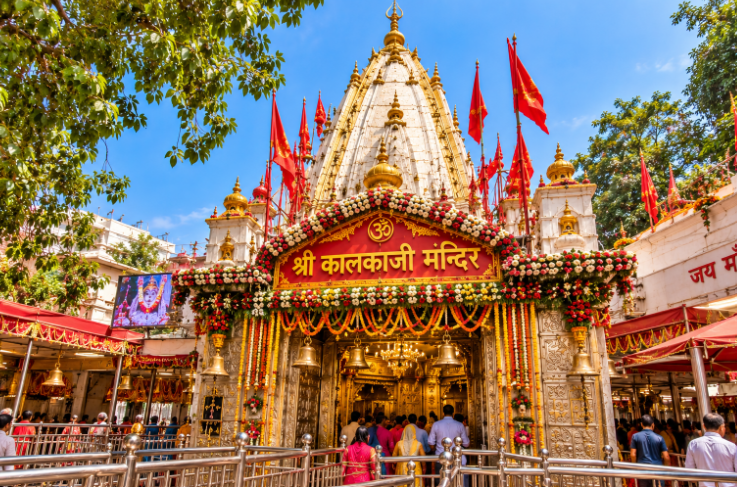
About Kalkaji Mandir, Kalkaji, New Delhi
Kalkaji Mandir, also known as Kalka Ji Mandir, is dedicated to Maa Kalka, worshipped here as a form of Goddess Kali. Located in South Delhi opposite Nehru Place, the temple is one of Delhi’s best-known shrines of the Goddess and is especially busy during Navratri.
The temple is known for its central shrine, the local legend of Kalka’s victory over Raktabija, and its two annual Navratri fairs. The surviving structure developed through several building and renovation phases, while the religious tradition of the shrine places its origins in the mythological past.
Story of Kalkaji Mandir
According to local tradition, the shrine is connected with the appearance of Goddess Kalka to defeat the demons who threatened the gods. The story places the goddess at this site in the mythological age, but the age of the surviving building is different: the National Mission on Monuments and Antiquities dates the oldest surviving phase to around 1764. The temple’s present form reflects additions made over the following centuries.
Historical accounts associate further work on the central shrine with the late 18th century. In 1816, Mirza Raja Kidar Nath, an official in the court of Akbar II, is recorded as having funded the construction of a dome and additional rooms around the shrine. More rooms and dharamshalas were later built through donations from devotees and merchants, creating the wider complex that developed around the sanctum.
Maa Kalka is worshipped at the centre of the temple. The main chamber is twelve-sided, with a covered verandah and a series of arched openings around it. Red sandstone figures of tigers, a trident and a bell form distinctive features of the approach. The building is often described as reflecting Maratha-period construction alongside later decorative details found in Delhi’s architectural traditions.
The temple has continued to change as devotees have renewed and expanded its structures. The central shrine underwent later renovation phases, including work in the 1980s and between 2012 and 2018. Smaller shrines, ritual spaces, donor-built rooms and dharamshalas form part of the larger precinct. Kalkaji is therefore best understood as a living temple complex whose architecture has developed alongside its continuing worship.
What Makes Kalkaji Mandir Sacred for Devotees
The Legend of Maa Kalka and Raktabija
A well-known local legend tells of the demon Raktabija, whose blood was believed to produce more demons whenever it touched the ground. The gods sought help against him, and Parvati sent Goddess Kaushiki to fight the demon. When the battle could not be won by ordinary means, Kali emerged from Kaushiki and drank Raktabija’s blood before it reached the earth. The gods were then able to defeat him.
In the temple’s origin tradition, Kalka settled at the place where the battle took place and came to be worshipped there. This story explains the shrine’s association with the fierce and protective form of the Goddess. It belongs to religious tradition, rather than serving as a datable account of the temple’s construction.
Jayanti Peetha and Manokamna Siddha Peetha
Kalkaji Mandir is also known locally as Jayanti Peetha and Manokamna Siddha Peetha. The latter name reflects devotees’ belief that prayers offered to Maa Kalka can help fulfil their wishes. Devotees visit the shrine for blessings, protection and strength at important points in their lives.
These names express the temple’s place in local worship. They should be understood within the faith associated with the shrine, rather than as a guarantee of a particular worldly outcome.
Maa Kalka in the Shakta Tradition
Maa Kalka is worshipped as a form of Kali and is also associated with Durga in the temple’s religious tradition. The goddess’s fierce form represents the power that confronts destructive forces, while devotees approach her as a source of protection and support.
Kalkaji’s identity is closely tied to this tradition of Goddess worship. The story of Kalka and Raktabija remains central to how many devotees understand the shrine and its significance.
Annual Festivals & Rituals at Kalkaji Mandir, Kalkaji, New Delhi
Daily worship and aarti form the regular rhythm of the temple. Special observances draw larger gatherings, and the timings or arrangements for public darshan may change during festivals.
Navratri Celebrations
Kalkaji’s most prominent annual gatherings take place during Chaitra Navratri in spring and Sharad Navratri in autumn. Across the nine nights, devotees visit the shrine, offer prayers and sing hymns to the Goddess. Fairs develop around the temple, and queues can extend through the surrounding approaches.
Durga Ashtami
Durga Ashtami falls within the Navratri observance and is marked by special worship and offerings to the Goddess. It is one of the busier days at the temple, so visitors should allow extra time and check any crowd-management instructions in force.
Diwali
Diwali is also observed by devotees who visit the shrine to offer prayers. The festival can bring additional footfall, although Navratri remains the main annual gathering associated with Kalkaji Mandir.
Sacred Places to Visit Near Kalkaji Mandir
Lotus Temple
The Lotus Temple is a Bahá’í House of Worship near Kalkaji Mandir. Its distinctive lotus-shaped architecture and quiet interior make it a nearby place of interest, though its worship tradition differs from that of the Kali shrine.
ISKCON Temple Delhi
The ISKCON Temple in East of Kailash is dedicated to Lord Krishna and is another well-known place of worship in South Delhi. Its devotional practices and temple setting offer a point of comparison with the Shakta tradition at Kalkaji.
Ashoka’s Minor Rock Edict at Bahapur
The Ashokan edict at nearby Bahapur is an important historical site in the surrounding area. Dating to the 3rd century BCE, it provides a connection to the much older history of the Delhi Ridge and the region around Kalkaji.
Plan Your Visit to Kalkaji Mandir
NamanDarshan is a technology platform that arranges darshan and related services on your behalf through independent service providers.
Common Questions About Visiting Kalkaji Mandir
The main deity is Maa Kalka, worshipped as a form of Goddess Kali. Local tradition also associates her with Durga and the legend of the defeat of Raktabija.
The religious tradition of the shrine places its origins in the mythological past. The oldest surviving phase of the built structure is generally dated to around 1764, with important additions made later.
The temple is especially busy during Chaitra Navratri and Sharad Navratri, when fairs and large gatherings take place. Durga Ashtami can also draw heavy crowds.
Kalkaji Mandir Metro station is the nearest station and serves both the Violet and Magenta lines. From the station, the temple is reached on foot through the surrounding approach roads.
NamanDarshan is a technology platform that arranges darshan and related services on your behalf through independent service providers. We are not the temple or its management, and the temple's rules always apply.
Visitor Information
Darshan Timing
Address
Shri Kalkaji Mandir Ma Anandmayee Marg, NSIC Estate, Block 9, Kalkaji, New Delhi, Delhi 110019, India
Notable Events
Mythological origin tradition — The story of Maa Kalka
Local religious tradition links the shrine to the Goddess’s victory over Raktabija. This is the temple’s origin story, not a dated construction record.
1764 — Oldest surviving building phase
The National Mission on Monuments and Antiquities records 1764 as the date associated with the surviving built heritage.
Around 1783 — Work on the central shrine
Historical accounts associate this period with changes to the shrine’s enclosure and the protection around the deity.
1816 — Dome and additional rooms
Mirza Raja Kidar Nath is recorded as having funded a dome and outer rooms, contributing to the growth of the temple complex.
19th century onward — Expansion of the precinct
Devotees and merchants supported the construction of additional rooms and dharamshalas around the central shrine. The wider complex developed through successive additions.
20th century — Growth with modern Delhi
As Delhi expanded, the temple became increasingly connected with the city’s growing population and neighbourhood. The surrounding complex continued to evolve through changing use and periodic renewal.
1980s and 2012–2018 — Later renewal of the central shrine
The shrine underwent further renovation and changes to its exterior finish, part of the continuing renewal of a temple that remains in active use.
How to Reach the Temple
By Metro:
Kalkaji Mandir Metro station serves the Violet and Magenta lines. It is the most convenient public-transport option for reaching the temple, with the final approach completed on foot.
By Air:
Indira Gandhi International Airport is the main airport serving Delhi. From the airport, continue by road or Metro connections toward South Delhi and Kalkaji.
By Rail:
Hazrat Nizamuddin is a useful railway reference for reaching the temple area. New Delhi and Old Delhi railway stations are also connected to the city’s Metro network and road transport.
By Road:
The temple is located on Ma Anandmayee Marg in Kalkaji, opposite the Nehru Place area. Taxis and other local transport can reach the neighbourhood, although vehicle movement and final access may change during Navratri and other crowded occasions.