
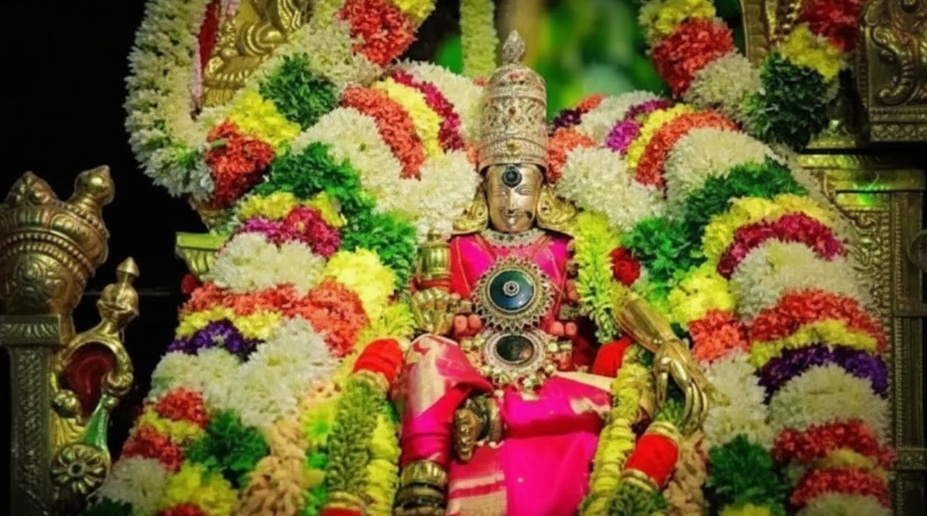
About Meenakshi Temple, Madurai, Tamil Nadu
Meenakshi Temple, also known as Sri Meenakshi Sundareswarar Temple, is dedicated to Goddess Meenakshi and Lord Sundareswarar, the Madurai forms of Parvati and Shiva. The temple stands at the centre of Madurai and has shaped the city's religious and urban identity for centuries.
The temple is known for its towering gopurams, sculpted mandapas, the Golden Lotus Tank, the Thousand Pillared Hall and the sacred marriage of Meenakshi and Sundareswarar celebrated during the Chithirai Festival. Its importance comes from the way history, temple worship, Tamil Shaiva tradition and the city's religious life remain closely connected.
Story of Meenakshi Temple
The history of the temple is closely connected with the history of Madurai. Early Tamil literature and Tevaram traditions refer to the sacred centre of the city, while inscriptions provide evidence for the development of the temple during the Pandya period. The shrine suffered major damage during the early 14th-century invasion led by Malik Kafur, after which the complex was gradually rebuilt and expanded. Much of the temple seen today took shape under the Madurai Nayaks, particularly during the 16th and 17th centuries.
The principal deities are Meenakshi, a form of Parvati, and Sundareswarar, a form of Shiva. Their shrines stand together at the centre of the complex, with Meenakshi holding the primary place in the temple's religious identity. This pairing of the goddess and Shiva is central to Madurai's temple tradition and is expressed most clearly during the annual Meenakshi Thirukalyanam, the divine marriage celebrated as part of Chithirai.
The present complex is a major example of Dravidian temple architecture. Its large enclosure contains gopurams, inner prakarams, mandapas and the Potramarai Kulam, or Golden Lotus Tank. The Ayiram Kaal Mandapam, commonly called the Thousand Pillared Hall, is known for its carved stone pillars; although called a thousand-pillared hall, it contains 985 pillars. The complex also has musical pillars, the gold-covered vimanas above the principal shrines and numerous sculpted halls associated with temple worship and festivals.
The temple's architecture is also closely tied to the city around it. Madurai's streets developed in successive concentric arrangements around the temple, making the shrine not simply one monument within the city but the centre around which the historic city was organised.
What Makes Meenakshi Temple Sacred for Devotees
The story of Meenakshi
According to the Thiruvilaiyadal Puranam tradition, the Pandya king Malayadhwaja and Queen Kanchanamalai performed a sacrificial rite seeking a child. A girl emerged from the sacred fire with three breasts. A divine announcement told the king that the unusual third breast would disappear when she met her destined husband.
The girl was raised as a royal heir and became a warrior queen. In the traditional story, she eventually travelled towards Kailasa and encountered Shiva. At that moment the third breast disappeared, revealing him as her destined husband. Shiva came to Madurai as Sundareswarar, and their marriage became one of the central traditions of the temple.
This account belongs to Tamil sacred tradition and should be understood as a religious narrative rather than a documented historical account.
Meenakshi as the presiding goddess
The name Meenakshi is traditionally interpreted as “fish-eyed”, an epithet associated with the goddess's beautiful eyes. In the religious tradition of Madurai, Meenakshi is not presented only as Shiva's consort; she is also the goddess who rules the city and occupies the principal place in the temple's devotional life.
Sundareswarar and the 64 divine acts
Madurai's religious tradition includes the Thiruvilaiyadal, the sacred acts of Shiva in the city. The temple and its surrounding traditions preserve stories of the 64 divine acts through which Sundareswarar is believed to have appeared in different forms and helped devotees, rulers and ordinary people. The Avanimoolam Festival continues this tradition through ritual presentations of these stories.
The Golden Lotus Tank
The Potramarai Kulam, or Golden Lotus Tank, is one of the best-known sacred features of the complex. According to temple tradition, the tank was associated with a golden lotus connected with Shiva worship. Another long-standing tradition links the tank with the literary culture of ancient Tamil Nadu and the testing of poetic works.
These accounts are part of the religious and literary traditions surrounding the temple rather than archaeological explanations for the tank's origin.
Nataraja at Velli Ambalam
The temple also contains the Velli Ambalam, or Silver Hall, associated with Nataraja, the dancing form of Shiva. The image is traditionally noted for its unusual dancing posture, with the right leg raised. According to temple tradition, Shiva adopted this variation in response to a request from the Pandya king.
Meenakshi and the sacred marriage
The marriage of Meenakshi and Sundareswarar is not simply a story associated with the temple. It forms part of the living ritual calendar of Madurai. The Meenakshi Thirukalyanam is celebrated during Chithirai and remains one of the principal annual events associated with the shrine.
Annual Festivals & Rituals at Meenakshi Temple, Madurai, Tamil Nadu
Daily Poojas Celebrations at the Temple
The temple follows a daily sequence of worship beginning in the morning and continuing through evening and night rituals. The present temple schedule lists six principal pooja periods, including the early morning Thiruvanandal Pooja, Vilaa Pooja, Kalasandhi Pooja, evening Pooja, Arthajama Pooja and the night Palliyarai Pooja.
Chithirai Festival Celebrations at the Temple
The Chithirai Festival is the temple's best-known annual celebration. It centres on the divine marriage of Meenakshi and Sundareswarar and includes major processions and rituals through Madurai. The festival also includes the tradition of Alagar, the form of Vishnu associated with Azhagar Kovil, coming towards Madurai for the celebration.
Festival of the Cradle Celebrations at the Temple
During the Festival of the Cradle, the images of Meenakshi and Sundareswarar are taken to a mirror chamber and placed on a swing for nine days. The observance is part of the temple's annual cycle of ceremonial worship.
Avanimoolam Festival Celebrations at the Temple
The Avanimoolam Festival celebrates the coronation of Sundareswarar and recalls stories of Shiva's 64 divine acts in Madurai. Ritual performances during the festival bring these traditional accounts into the temple's living calendar.
Navarathri Celebrations at the Temple
During Navarathri, Meenakshi is presented in different forms across nine days. The Kolu Mandapam becomes an important part of the celebration, with the goddess receiving special decoration and worship throughout the festival.
Float Festival Celebrations at the Temple
The Float Festival is associated with the large Vandiyur Mariamman Teppakulam and the ceremonial movement of the festival images across the water. It forms part of Madurai's wider temple festival tradition connected with the Meenakshi-Sundareswarar temple.
Sacred Places to Visit Near Meenakshi Temple
Thirumalai Nayak Palace : Thirumalai Nayak Palace is closely associated with the Nayak period that also shaped the present Meenakshi Temple complex. Its large ceremonial halls and surviving palace structures provide context for Madurai's 17th-century history.
Koodal Azhagar Temple : Koodal Azhagar Temple is a prominent Vaishnava shrine in central Madurai, dedicated to Lord Vishnu. It offers a different but closely related perspective on the city's longstanding temple traditions.
Vandiyur Mariamman Teppakulam : Vandiyur Mariamman Teppakulam is a large temple tank associated with the Float Festival. The festival images of Meenakshi and Sundareswarar are traditionally taken to the tank as part of the annual celebration.
Thirupparankundram Murugan Temple : Thirupparankundram Murugan Temple is one of the six major abodes of Lord Murugan in Tamil tradition. The rock-cut temple is located south of Madurai and is an important pilgrimage destination in its own right.
Azhagar Kovil : Azhagar Kovil is a Vishnu temple dedicated to Kallazhagar, located in the Alagar Hills. Its connection with the Chithirai Festival makes it particularly relevant to the religious calendar of Madurai.
Gandhi Memorial Museum : The Gandhi Memorial Museum at the historic Tamukkam Palace presents collections relating to India's freedom struggle and the life and work of Mahatma Gandhi. It is one of the principal cultural attractions in Madurai.
Plan Meenakshi Temple Darshan
For current darshan planning, queue information, date-specific timings and Naman Darshan's Guided Darshan Assistance, continue to the dedicated Meenakshi Temple Darshan page.
Common Questions About Visiting Meenakshi Temple
Visitor Information
Entry Fee
Inner shrine access follows temple rules – Follow the instructions displayed at the temple.
Darshan Timing
Address
Arulmigu Meenakshi Sundareswarar Temple, Chithirai Streets, Madurai, Tamil Nadu 625001, India, The official HR&CE temple listing identifies the temple at Chithirai Veethi, Madurai, with the temple office telephone number 0452-2344360.
Notable Events
Pandya period – The temple developed as the principal sacred centre of Madurai, with surviving inscriptions and masonry associated with the medieval Pandya period. • Early 14th century – The temple suffered major damage during the invasion led by Malik Kafur, after which the complex was rebuilt and expanded over subsequent centuries. • 16th–17th centuries – The Madurai Nayaks transformed the complex into the large temple city seen today, adding major gopurams, mandapas, sculptures and other structures. • 17th century – The temple and surrounding city reached much of their present architectural form under the Nayak rulers, including major work associated with Thirumalai Nayak. • 2009 – The temple underwent a major Maha Kumbhabhishekam, an important consecration ceremony in the temple's modern maintenance history. • 17 September 2026 – The Maha Kumbhabhishekam of Meenakshi Sundareswarar Temple was conducted following a series of preparatory rituals and district-level arrangements.
How to Reach the Temple
By air: Madurai International Airport is the nearest airport and is approximately 12 kilometres from central Madurai.
By rail: Madurai Junction is the main railway station serving the city and is well connected with major Indian cities.
By road: Madurai is connected by road with Chennai, Bengaluru, Coimbatore, Tiruchirappalli and other major cities in Tamil Nadu and neighbouring states.
Within Madurai: The temple is in the historic centre of the city. Auto-rickshaws, taxis and local public transport serve the temple area, while the immediate streets around the complex can become heavily crowded during festivals and major religious events.
Trimbak, Nashik, Maharashtra