
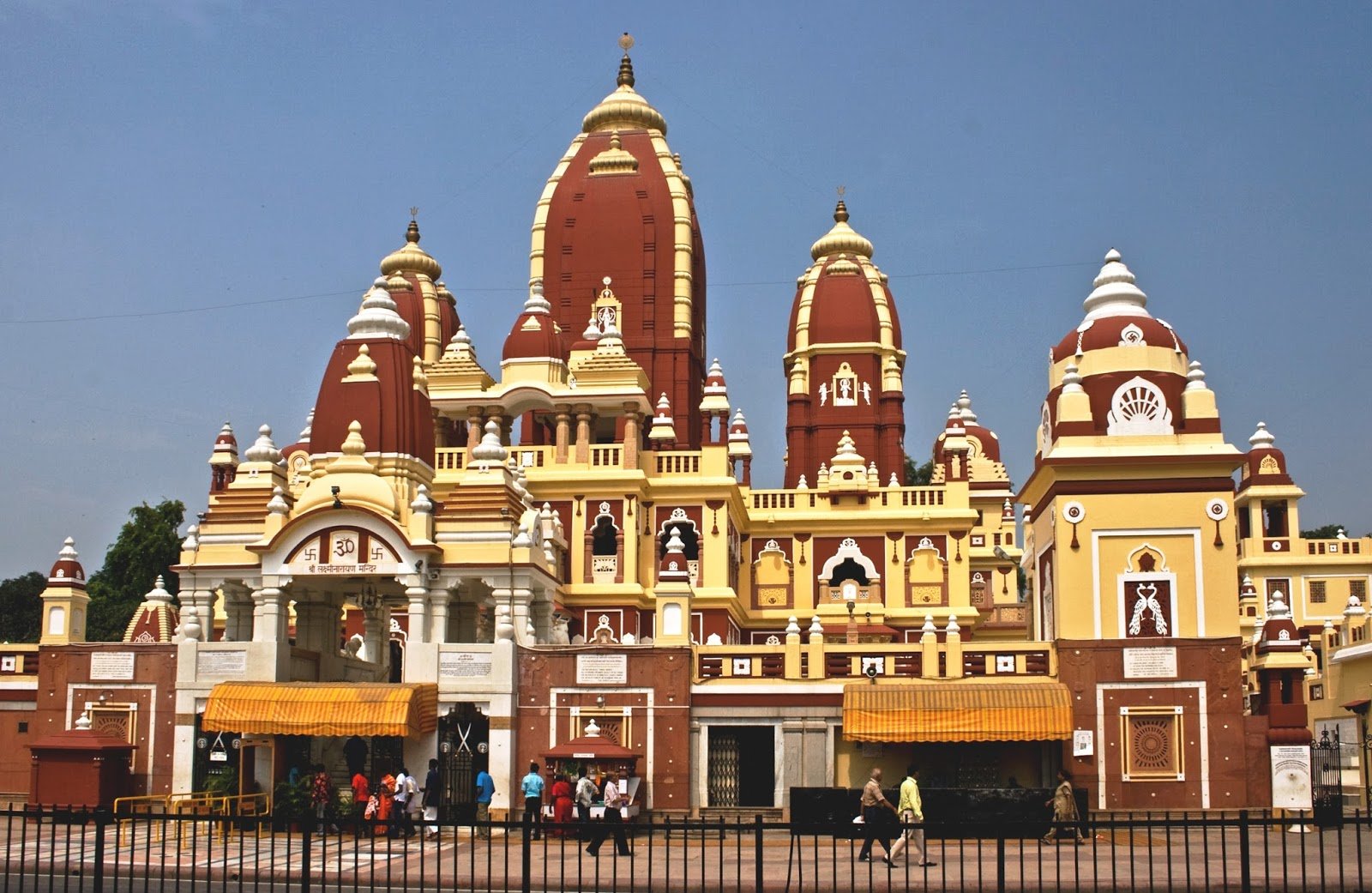
About Laxminarayan Temple, New Delhi, Delhi
Laxminarayan Temple, commonly known as Birla Mandir, is dedicated to Lord Narayan and Goddess Lakshmi. Located on Mandir Marg near Connaught Place, it was built between 1933 and 1939 by the Birla family and became one of the best-known modern Hindu temples in Delhi.
The temple is closely associated with Mahatma Gandhi, who inaugurated it in 1939 on the condition that people of all castes would be allowed to enter. The complex is also known for its Nagara-style shikharas, several associated shrines, Geeta Bhawan and the festivals of Janmashtami and Diwali.
Story of Laxminarayan Temple
The construction of Laxminarayan Temple began in 1933. It was built by Baldeo Das Birla and his son Jugal Kishore Birla, with the foundation stone laid by Maharaja Udaybhanu Singh. Pandit Vishwanath Shastri guided the temple's construction, while the concluding yagna was performed by Swami Keshavanandji.
The temple was completed in 1939 and was inaugurated by Mahatma Gandhi. Gandhi agreed to open the temple on the condition that people of all castes would be allowed entry. This became an important part of the temple's modern history and remains closely associated with its identity as a public place of worship.
The main shrine is dedicated to Laxminarayan, the combined worship of Vishnu as Narayan and Goddess Lakshmi. Other shrines within the complex are dedicated to deities including Shiva, Durga, Ganesha, Hanuman and Buddha. Geeta Bhawan, associated with Lord Krishna, forms another important part of the wider complex.
The temple follows the northern Nagara tradition, with a three-storeyed east-facing structure raised on a high plinth and marked by tall shikharas. Sris Chandra Chatterjee is identified as its principal architect, and more than one hundred artisans from Varanasi were involved in the work. Carved surfaces, marble and stone detailing, scriptural images and the landscaped surroundings give the complex the character of a planned modern temple rather than an isolated shrine.
What Makes Laxminarayan Temple Sacred for Devotees
Laxminarayan refers to Vishnu in his form as Narayan together with Goddess Lakshmi. In Hindu tradition, Narayan is associated with the preservation and sustaining order of the universe, while Lakshmi is associated with prosperity and abundance. Their joint worship is therefore central to the identity of the temple.
The temple's importance is also connected with the idea of the public temple. Built in late colonial Delhi, it was intended as a large place of worship accessible to a wider Hindu public, and its inauguration by Gandhi gave that principle a distinct place in its history.
The temple complex brings together several forms of Hindu worship. Alongside the central Laxminarayan shrine are temples and spaces associated with Shiva, Durga, Ganesha, Hanuman, Buddha and Krishna. Geeta Bhawan and the scriptural and devotional imagery of the complex add another layer to its religious setting.
The temple is therefore known not only for its principal deity but also for the way worship, religious teaching, sculpture, inscriptions and public gathering are brought together within one complex.
Annual Festivals & Rituals at Laxminarayan Temple, New Delhi, Delhi
Daily Worship and Aarti Celebrations at the Temple
Daily worship at Laxminarayan Temple includes regular puja and aarti. The temple's published visitor information specifically notes morning and evening aarti as important times in the daily cycle.
Janmashtami Celebrations at the Temple
Janmashtami is one of the major festivals observed at Birla Mandir. The celebration is associated with the birth of Lord Krishna, with special worship and devotional activity at the temple and Geeta Bhawan.
Diwali Celebrations at the Temple
Diwali is another major festival at Laxminarayan Temple. The temple becomes part of Delhi's wider Diwali observances, with special worship and increased devotional activity.
Holi Celebrations at the Temple
Holi is also celebrated at the temple as part of the annual Hindu festival calendar. The observance reflects the temple's connection with Krishna traditions as well as the wider festival culture of Delhi.
Ram Navami Celebrations at the Temple
Ram Navami marks the birth of Lord Rama and is observed with special prayers and worship at the temple.
Navratri and Durga Puja Celebrations at the Temple
Navratri and Durga Puja are observed in the temple complex, particularly through the worship of Goddess Durga and the wider Shakta traditions represented within the complex.
Vishnu-Lakshmi Traditions Celebrations at the Temple
As a temple dedicated to Laxminarayan, worship connected with Vishnu and Lakshmi remains central throughout the year. Special observances may vary according to the temple's religious calendar.
Sacred Places to Visit Near Laxminarayan Temple
New Delhi Kali Bari : New Delhi Kali Bari is a major Kali shrine on Mandir Marg, close to Laxminarayan Temple. It is also an important centre for Bengali religious and cultural traditions in the capital.
Hanuman Mandir, Connaught Place : Hanuman Mandir near Connaught Place is one of Delhi's well-known Hanuman shrines and is traditionally associated with the old temple landscape around the central city.
Gurdwara Bangla Sahib : Gurdwara Bangla Sahib is a prominent Sikh place of worship near Connaught Place. Its association with Guru Har Krishan and its sacred sarovar make it an important religious landmark in central Delhi.
Jantar Mantar : Jantar Mantar is one of Delhi's historic astronomical observatories. Built in the 18th century, it forms part of the historic city landscape around Connaught Place.
Connaught Place : Connaught Place is one of central Delhi's principal commercial and urban districts. Its location around Laxminarayan Temple makes it a natural part of a wider visit to the area.
India Gate : India Gate is one of New Delhi's best-known landmarks and can be included in a wider central Delhi itinerary after visiting the temple.
Plan Laxminarayan Temple Darshan
For current darshan planning, date-specific timings and Naman Darshan's Guided Darshan Assistance, continue to the dedicated Laxminarayan Temple Darshan page.
Common Questions About Visiting Laxminarayan Temple
Visitor Information
Entry Fee
Free – General entry is free; any separate service should not be treated as temple entry.
Darshan Timing
Address
Laxminarayan Temple (Birla Mandir), Mandir Marg, Near Gole Market, New Delhi, Delhi 110001, India
Notable Events
1933 — Construction begins – Construction of the Laxminarayan Temple begins under the patronage of the Birla family. • 1933 — Foundation stone laid – Maharaja Udaybhanu Singh lays the foundation stone. • 1933–1939 — Temple construction – The temple is built under the guidance of Pandit Vishwanath Shastri, with architect Sris Chandra Chatterjee associated with the design. • 1939 — Temple completed and inaugurated – The temple is completed and inaugurated by Mahatma Gandhi. Its open-entry principle for people of all castes becomes an important part of its modern history. • 1939 — First major Birla temple in the series – Laxminarayan Temple becomes the first of the major temples subsequently built by the Birla family in different Indian cities. • Present day — Living temple and heritage structure – The temple continues to function as a place of worship while remaining one of the recognised built-heritage landmarks of New Delhi.
How to Reach the Temple
By Metro: Ramakrishna Ashram Marg Metro Station is the nearest metro station listed by Delhi Tourism. From the station, continue toward Mandir Marg by local transport or on foot.
By Rail: New Delhi Railway Station is the main railway station serving the area. The temple can be reached from the station by taxi, auto-rickshaw or Metro with the final road connection toward Mandir Marg.
By Air: Indira Gandhi International Airport is the main airport serving Delhi. The temple is connected to the airport by road and public transport.
By Road: Laxminarayan Temple is on Mandir Marg near Gole Market and Connaught Place. Taxis, auto-rickshaws and other local transport services provide access from different parts of Delhi.
Within the area: The final approach is through a busy central Delhi neighbourhood. Festival days may bring additional traffic and crowd-control measures around the temple.
SEO Title
Ramanathaswamy Temple: History, Jyotirlinga & Guide
Meta Description
Explore Ramanathaswamy Temple in Rameswaram, its history, Shiva Jyotirlinga, Ramalingam, 22 Theerthams, rituals, festivals and visitor information.
Rameswaram, Tamil Nadu