
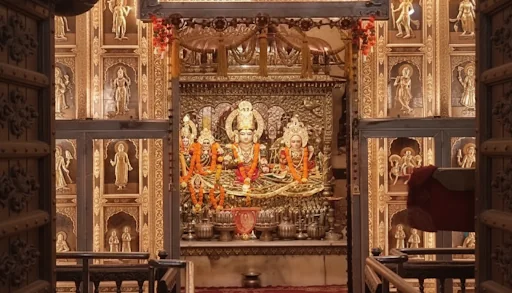
About Kanak Bhawan, Ayodhya, Uttar Pradesh
Kanak Bhawan is a temple in Ayodhya dedicated to Lord Rama and Devi Sita. It stands in the Ramkot area, to the north-east of the Ram Janmabhoomi complex, and is traditionally regarded as the private palace of Sita and Rama.
The temple is known for its three pairs of Sita-Rama deities, their gold crowns and ornaments, and the palace-like character of the present structure. The name Kanak Bhawan, meaning “Golden House” or “Golden Palace”, reflects the traditional association of the temple with the royal home of the divine couple.
Story of Kanak Bhawan
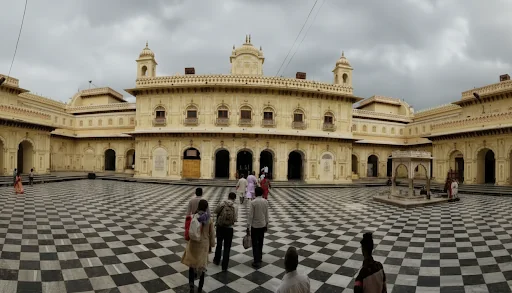
The sacred history of Kanak Bhawan begins, according to Ramayana tradition, with Queen Kaikeyi gifting a palace to Sita after her marriage to Lord Rama. The Ayodhya District administration also records this as the traditional origin of the shrine. Accounts of the site's later reconstruction vary, with temple tradition associating it with King Vikramaditya and other rulers. These older accounts belong to the religious history of Ayodhya and should not be treated as a continuous archaeological record.
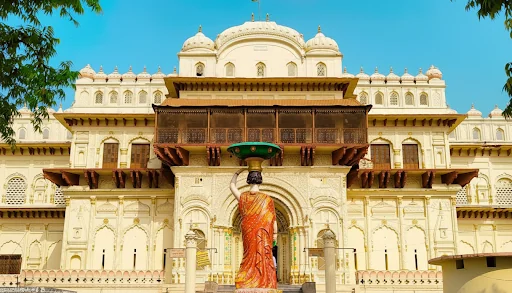
The present temple is associated with the reconstruction carried out by Maharani Vrish Bhanu Kunwari of Tikamgarh under the patronage of Maharaja Pratap Singh Ju Deo. The structure was completed and consecrated in 1891, giving Kanak Bhawan the form that largely defines the temple today. Government sources place the present shrine within the architectural traditions of Bundelkhand and Rajasthan.
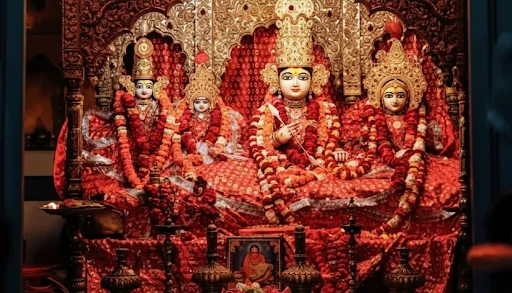
The sanctum contains three pairs of Lord Rama and Devi Sita. The largest pair is traditionally associated with Maharani Vrish Bhanu Kunwari. A second, medium-sized pair is traditionally linked with King Vikramaditya, while the smallest pair is associated in temple tradition with Lord Krishna and a woman ascetic who worshipped Rama at the site. All three pairs are enshrined and worshipped in the present temple.
Kanak Bhawan was conceived more like a royal residence than a conventional temple building. Its Bundela-style design has a broad central hall, arched openings and an inner courtyard, with the sanctum at the heart of the complex. The palace-like arrangement, together with the crowned Sita-Rama deities beneath the silver canopy, gives the temple its distinctive royal-darbar character.
What Makes Kanak Bhawan Sacred for Devotees
The traditional gift from Kaikeyi
According to the traditional account associated with Kanak Bhawan, Queen Kaikeyi presented the palace to Sita after her marriage to Rama. The story gives the temple a different place within Ayodhya's Ramayana landscape: it is remembered not as a battlefield or royal court, but as the home of Sita and Rama.
This tradition is preserved in government descriptions of the temple and remains central to its religious identity. It should be understood as a sacred tradition rather than as a documented architectural history of the original palace.
Sita-Rama as the royal couple
The central devotional focus of Kanak Bhawan is Sita-Rama together, worshipped as the divine couple. Devotional traditions associated with the temple refer to them as Jugal Sarkar, giving the shrine a strong Vaishnava and Sita-Rama bhakti character.
The palace setting reinforces this form of worship. Rama is approached here in his household and royal form with Sita beside him, rather than only through the heroic episodes of the Ramayana.
The three pairs of deities
The presence of three pairs of Sita-Rama images is one of Kanak Bhawan's distinctive traditions. Their different sizes and traditional associations preserve the layered history of the shrine as it is remembered through temple accounts.
The stories connected with Vikramaditya and the smallest pair attributed to Krishna belong to this traditional history. They are best presented as religious accounts rather than as independently established historical events.
Kanak Bhawan and Ayodhya's devotional tradition
Kanak Bhawan forms part of the wider Sita-Rama pilgrimage tradition of Ayodhya. Its worship, festivals and devotional music are centred on the daily life of the divine couple, while the surrounding city connects the shrine with other Ramayana-related temples, ghats and sacred places.
Annual Festivals & Rituals at Kanak Bhawan, Ayodhya, Uttar Pradesh
Daily worship Celebrations at the Temple
Daily worship at Kanak Bhawan follows a regular cycle of Raga, Shringar and Bhog, with darshan arranged around the temple's worship schedule. Ritual details and public access can vary according to the day's observances.
Ram Navami Celebrations at the Temple
Ram Navami marks the birth of Lord Rama and is one of the principal celebrations associated with Kanak Bhawan. Special worship and devotional programmes draw larger numbers of devotees than an ordinary day.
Janaki Navami Celebrations at the Temple
Janaki Navami marks the birth of Devi Sita. The festival is especially appropriate to Kanak Bhawan because the shrine's worship centres on Sita together with Rama.
Phool Bangla Celebrations at the Temple
During Phool Bangla, the deities and temple spaces are decorated with flowers. The floral decoration is one of the temple's distinctive seasonal observances.
Jhula Festival Celebrations at the Temple
The Jhula, or Swing Festival, is observed during the monsoon season. A silver swing is installed in the main hall and the deities are brought out according to the temple tradition. The observance continues for about fifteen days, with a procession associated with the opening day.
Sharad Purnima Celebrations at the Temple
On Sharad Purnima, a special darshan is traditionally held in the inner courtyard under the full moon. It is one of the annual observances specifically described in the Uttar Pradesh government's Kanak Bhawan account.
Holi Celebrations at the Temple
Holi is also observed at Kanak Bhawan, with a special darshan in the main hall and the traditional offering of colours to the deities.
Sacred Places to Visit Near Kanak Bhawan
Shri Ram Janmabhoomi : The Ram Janmabhoomi temple complex is one of the central pilgrimage sites of modern Ayodhya and lies within the same historic pilgrimage zone as Kanak Bhawan.
Hanuman Garhi : Hanuman Garhi is one of Ayodhya's principal Hanuman shrines. The district administration describes it as a historic religious site associated with Hanuman's presence as the guardian of Ayodhya.
Ram Ki Paidi : Ram Ki Paidi is a series of ghats on the bank of the Sarayu. It forms part of Ayodhya's riverfront pilgrimage landscape and is traditionally associated with ritual bathing.
Nageshwar Nath Temple : Nageshwar Nath Temple stands at Ram Ki Paidi and is dedicated to Lord Shiva. The district administration records the traditional association of the temple with Kush, the son of Rama, while the present structure dates to the 18th century.
Sita Ki Rasoi : Sita Ki Rasoi is another sacred site associated with Sita's household life in Ayodhya. It complements the domestic and family-centred devotional theme associated with Kanak Bhawan.
Plan Kanak Bhawan Darshan
For current darshan timings, entry planning and Naman Darshan's date-specific Guided Darshan Assistance, continue to the dedicated Kanak Bhawan Darshan page.
Common Questions About Visiting Kanak Bhawan
Visitor Information
Entry Fee
Generally free – Confirm any temporary arrangements locally.
Darshan Timing
Address
Kanak Bhawan Temple, Tulsi Nagar, Ayodhya, Uttar Pradesh – 224123, India
Notable Events
Treta Yuga — Traditional origin – According to temple tradition, Queen Kaikeyi gifted a palace to Sita after her marriage to Lord Rama. This account forms the sacred foundation of Kanak Bhawan's identity. • Vikramaditya period — Traditional reconstruction – Temple tradition credits King Vikramaditya with restoring the sacred site during an earlier period of Ayodhya's revival. The associated history belongs to traditional accounts rather than a continuous archaeological record. • Samudragupta period — Traditional renovation account – The Uttar Pradesh government's published history also records a renovation under Samudragupta. This chronology is part of the traditional history presented for the temple. • 1891 — Present structure completed – Maharani Vrish Bhanu Kunwari, under the patronage of Maharaja Pratap Singh Ju Deo, reconstructed and consecrated the temple in the form that exists today. • Modern Ayodhya — Continued pilgrimage importance – Kanak Bhawan remains listed by the Ayodhya district administration as a historic and religious place of interest and continues to form part of the city's principal Sita-Rama pilgrimage circuit.
How to Reach the Temple
By Air: Maharishi Valmiki International Airport, Ayodhya, is the nearest airport serving the city. Lucknow's Chaudhary Charan Singh International Airport remains another major option for travellers reaching Ayodhya.
By Rail: Ayodhya Dham Junction is the main railway station serving the city and is well connected with major destinations. Ayodhya's other railway facilities also serve the central pilgrimage area.
By Road: Ayodhya is connected by road with Lucknow, Gorakhpur, Prayagraj, Varanasi and other major cities of Uttar Pradesh. Local taxis, e-rickshaws and other city transport can be used for the final approach to Kanak Bhawan.
Within Ayodhya: Kanak Bhawan lies in the central pilgrimage area near Ram Janmabhoomi and other major temples. The final approach can become more pedestrian-oriented during festivals and periods of heavy pilgrim movement.
Ayodhya, Uttar Pradesh