
About Kalighat Kali Temple, Kolkata, West Bengal
Kalighat Kali Temple is dedicated to Goddess Kali and is one of the major Shakta pilgrimage centres of Kolkata. The temple stands beside the Adi Ganga and is traditionally identified with a Shakti Peetha associated with the toes of Sati's right foot.
The present temple dates to the early 19th century and was completed in 1809 under the patronage of the Sabarna Roy Choudhury family. Kalighat is known for its distinctive form of Kali, the Nakuleshwar Bhairava shrine, its Shakta and Tantric traditions, Kali Puja and the sacred spaces that surround the main sanctum.
Story of Kalighat Kali Temple
The sacred history of Kalighat is older than the present temple building. References to a shrine at Kalighat occur in 15th-century and 17th-century Bengali literary traditions, including Mansar Bhasan and Kavi Kankan Chandi. The site developed beside the old course of the Ganga, now known as the Adi Ganga, and became an established pilgrimage centre before the construction of the present temple.
The temple seen today was completed in 1809 under the patronage of the Sabarna Roy Choudhury family of Barisha. The construction replaced earlier structures at a time when Calcutta was expanding around the river and its trading routes. Kalighat grew with the city, and the temple became one of its principal centres of pilgrimage.
The development of the temple complex continued through the 19th century. Kashinath Roy built the Nat Mandir in 1835, while Uday Narayan Mondal of the Bawali Raj family established the present Shyam-Rai shrine in 1843. These additions also show how different strands of Bengali Hindu worship developed within the same precinct.
Kalighat's influence extended beyond the temple itself. The busy pilgrimage quarter supported a community of artists known as patuas, whose devotional and secular paintings became known as Kalighat paintings. The style developed in 19th-century Kolkata and became an important part of the city's artistic history.
Deity and Architecture of Kalighat Kali Temple
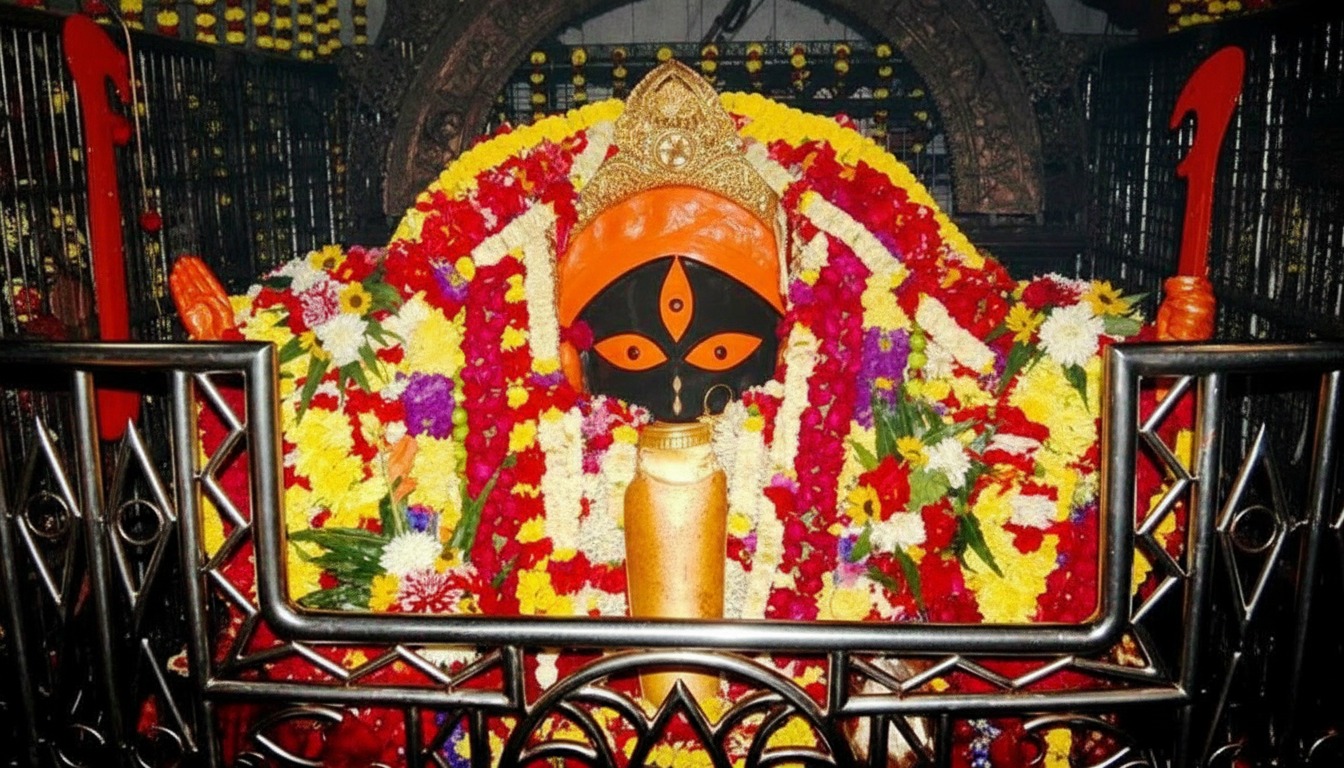
The principal deity is Goddess Kali, worshipped at Kalighat in a distinctive image with three eyes, four arms and a prominently protruding tongue. The image is traditionally described as being made from dark touchstone, with the tongue, eyes and other ornaments adorned with gold or metalwork.
The iconography is direct and recognisable. One hand holds a sword and another holds a severed head, while the remaining hands are associated with protective and granting gestures. These features belong to the traditional representation of Kali as the goddess who destroys forces of disorder while protecting her devotees.
The main temple follows the at-chala form of Bengali temple architecture. The structure developed from the roof forms of traditional Bengali dwellings and is characterised by its layered, curved roof profile. The present building also carries decorative work associated with the architectural traditions of Bengal.
The wider complex includes several spaces that are important to understanding Kalighat:
Nat Mandir, the large hall in front of the sanctum, was added in 1835 and forms an important part of the temple's ritual space.
Jor Bangla, positioned between the Nat Mandir and sanctum, forms part of the traditional arrangement around the main shrine.
Shoshti Tala, marked by three stones associated with Shashthi, Shitala and Mangal Chandi, is another sacred point within the complex.
Harkath Tala is the designated area traditionally associated with bali offerings.
Shyam-Rai Temple is the Radha-Krishna shrine established within the wider temple precinct.
Kundupukur is the sacred tank traditionally associated with the discovery story of Sati's relic.
Nakuleshwar Mahadev is the Shiva shrine traditionally identified with Kalighat's Bhairava.
The temple complex has also undergone major recent redevelopment around the historic shrine. The main sanctum was kept untouched during the wider redevelopment, while the surrounding complex, Kundupukur and pilgrim circulation areas were improved.
What Makes Kalighat Kali Temple Sacred for Devotees
Kalighat and the Shakti Peetha tradition
According to Shakta tradition, when Sati's body was divided after Shiva carried it during his grief, parts of her body fell at different sacred sites. Kalighat is traditionally associated with the toes of Sati's right foot.
Different Shakta texts and regional traditions vary in how they enumerate the Peethas and describe the body part associated with each site. Kalighat's connection with Sati's right foot should therefore be presented as a religious tradition rather than as an archaeological claim.
The Kalikunda tradition
A local tradition associates the discovery of the sacred relic with a pond known as Kalikunda, now represented by the Kundupukur tradition near the temple. Accounts identify the ascetics Atmaram Giri and Brahmananda Giri with the discovery and early worship of the sacred form.
These stories belong to the religious history of Kalighat. They explain why the site became associated with the Shakti Peetha tradition and should be understood as sacred narratives rather than independently established historical events.
Kali and Nakuleshwar
Shakta tradition links a Shakti Peetha with an accompanying form of Shiva known as its Bhairava. At Kalighat, this role is associated with Nakuleshwar Mahadev.
The presence of the Shiva shrine gives the pilgrimage site a wider Shakta structure in which Goddess and Bhairava are understood together. Nakuleshwar therefore forms part of the religious identity of Kalighat rather than being simply another shrine near the temple.
Shoshti Tala
Shoshti Tala is associated with Shashthi, Shitala and Mangal Chandi and is marked by three stones beneath a sacred tree. Worship at this smaller shrine forms part of the wider religious life of Kalighat.
The presence of these smaller sacred points is important because Kalighat is not centred only on the main image of Kali. The temple complex contains several forms of goddess worship, each with its own place and tradition.
Shakta and Tantric traditions
Kalighat has long been associated with Shakta worship and with Tantric traditions of goddess worship. Kali is worshipped here as Shakti, and the temple's rituals, offerings and sacred geography reflect the older Bengali traditions surrounding the goddess.
The temple's identity should therefore not be reduced to the modern image of a busy city temple. Its importance comes from a continuing form of goddess worship that has remained part of Kolkata's religious life for centuries.
The image of Kali
The distinctive image of Kali at Kalighat is central to the temple's identity. The three eyes, four arms, sword, severed head and protruding tongue are part of the traditional iconography through which devotees understand the goddess.
Stories about the making and discovery of the image vary. They are part of Kalighat's sacred tradition and are best presented as traditions rather than as a single documented account of the sculpture's origin.
Kalighat and the culture of Kolkata
Kalighat's religious importance also shaped the surrounding culture of the city. In the 19th century, patua artists settled around the pilgrimage centre and produced paintings for devotees and visitors. These works became known internationally as the Kalighat style.
The development of this art tradition reflects the relationship between pilgrimage and everyday life in Kolkata. Kalighat was not only a place people came to worship; it also supported an entire neighbourhood of artists, vendors, craftsmen and service communities.
Annual Festivals & Rituals at Kalighat Kali Temple, Kolkata, West Bengal
Daily worship at Kalighat Celebrations at the Temple
The temple day follows a sequence of worship, offerings and periods of public darshan. The broad visiting hours are divided between morning and evening sessions, with ritual activities taking place throughout the day. Public darshan can therefore pause or change around Bhog and other temple observances. Exact aarti and darshan timings belong to the current operational schedule and are covered separately on the Darshan page.
Snan Yatra Celebrations at the Temple
Snan Yatra is one of Kalighat's important annual observances. During the bathing ritual, the sacred image and the tradition associated with the hidden relic are treated according to established temple practice. Accounts of the ceremony describe the senior priest performing the ritual with the eyes covered. This is part of the temple's sacred tradition and is not an ordinary daily ritual.
Kali Puja Celebrations at the Temple
Kali Puja is the principal annual festival associated with Kalighat. The worship of Kali becomes especially prominent during the new-moon night of the Bengali Kartik season, when the temple attracts large numbers of devotees. Special worship, offerings and decoration take place during the festival. Visitor conditions are very different from an ordinary temple day, so current arrangements should be checked before travelling.
Durga Puja Celebrations at the Temple
Although Kalighat is dedicated to Kali, the temple also observes Durga Puja as part of Bengal's wider Shakta tradition. The festival forms part of the temple's annual religious calendar and draws increased attendance.
Poila Boishakh and Sankranti Celebrations at the Temple
Poila Boishakh, the Bengali New Year, and various Sankranti observances are important days at Kalighat. The temple becomes particularly busy as devotees visit to begin the new year or mark significant points in the Bengali calendar.
Amavasya and other lunar observances Celebrations at the Temple
Lunar observances, particularly Amavasya, are closely associated with Kali worship. Tuesdays and Saturdays are also traditionally busy days for devotees of Kali, and crowd levels can be considerably higher than on ordinary weekdays.
Sacred Places to Visit Near Kalighat Kali Temple
Nakuleshwar Mahadev Temple : Nakuleshwar Mahadev is the Shiva shrine traditionally associated with Kalighat's Shakti Peetha. It forms an important part of the wider pilgrimage associated with the goddess.
Adi Ganga : The Adi Ganga is the old river channel beside which Kalighat developed. Its relationship with the temple explains much of the site's early pilgrimage history and the meaning of the name Kalighat.
Rabindra Sarobar : Rabindra Sarobar is a large lake and open space in South Kolkata, a short distance from the temple and part of the wider cultural landscape of the area.
Birla Mandir : Birla Mandir on Ashutosh Choudhury Avenue is dedicated to Radha and Krishna and represents another major Hindu temple tradition within Kolkata.
Alipore Zoological Gardens : The Alipore Zoological Gardens is one of Kolkata's established public attractions and can be combined with a Kalighat visit when exploring South Kolkata.
Dakshineswar Kali Temple : Dakshineswar Kali Temple stands on the eastern bank of the Hooghly and is another major Kali shrine of Kolkata. Its history is closely associated with Rani Rashmoni and Sri Ramakrishna, making it a useful second destination for understanding Bengal's modern Kali tradition.
Plan Kalighat Kali Temple Darshan
For current planning guidance, darshan timings, queue information and Naman Darshan's Guided Darshan Assistance, continue to the dedicated Kalighat Kali Temple Darshan page.
Common Questions About Visiting Kalighat Kali Temple
Visitor Information
Darshan Timing
Address
Kalighat Kali Temple, Kalighat Temple Road, Kalighat, Kolkata, West Bengal 700026, India
Notable Events
1809 — Present temple completed – The present Kalighat temple was completed under the patronage of the Sabarna Roy Choudhury family. • 1835 — Nat Mandir added – The Nat Mandir was added in front of the main shrine and became an important part of the temple complex. • 1843 — Present Shyam-Rai shrine established – The Radha-Krishna shrine received its present structure within the temple precinct. • 19th century — Kalighat grows as a pilgrimage centre – With the growth of Kolkata, Kalighat developed into a major urban pilgrimage area and also influenced the city's cultural life. • Modern period — Temple precinct redevelopment – The temple and surrounding areas have seen various access, conservation and public-space improvement works.
How to Reach the Temple
By Metro: West Bengal Tourism identifies Kalighat and Jatin Das Park as the nearest metro stations. From either station, the final approach continues through the Kalighat neighbourhood to the temple.
By rail: Howrah and Sealdah are the principal railway stations serving Kolkata. From either station, continue by Metro, taxi or other local transport towards Kalighat.
By air: Netaji Subhas Chandra Bose International Airport is the main airport serving Kolkata. The temple can be reached from the airport by road.
By road: Kalighat is well connected with the rest of Kolkata by buses, taxis and private vehicles. During major festivals, traffic restrictions and pedestrian arrangements can change around the temple.
By foot from the approach roads: The Kalighat Skywalk provides a dedicated pedestrian connection towards the temple complex from the SP Mukherjee Road side and other adjoining points. The final approach remains a busy pilgrimage area with shops and pedestrian movement.
Guwahati, Assam