
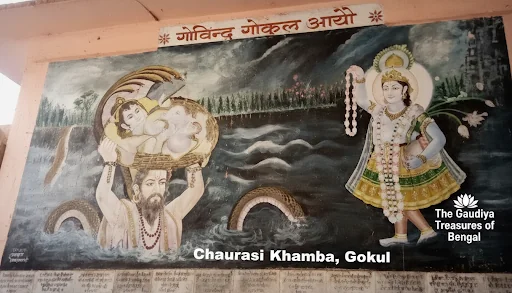
About Gokul (Chaurasi Khamba) Temple, Gokul, Uttar Pradesh
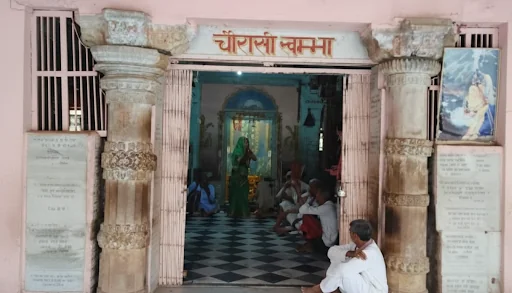
Gokul (Chaurasi Khamba) Temple, also known as Nand Bhavan, is a sacred site in Mahavan, the area traditionally identified with Old Gokul. In Braj tradition, it is regarded as the home of Nanda Maharaj and Yashoda Maiya, where Krishna and Balarama spent their early childhood.
The temple is known for its 84 stone pillars, its association with Krishna's childhood lilas, and the shrines connected with Nanda, Yashoda, Balarama and child Krishna. Its importance comes from the way the structure, the stories of Krishna's infancy and the wider sacred landscape of Gokul-Mahavan remain connected in the living Braj tradition.
Story of Gokul (Chaurasi Khamba) Temple
The history of Chaurasi Khamba is closely tied to Mahavan, which is also known in Braj tradition as Old Gokul or Brihadvan. Government sources describe Mahavan as one of the old settlements of the Gokul region, while historical and pilgrimage studies show that the names Gokul and Mahavan were not always separated in earlier traditions. Over time, present-day Gokul and Mahavan developed as neighbouring but distinct pilgrimage settlements.
The sacred identity of the place comes from the Krishna traditions associated with Gokul. According to the Bhagavata tradition, Krishna was brought from Mathura to the cowherd settlement of Nanda and Yashoda after his birth. Braj pilgrimage tradition identifies the Mahavan area with this early period of Krishna's life. The Chaurasi Khamba shrine is consequently revered as Nand Bhavan, the household of Nanda Maharaj, rather than simply as a conventional Krishna temple.
The defining feature of the present structure is its 84 stone pillars, from which the name Chaurasi Khamba comes. The hall is supported by rows of carved pillars and has a comparatively low, horizontal form rather than the tall shikhara-dominated profile seen in many later Braj temples. Paintings and devotional motifs associated with Krishna's childhood add to the character of the interior and surrounding spaces.
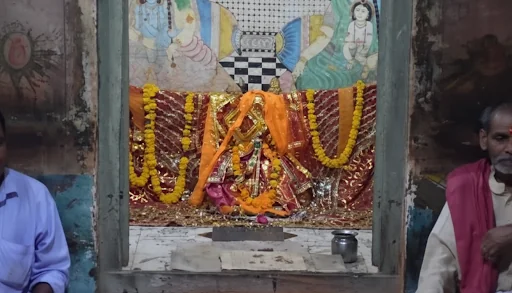
Inside, the shrine is associated with Nanda Maharaj, Yashoda Maiya, Balarama and child Krishna. A cradle associated with Bal-Krishna is also part of the traditional darshan. The number 84 carries religious interpretations in Braj tradition, including associations with the 84 lakh forms of life, but these are devotional meanings attached to the number rather than an architectural explanation for the construction of the hall.
What Makes Gokul (Chaurasi Khamba) Temple Sacred for Devotees
Krishna's arrival in Gokul
According to the Bhagavata tradition, Krishna was born to Devaki and Vasudeva in Mathura when Kansa was seeking to destroy the child foretold to be his enemy. Vasudeva carried the newborn Krishna across the Yamuna and took him to the household of Nanda and Yashoda.
This is the beginning of Gokul's place in Krishna pilgrimage. Mathura is remembered for Krishna's birth, while Gokul-Mahavan is remembered for the years of his early childhood.
Nanda Bhavan and Krishna's childhood
Braj tradition identifies Chaurasi Khamba with Nand Bhavan, the home of Nanda Maharaj. The surrounding sacred landscape is connected with the childhood stories of Krishna and Balarama, including the playful episodes for which Gokul is remembered across Vaishnava traditions.
The site is especially associated with the simple household setting of Krishna's infancy: Yashoda caring for the child, Nanda's pastoral household and the early lilas that later became central to Krishna-bhakti.
The naming ceremony of Krishna and Balarama
A long-standing pilgrimage tradition connects Nand Bhavan with the naming ceremony of Krishna and Balarama, performed by Garga Muni. The Bhagavata account places the ceremony in the cowherd settlement and describes the secrecy maintained because of Kansa's threat.
The association with Nand Bhavan has therefore become part of the sacred geography of Mahavan, even though the exact modern location of the ceremony cannot be established as a historical event from archaeology.
Putana and the childhood lilas
The Gokul-Mahavan landscape is associated with several of Krishna's early encounters with the forces sent by Kansa. These include the story of Putana, who came in the appearance of a nursing woman, and Trinavarta, the whirlwind demon.
These stories are part of the religious narratives of Krishna's infancy and are important to the identity of the Gokul pilgrimage. They are preserved in Vaishnava scriptures and later Braj traditions rather than presented here as independently verifiable historical events.
Damodara and the wooden mortar
One of the most familiar childhood traditions associated with Gokul is the Damodara lila, in which Yashoda binds Krishna with a rope to a wooden mortar after his mischief.
Mahavan preserves objects and sites that local pilgrimage traditions connect with this episode. Devotees remember the story not simply as an account of childhood mischief, but as a central Krishna-bhakti theme in which the divine child accepts the loving authority of his mother.
The 84 pillars
The name Chaurasi Khamba literally means “eighty-four pillars.” The number has acquired additional religious meanings in Braj tradition. Some traditions associate 84 with the 84 lakh forms of life through which a soul is believed to pass, while the wider Braj pilgrimage also revolves around the 84-kos parikrama.
These meanings belong to religious tradition. They should be understood as devotional symbolism rather than as evidence that the building was mathematically designed to represent a particular cosmological calculation.
Gokul, Mahavan and the Vaishnava traditions
The religious importance of Gokul grew again during the revival of Braj pilgrimage in the late medieval period. Vallabhacharya and later Vitthalnath played an important role in establishing Gokul as a major centre of the Pushtimarg tradition.
Historical studies of Braj record the renewed identification and development of Gokul during the 16th century. This later Vaishnava history is an important part of understanding why Gokul became a major pilgrimage centre in addition to its older association with Krishna's childhood.
Annual Festivals & Rituals at Gokul (Chaurasi Khamba) Temple, Gokul, Uttar Pradesh
Daily Worship and Darshan Celebrations at the Temple
The temple follows the household-oriented devotional character common to Braj worship, with the deities served through offerings, shringar and darshan during the day. Public access is organised around the temple's daily worship rather than treated as one uninterrupted ritual period. Exact timings can change, particularly during festivals and special observances.
Krishna Janmashtami Celebrations at the Temple
Janmashtami marks the birth of Lord Krishna and is one of the principal festivals of the Gokul-Mahavan region. Devotional singing, midnight worship and special decoration are followed by celebrations associated with the joy of Krishna's arrival.
Nandotsav Celebrations at the Temple
The day after Janmashtami is celebrated as Nandotsav, recalling Nanda Maharaj's joy at the birth of Krishna. In Gokul, the festival has a particularly strong local identity, with devotional singing, offerings and traditional celebrations centred on the childhood form of Krishna.
Chhadimar Holi Celebrations at the Temple
Holi in Gokul has its own local tradition. During Chhadimar Holi, a decorated dol or procession carrying Thakurji begins from Nand Bhavan and moves through the Gokul area, accompanied by devotional music, flowers and the traditional colours of Braj.
Annakut and Govardhan Puja Celebrations at the Temple
Annakut is observed across Braj in connection with Krishna's Govardhan tradition. The festival forms part of the wider annual Vaishnava calendar followed in Gokul and neighbouring pilgrimage centres.
Other Vaishnava Observances Celebrations at the Temple
Seasonal shringar, jhankis, special bhog and other Vaishnava observances continue through the year. Festival arrangements vary according to the local temple tradition and the Braj religious calendar.
Sacred Places to Visit Near Gokul (Chaurasi Khamba) Temple
Gokulnath Ji Temple : Gokulnath Ji Temple is one of the important Vaishnava shrines of Gokul and is closely connected with the Pushtimarg tradition. Together with the Nand Bhavan area, it helps explain the later religious development of Gokul.
Raman Reti : Raman Reti is associated in Braj tradition with the sandy ground where Krishna and Balarama played with the cowherd boys. The Mathura district administration also identifies the site as an important Gokul pilgrimage destination.
Brahmand Ghat : Brahmand Ghat is associated with the story in which Yashoda sees the universe within Krishna's mouth after he is said to have eaten mud while playing. It forms one of the central childhood-Krishna sites in the Gokul-Mahavan circuit.
Thakurani Ghat : Thakurani Ghat is an important Vaishnava pilgrimage site in Gokul and is associated with Vallabhacharya and his worship of Yamuna Maharani. The ghat forms part of the later devotional history of Gokul.
Chintaharan Mahadev : Chintaharan Mahadev is a Shiva shrine in the Gokul area. Local tradition associates the shrine with Yashoda's prayers for Krishna's protection, linking Shiva worship with the childhood traditions of Gokul.
Raskhan Samadhi : The samadhi of Raskhan, the celebrated Krishna-devotee and poet, is associated with the wider Mahavan-Gokul pilgrimage landscape. It adds a later layer of Braj devotional literature to the area's older Krishna traditions.
Plan Gokul (Chaurasi Khamba) Darshan
For current planning guidance, darshan timings and Naman Darshan's Guided Darshan Assistance, continue to the dedicated Gokul Darshan page.
Common Questions About Visiting Gokul (Chaurasi Khamba) Temple
Visitor Information
Entry Fee
Current visitor sources generally list free entry – Temple arrangements can change during special events.
Darshan Timing
Address
Chaurasi Khamba / Nand Bhavan, Mahavan, near Gokul, Mathura District, Uttar Pradesh, India, Current third-party listings place the shrine in the Mahavan (Old Gokul) area; postcode listings vary between local directories, so the exact location should be confirmed through the map or local directions before travel.
Notable Events
1017 CE — Mahavan enters recorded medieval history – Historical accounts record the sack of Mahaban by Mahmud of Ghazni during his campaign against Mathura. This is an event in the history of Mahaban as a settlement and should not be treated as proof of the date or destruction history of the present Chaurasi Khamba structure. • 1150 CE — Medieval Mahaban inscription – An inscription from Mahaban dated to 1150 CE refers to Ajaypal of a Yadava lineage. It provides evidence for the medieval history of the settlement, although it does not establish the construction date of the present 84-pillared shrine. • 16th century — Gokul's Vaishnava revival – Gokul and Mahavan re-entered wider Braj pilgrimage history during the revival associated with Vallabhacharya and other Vaishnava teachers. The later development of Gokul as a Pushtimarg centre gave the area an important place in early modern Krishna devotion. • 16th–17th centuries — Growth of the Pushtimarg centre – Vitthalnath expanded the religious importance of Gokul and established it as a major centre of the Pushtimarg tradition. Historical sources also record Mughal-era patronage and grants connected with the community in Gokul. • 19th century — Nand Bhavan documented in historical literature – 19th-century antiquarian writing records Nand Bhavan at Mahaban, showing that the shrine was already recognised as part of the area's sacred landscape by that period. • Present day — Part of the Braj pilgrimage circuit – Gokul and Mahavan continue to form part of the Mathura district's Braj pilgrimage geography, including the wider Braj Chaurasi Kos Parikrama. The district administration also places Gokul, Mahavan, Raman Reti and Brahmand Ghat within its tourism and pilgrimage circuits.
How to Reach the Temple
By air: For air travel, the nearest major airports used for Mathura are Kheria Airport in Agra and Indira Gandhi International Airport in Delhi. The Mathura district administration lists them at approximately 46 km and 136 km from Mathura respectively.
By rail: The main railheads are Mathura Junction and Mathura Cantt. From Mathura, continue by road toward Gokul and Mahavan.
By road: Mathura is connected to the wider region by road, with local buses, taxis, autos and other transport available for the Gokul-Mahavan side. The Chaurasi Khamba shrine is reached through the local lanes of Mahavan.
Within Gokul-Mahavan: Gokul, Mahavan, Raman Reti and the major ghats are close enough to be covered as a single pilgrimage circuit. Local transport can take you between the major points, while the final approach to some shrines is on foot.
Nandgaon, Mathura, Uttar Pradesh