
About Brihadeeswarar Temple, Thanjavur, Tamil Nadu
Brihadeeswarar Temple, also known as Peruvudaiyar Kovil or the Big Temple, is a Shaivite temple in Thanjavur built under Chola emperor Rajaraja Chola I. It is one of the three temples that form the UNESCO-listed Great Living Chola Temples.
The temple is dedicated to Lord Shiva, worshipped here as Brihadeeswarar in the form of a large Shiva Linga. Its towering vimana, monolithic Nandi, Chola inscriptions, sculptures and surviving mural paintings are part of the same temple complex where worship continues today.
Story of Brihadeeswarar Temple
The present Brihadeeswarar Temple was built under Rajaraja Chola I between about 1003 and 1010 CE, when Thanjavur was the Chola capital. Inscriptions refer to the temple as Rajarejesvaram, and the temple became an important centre of royal Shaiva worship. UNESCO records that construction was begun around Rajaraja's 19th regnal year and that the temple was consecrated in his 25th regnal year.
The inscriptions are an important part of the temple's historical record. They describe gifts, lands, lamps, offerings, temple personnel and other aspects of administration and religious life. They show that the temple was not only a place of worship but also a major institution supported by the Chola state and its people.
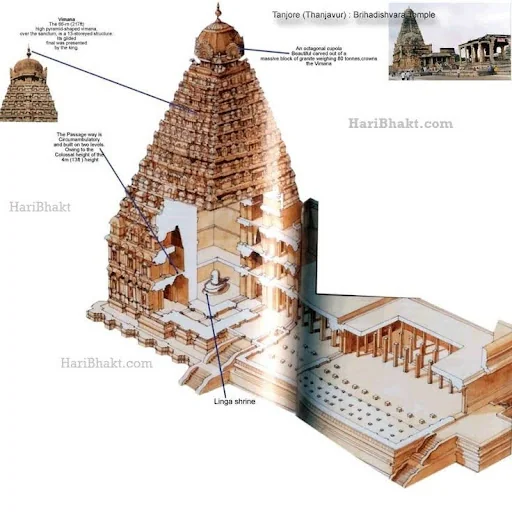
The main shrine follows the Dravida tradition of South Indian temple architecture. The sanctum is enclosed within a large rectangular complex, with mandapas, gateways and a circumambulatory passage around the shrine. The central Sri Vimana rises to about 59.82 metres and is arranged in 13 receding levels or talas, ending in an octagonal shikhara. In front of the temple stands the large monolithic image of Nandi.
The walls and halls carry sculptures, inscriptions and paintings that record the artistic world of the Chola period. Around the sanctum, 81 of the 108 karanas of classical Indian dance are carved in stone. The inner ambulatory also preserves important mural paintings, while the temple complex contains later additions, including the Amman shrine. The temple remains in active worship and is protected as part of the Great Living Chola Temples.
What Makes Brihadeeswarar Temple Sacred for Devotees
Brihadeeswarar and Peruvudaiyar
The principal deity is Lord Shiva, worshipped as Brihadeeswarar, also known as Peruvudaiyar. The deity is represented by a large Shiva Linga in the sanctum, and daily worship follows the temple's Shaiva ritual tradition.
Dakshina Meru
The temple is known in its inscriptions as Dakshina Meru, or the Meru of the South. The name is connected with the traditional understanding of the temple as a sacred architectural representation associated with Mount Meru and the cosmic order. This is a religious and architectural interpretation, not a scientific description.
Shaiva Tradition and the Nayanmars
Brihadeeswarar Temple has a strong Shaiva identity. The temple complex includes sculptural and inscriptional references connected with Shaiva saints, including the 63 Nayanmars, reflecting the place of Tamil Shaivism in Chola religious culture.
Periyanayaki Amman
The temple complex also includes a shrine for the Goddess, known as Periyanayaki Amman. UNESCO dates the Amman shrine to around the 13th century, showing how the temple complex developed over time while retaining the central Shiva shrine as its focus.
A Living Chola Temple
The significance of Brihadeeswarar is not limited to the structure built in the Chola period. Worship, ritual observances and temple festivals continue within the historic complex. This continuing use is central to its identity as a Great Living Chola Temple.
Annual Festivals & Rituals at Brihadeeswarar Temple, Thanjavur, Tamil Nadu
The temple follows a regular Shaiva worship cycle through the day, with offerings and pujas performed at established intervals. Exact timings can vary with temple schedules and special observances.
Maha Shivaratri Celebrations at the Temple
Maha Shivaratri is one of the major annual observances at the temple. Special worship of Lord Shiva takes place through the festival, with larger numbers of devotees visiting the temple.
Chithirai Festival Celebrations at the Temple
The annual Chithirai Festival is an important festival in Thanjavur. It includes special worship and traditional processions and can affect normal visitor movement around the temple.
Sathaya Vizha Celebrations at the Temple
Sathaya Vizha is associated with Rajaraja Chola I and is observed in connection with his birth star. The occasion combines temple observances with cultural programmes that remember the Chola ruler who commissioned the temple.
Pradosham Celebrations at the Temple
Pradosham is a recurring Shaiva observance held twice in the lunar month. Special worship takes place on Pradosham days, and visitor numbers may be higher than on an ordinary day.
Sacred Places to Visit Near Brihadeeswarar Temple
Thanjavur Palace : The Thanjavur Palace complex reflects the later Nayak and Maratha history of the city. Its museums, galleries and historic buildings complement a visit to the Chola temple.
Saraswathi Mahal Library : Located within the palace complex, the Saraswathi Mahal Library is known for its historic manuscripts and collections connected with the intellectual history of Thanjavur.
Thanjavur Art Gallery : The Art Gallery houses important examples of Chola-period and later South Indian sculpture, including bronze images and stone works.
Gangaikonda Cholapuram : The Brihadisvara Temple at Gangaikonda Cholapuram, built by Rajendra Chola I, is one of the three Great Living Chola Temples. It provides a useful comparison with the earlier temple at Thanjavur.
Airavatesvara Temple, Darasuram : The Airavatesvara Temple at Darasuram is the third member of the Great Living Chola Temples group. It was built under Rajaraja II and is known for its detailed stone architecture and sculpture.
Punnainallur Mariamman Temple : Punnainallur Mariamman Temple is a well-known goddess temple near Thanjavur and forms part of the city's wider pilgrimage landscape.
Plan Brihadeeswarar Temple Darshan
For current darshan planning, queue guidance and Naman Darshan's Guided Darshan Assistance, continue to the dedicated Brihadeeswarar Temple Darshan page.
Common Questions About Visiting Brihadeeswarar Temple
Visitor Information
Entry Fee
Ordinary temple entry does not require a separate admission ticket – Special worship or other services are separate from general entry.
Darshan Timing
Address
Arulmigu Brihadeeswarar Temple / Sri Peruvudaiyar Temple, Thanjavur, Tamil Nadu 613001, India
Notable Events
1003-1004 CE - Construction begins – Rajaraja Chola I inaugurated the construction of the great temple at Thanjavur during the later part of his reign. • 1009-1010 CE - Temple consecrated – The temple was completed and consecrated during Rajaraja Chola I's reign. It became one of the major Shaiva institutions of the Chola capital. • Later medieval periods - Temple complex develops – The temple continued to be used and altered by later rulers. Additional shrines, structures and works were added to the complex over time while the main Chola temple remained its centre. • 1987 - UNESCO World Heritage inscription – Brihadisvara Temple at Thanjavur was inscribed on the UNESCO World Heritage List. • 2004 - Great Living Chola Temples expanded – The UNESCO property was extended to include the Brihadisvara Temple at Gangaikondacholapuram and the Airavatesvara Temple at Darasuram, creating the present Great Living Chola Temples group. • 2010 - Millennium of the temple – The temple and the city marked approximately one thousand years of its Chola foundation, bringing renewed attention to its history and cultural importance. • 27 January 2025 - Maha Kumbhabhishekam – A Maha Kumbhabhishekam was held at the temple in January 2025 after a gap of more than two decades. The occasion involved traditional Vedic and Tamil liturgical observances and temporarily changed normal temple arrangements.
How to Reach the Temple
By air: Tiruchirappalli International Airport is the nearest major airport serving Thanjavur. The journey from the airport continues by road.
By rail: Thanjavur Railway Station is the nearest railway station and provides connections to major cities in Tamil Nadu and other parts of India.
By road: Thanjavur is connected by road with Tiruchirappalli, Kumbakonam, Chennai, Madurai and other major centres in Tamil Nadu. Buses, taxis and private vehicles are available.
Within Thanjavur: The temple is close to the city centre and can be reached by local auto-rickshaw, taxi and other city transport. The Old Bus Stand is approximately half a kilometre from the temple area.
Khatu, Sikar, Rajasthan