
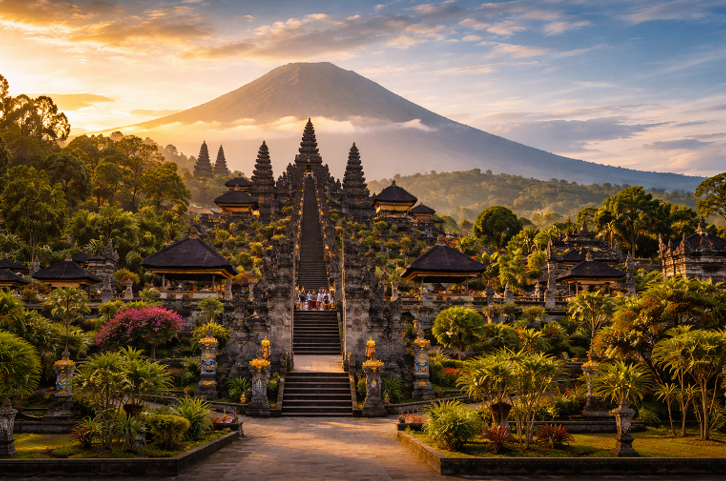
About Besakih Great Temple, Karangasem, Bali, Indonesia
Besakih Great Temple, known locally as Pura Agung Besakih, is the largest and most important Hindu temple complex in Bali. It stands on the southwestern slopes of Mount Agung, Bali’s highest and most revered mountain, in Besakih Village, Karangasem.
Besakih is known as the Mother Temple of Bali because it brings together a large network of temples and shrines that serve the religious life of Balinese Hindus. At its centre is Pura Penataran Agung, while the surrounding temples, rituals and sacred spaces form a larger religious landscape connected with the deities, directions, communities and traditions of Bali.
Story of Besakih Great Temple
The sacred landscape of Besakih is much older than the buildings seen today. Megalithic remains, including stone seats and stepped structures, indicate that the area was regarded as sacred before the development of Hindu temple architecture. The earliest recorded reference commonly associated with Besakih is an inscription dated to 1007 CE, while by the 15th century the temple had become an important state temple under the Gelgel dynasty.
Balinese tradition connects the early history of Besakih with Rsi Markandeya, a Hindu sage said to have established the first sacred foundation at the site. Another tradition associates the name with Naga Basuki, the sacred serpent linked with Mount Mandara in Hindu mythology. These accounts are part of the religious history of Besakih and should be understood as traditions rather than as archaeological explanations of the temple's origin.
Besakih developed as a large complex rather than as a single shrine. Pura Penataran Agung forms the central sanctuary, while major temples are arranged around it according to the sacred directions. Pura Gelap stands to the east, Pura Kiduling Kreteg to the south, Pura Ulun Kulkul to the west and Pura Batu Madeg to the north. This arrangement reflects the Balinese understanding of sacred space and the relationship between the temple, the directions and Mount Agung.
The architecture rises in terraces along the mountain slope, with stairways, gateways, courtyards, shrines and distinctive meru towers forming the complex. At the heart of Pura Penataran Agung is the Padma Tiga, the triple lotus throne associated with the worship of Shiva in three aspects. The entire layout is closely connected with Balinese ideas of harmony between the divine, human life and the natural world, expressed through the principle of Tri Hita Karana.
What Makes Besakih Great Temple Sacred for Devotees
Besakih and Mount Agung
For Balinese Hindus, the position of Besakih on Mount Agung is part of its religious identity. The mountain is regarded as sacred, and the temple complex is oriented toward it. In local traditions, Besakih is described as Huluning Bali Rajya, the spiritual centre or head of Bali.
The connection between mountain and temple is therefore not simply geographical. The rising terraces, shrines and ceremonial paths form part of a sacred landscape in which the mountain remains an important reference point for worship.
The Rsi Markandeya Tradition
One of the best-known traditions tells of Rsi Markandeya travelling to Bali and establishing a sacred foundation at Pura Basukian after receiving divine instruction. The story also refers to the planting of the panca dhatu, or five sacred metals, and is widely associated with the early religious history of Besakih.
This account belongs to Balinese religious tradition. The archaeological evidence for the site is older and more complex than any single founding story, so the tradition should not be presented as a documented construction date.
Naga Basuki and the Name Besakih
The name Besakih is associated in local traditions with Basuki or Wasuki, a word connected with safety or well-being. Another traditional explanation links the name with Naga Basuki, the sacred serpent associated with the cosmic balance of Mount Mandara.
The story forms part of the religious understanding of the place and helps explain why protection, balance and the mountain landscape are recurring themes in Besakih tradition.
Tri Hita Karana
Besakih reflects the Balinese principle of Tri Hita Karana, the idea that life should remain in harmony with God, with other people and with the natural environment. The organisation of the temple, its ceremonial life and its relationship with Mount Agung are all understood within this wider framework.
This is one of the clearest ways to understand why Besakih is more than a collection of individual shrines. The complex works as a connected religious landscape.
The 1963 Eruption of Mount Agung
Mount Agung erupted violently in 1963, causing widespread destruction in surrounding areas. The lava did not destroy the main Besakih complex, and the survival of the temple became an important part of Balinese religious memory.
Many devotees understood the event as a sign of the sanctity and protection of Besakih. That interpretation is part of living religious tradition; the physical fact is that the temple complex survived largely intact despite the eruption's proximity.
Annual Festivals & Rituals at Besakih Great Temple, Karangasem, Bali, Indonesia
Daily Worship and Odalan Celebrations at the Temple
Worship continues throughout the year at the many shrines of Besakih. Each temple has its own odalan, or temple anniversary, which follows the Balinese ritual calendar. Because the complex contains many temples, the annual cycle of ceremonies is extensive.
Ida Bhatara Turun Kabeh Celebrations at the Temple
Ida Bhatara Turun Kabeh is the major annual ceremony at Besakih, traditionally held during Purnama Kedasa. Balinese Hindus believe that the divine manifestations associated with the different temples come together at Besakih during the ceremony. Large numbers of devotees travel to the complex to make offerings and perform worship. The ceremony also shows how the many individual shrines of Besakih function as one connected sacred centre.
Panca Wali Krama Celebrations at the Temple
Panca Wali Krama is a major purification ceremony associated with Besakih and traditionally held in a ten-year cycle. It involves extensive offerings and rituals directed toward maintaining balance in the wider natural and spiritual order.
Eka Dasa Rudra Celebrations at the Temple
Eka Dasa Rudra is one of the most significant large-scale ceremonies associated with Besakih. It belongs to a much longer ritual cycle and was most recently conducted in 1979. The ceremony is connected with Rudra worship and the purification and balancing of the world. Its scale and ritual importance make it distinct from the annual temple festivals.
Sacred Places to Visit Near Besakih Great Temple
Pura Penataran Agung : Pura Penataran Agung is the central and largest sanctuary within the Besakih complex. Its terraces, shrines and Padma Tiga form the principal architectural and ritual focus of the temple landscape.
Pura Batu Madeg : Located to the north of the central sanctuary, Pura Batu Madeg is traditionally associated with Vishnu. It forms one of the principal directional temples of Besakih.
Pura Gelap : Pura Gelap stands to the east and is traditionally associated with Iswara. It forms part of the directional arrangement surrounding Pura Penataran Agung.
Pura Kiduling Kreteg : Pura Kiduling Kreteg lies to the south and is associated with Brahma. Its position is part of the wider sacred ordering of the Besakih complex.
Pura Ulun Kulkul : Pura Ulun Kulkul is located to the west and is associated with Mahadeva. Together with the other directional temples, it helps complete the sacred arrangement around the central sanctuary.
Pura Goa Raja : Pura Goa Raja is one of the sacred places within the wider Besakih landscape. Its association with the complex makes it useful for understanding how Besakih extends beyond the main Penataran Agung courtyard.
Plan Besakih Great Temple Darshan
For current entry planning, temple access, date-specific guidance and Naman Darshan's Guided Darshan Assistance, continue to the dedicated Besakih Great Temple Darshan page.
Common Questions About Visiting Besakih Great Temple
Visitor Information
Entry Fee
IDR 150,000 – Current published rate; reconfirm before travel. IDR 80,000 – Current published rate; reconfirm before travel.
Darshan Timing
Address
Pura Agung Besakih, Besakih Village, Rendang District, Karangasem Regency, Bali 80863, Indonesia
Notable Events
1007 CE — Earliest recorded reference – An inscription dated to 1007 CE is commonly cited as the earliest recorded mention associated with Besakih. • 15th century — Central temple of Bali – Besakih became an important central temple during the period of the Gelgel dynasty. • 1917 — Earthquake and repairs – The major earthquake of 1917 affected temples across Bali, and Besakih underwent subsequent repair and rebuilding work. • 1963 — Mount Agung eruption – A major eruption of Mount Agung caused extensive destruction in surrounding areas, while the Besakih complex largely survived the main lava flows. • 1979 — Eka Dasa Rudra – The major Eka Dasa Rudra ceremony was conducted at Besakih, becoming an important modern milestone in the temple's ritual history. • 2023 — Sacred-area facility development – The Indonesian government inaugurated major improvements around the Besakih sacred area, including parking, pedestrian areas, public facilities and visitor infrastructure. • 2026 — Restoration of the Parahyangan area – The Bali provincial government began a further restoration phase aimed at returning parts of the sacred complex toward traditional Balinese architectural standards and improving the coherence of the protected sacred landscape.
How to Reach the Temple
By air: The main airport serving Bali is Ngurah Rai International Airport near Denpasar. Besakih is in eastern Bali, and the journey from the airport continues by road toward Karangasem and Rendang.
By road: Besakih is located in Besakih Village, Rendang District, Karangasem Regency, on the southwestern slope of Mount Agung. From Klungkung and the east Bali road network, continue toward Rendang and Besakih.
From Ubud: Besakih can be reached by road as part of an East Bali journey. Indonesia Travel currently gives an approximate travel time of about two hours from Ubud, subject to traffic and road conditions.
From South Bali: Visitors travelling from areas such as Kuta and the southern tourist districts should allow several hours by road. Conditions can vary considerably with traffic and ceremony-related road management.
At Besakih: The managed sacred area has designated parking and visitor facilities. Electric-vehicle transfers are currently part of the published visitor arrangement, while the complex itself extends across terraces and slopes, so some walking and stairs remain part of the visit.
Thanjavur, Tamil Nadu