
About Banke Bihari Temple, Vrindavan, Uttar Pradesh
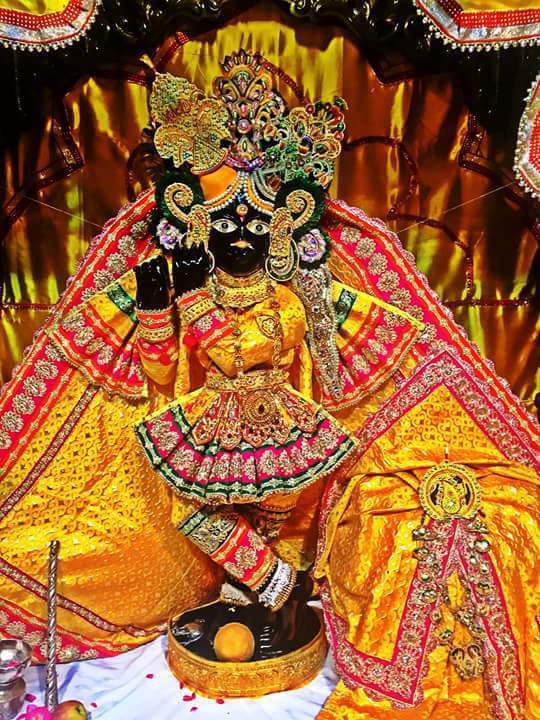
Banke Bihari Temple in Vrindavan is dedicated to Thakur Shri Banke Bihari Ji, worshipped in the Braj tradition as the combined form of Radha and Krishna. The deity was originally worshipped at Nidhivan under the name Kunj Bihari before being installed at the present temple in the 19th century.
The shrine is closely associated with Swami Haridas and the Haridasi tradition of Krishna devotion. Its worship is known for Jhanki Darshan, the absence of regular Mangala Aarti, seasonal Shringar and Rajbhog, and the major festivals of Holi, Jhulan Yatra, Janmashtami, Akshaya Tritiya, Sharad Purnima and Bihar Panchami.
Story of Banke Bihari Temple
The history of Banke Bihari Temple begins with Swami Haridas, the saint and musician associated with Nidhivan in Vrindavan. According to the temple's tradition, the divine couple Shyama-Shyam appeared before him and manifested as the single image now worshipped as Banke Bihari Ji. Haridas first worshipped the image as Kunj Bihari, while the name Banke Bihari became associated with the deity's three-fold bent Tribhanga form.
The deity remained connected with Nidhivan for generations. Historical accounts differ on the circumstances and exact period of the move, reflecting a long dispute between ascetic and Goswami followers over the custody of the deity. The temple's own history records that a new temple was constructed in 1862, while some government and travel sources give 1864; the building is generally described as a 19th-century temple in the contemporary Rajasthani style.
The sanctum houses Banke Bihari Ji in the Tribhanga posture. He is worshipped as a living child-like form of Krishna, and this understanding shapes the daily seva: the deity is dressed, offered food and later put to rest rather than being awakened with the usual pre-dawn Mangala worship found in many Krishna temples.
What Makes Banke Bihari Temple Sacred for Devotees
The appearance of Banke Bihari Ji at Nidhivan
According to temple tradition, Swami Haridas spent his devotional life in Nidhivan, singing and meditating on Radha and Krishna. When his disciples witnessed the divine couple appear before them, Haridas requested that they take a single form so devotees could continue to worship them. The tradition holds that this single dark image became Banke Bihari Ji.
This is the central sacred narrative of the temple. It belongs to the religious tradition of the Haridasi lineage and should be understood as a devotional account rather than as an archaeological explanation of the image.
Why the name Banke Bihari?
The Government of Uttar Pradesh explains Banke as “bent” and Bihari as “enjoyer”. The name therefore refers to Krishna's characteristic three-bent posture and his association with divine play in Braj.
Jhanki Darshan
The deity is not kept visible continuously. A curtain is repeatedly drawn before Banke Bihari Ji during darshan, creating a sequence of brief glimpses known as Jhanki Darshan. Temple tradition connects this practice with the extraordinary beauty and power attributed to the deity's gaze.
No regular Mangala Aarti
Banke Bihari Ji is worshipped as a child, and the temple therefore does not follow the regular pre-dawn Mangala Sewa. The temple's own account says that Swami Haridas did not wish to disturb the Lord's sleep early in the morning. Krishna Janmashtami is the exception, when Mangala Aarti is performed as part of the special festival observance.
No bells and conches
Another distinctive custom is the absence of the usual temple bells and conches. According to the temple tradition, these sounds are avoided so that Banke Bihari Ji is not disturbed. Devotional chanting and other forms of worship take their place.
Swami Haridas and the seva tradition
Swami Haridas entrusted the seva of Bihariji to Goswami Jagannath, described by the temple as his younger brother and principal disciple. The temple states that the seva continues through the descendants of Jagannath Goswami, linking present-day worship with the Haridasi lineage.
Annual Festivals & Rituals at Banke Bihari Temple, Vrindavan, Uttar Pradesh
Daily Seva Celebrations at the Temple
The daily worship of Bihariji is organised around Shringar, Rajbhog and Shayan. Shringar includes dressing and adorning the deity, Rajbhog is the principal food offering, and Shayan marks the Lord's rest in the evening.
Holi Celebrations at the Temple
Holi is one of the major celebrations at Banke Bihari Temple. The festival is marked through special devotional observances and changes in the form of darshan during the Holi period.
Jhulan Yatra Celebrations at the Temple
During Jhulan Yatra, Banke Bihari Ji is placed on a decorated swing. The temple's official festival calendar lists Hariyali Teej as the principal swing observance.
Krishna Janmashtami Celebrations at the Temple
Janmashtami marks the birth of Lord Krishna and is especially important here because it is the one day on which Mangala Aarti is performed. The festival attracts substantially larger crowds than an ordinary temple day.
Akshaya Tritiya Celebrations at the Temple
Akshaya Tritiya is known for Charan Darshan in the morning and Sarvang Darshan in the evening. The festival calendar identifies it as one of the distinctive annual observances of Banke Bihari Ji.
Sharad Purnima Celebrations at the Temple
Sharad Purnima is associated with the Maha Raas tradition of Braj. On this day, the temple's official account describes special decoration and the appearance of the flute in Banke Bihari Ji's hands.
Bihar Panchami Celebrations at the Temple
Bihar Panchami commemorates the appearance of Banke Bihari Ji in the devotional tradition. The temple's official account describes celebrations beginning at Nidhivan and continuing with a procession to the Banke Bihari Temple.
Sacred Places to Visit Near Banke Bihari Temple
Nidhivan : Nidhivan is central to the history and religious tradition of Banke Bihari Ji because it is associated with the appearance of the deity to Swami Haridas. It also remains an important sacred site in Vrindavan's wider devotional landscape.
Radha Vallabh Temple : Radha Vallabh Temple is one of the important historic Vaishnava shrines of Vrindavan. Its presence near Banke Bihari provides another view of the devotional traditions that developed around Radha and Krishna in Braj.
Radha Raman Temple : Radha Raman Temple is another major historic shrine of Vrindavan, closely associated with the Gaudiya Vaishnava tradition. It is commonly included with the older temples of the town when exploring Vrindavan's sacred centre.
Govind Dev Ji Temple : Govind Dev Ji is one of Vrindavan's important historic Krishna temples and is also included by the Mathura district administration among the seven temples of Thakur of Vrindavan. Its history provides useful context for the temple-building and devotional traditions of old Vrindavan.
Prem Mandir : Prem Mandir is a modern Krishna and Radha temple complex in Vrindavan. It belongs to a much later period than Banke Bihari Temple and can be visited as part of a wider Vrindavan pilgrimage.
Seva Kunj : Seva Kunj is another important sacred grove in Vrindavan associated with the devotional understanding of Radha and Krishna's pastimes. Together with Nidhivan, it helps place Banke Bihari worship within the sacred geography of the town.
Plan Banke Bihari Temple Darshan
For current darshan timings, crowd conditions, entry guidance and Naman Darshan's Guided Darshan Assistance, continue to the dedicated Banke Bihari Darshan page.
Common Questions About Visiting Banke Bihari Temple
Visitor Information
Darshan Timing
Address
Shri Banke Bihari Temple, Madan Mohan Bankey Bihari Road, Biharipura,, Vrindavan, Mathura, Uttar Pradesh 281121, India
Notable Events
1478 CE — Traditional birth date of Swami Haridas – The temple's own historical account gives Swami Haridas's birth as 1478 CE, on Radha Ashtami. • 16th century — Banke Bihari tradition at Nidhivan – According to temple tradition, Swami Haridas received the image of Bihariji at Nidhivan, where the deity was initially worshipped as Kunj Bihari. • 18th century — Custody traditions and movement of the deity – Historical research records disagreements between the ascetic and Goswami followers of Swami Haridas concerning the custody of Banke Bihari. These traditions form an important part of the deity's historical movement within Vrindavan. • 1862 — Present temple constructed according to the temple's own history – The Banke Bihari Mandir's official history records the construction of the present temple in 1862 in the contemporary Rajasthani style. • 19th century — Deity established at the present temple – Following the construction of the new shrine, Banke Bihari Ji was transferred from the earlier place associated with Nidhivan to the present temple. Some published sources use 1864 for the temple date. • Present day — Haridasi seva tradition continues – The temple states that the seva of Bihariji continues through descendants of Goswami Jagannath, maintaining a long-established hereditary worship tradition.
How to Reach the Temple
By air: The temple's visitor guidance identifies Kheria Airport in Agra as the nearest airport, about 70 kilometres from Vrindavan. Indira Gandhi International Airport in Delhi is farther away but offers a much wider range of domestic and international connections.
By train: For travellers arriving by rail, Mathura Junction is the main railway station to use. The temple's own visitor guidance places it about 14 kilometres from the Mandir, with taxis, rickshaws and buses available for the onward journey to Vrindavan.
By road: Vrindavan can be approached from Delhi and the wider NCR through NH 44 or the Yamuna Expressway. Travellers using buses can continue from the Chhatikara area or Mathura and take local transport into Vrindavan.
Within Vrindavan: The temple is reached through the narrow streets around Biharipura. Cars cannot be taken all the way to the Mandir, so private vehicles should be left at available parking areas and the final approach completed on foot or by appropriate local transport.
Thiruvananthapuram, Kerala