
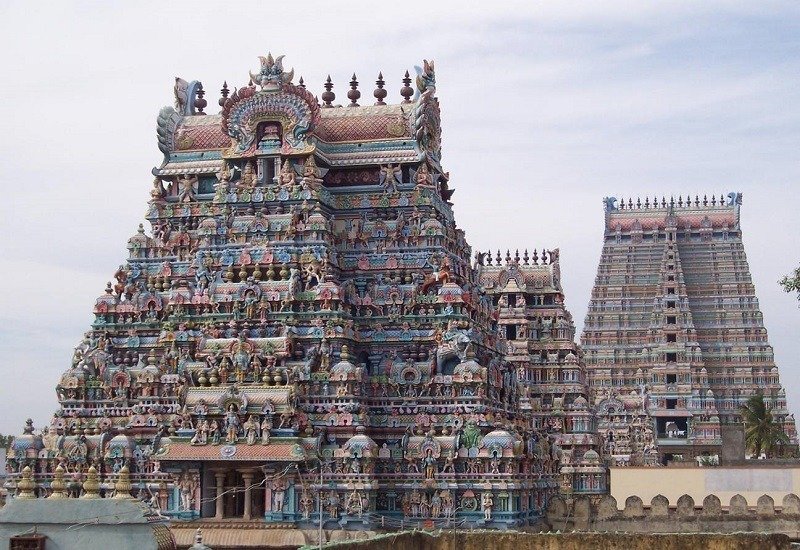
About Ranganathaswamy Temple, Srirangam, Tamil Nadu
Ranganathaswamy Temple is a major Sri Vaishnava temple in Srirangam, dedicated to Lord Ranganatha, the reclining form of Lord Vishnu, and Goddess Ranganayaki. It is the foremost among the 108 Divya Desams praised by the Alvar saints and is traditionally known as Bhooloka Vaikuntha.
The temple stands on the island of Srirangam between the Kaveri and Kollidam rivers. Its seven concentric prakarams, towering gopurams, historic mandapams and continuing Vaishnava worship make Srirangam a temple-town rather than a single shrine.
Story of Ranganathaswamy Temple
The sacred history of Srirangam is older than the present buildings. The shrine of Ranganatha is associated with the Ramayana tradition, while Tamil literature also refers to the deity at Srirangam. Over time, the site developed into an important centre of Vaishnava worship, and the Alvars composed hymns in praise of Ranganatha. The temple that stands today is the result of building, rebuilding and expansion over many centuries rather than the work of one ruler.
The Cholas played a major part in the development of the complex, followed by the Pandyas and Hoysalas. After the disturbances of the 14th century, Vijayanagara rulers and their governors undertook restoration and added new shrines, mandapams and towers. Later Nayaka patronage further expanded the temple-town. More than 600 inscriptions have been recorded from the complex, providing evidence of grants, administration, religious activity and the economic life connected with the temple.
The architecture is organised around seven concentric prakarams, each enclosed by substantial walls and connected through successive gateways. The innermost areas contain the principal shrine and associated sannidhis, while the outer enclosures gradually merge with the residential streets and traditional life of Srirangam. This temple-town arrangement is one of the defining features of the complex.
The complex covers about 156 acres and includes 21 gopurams, numerous shrines, mandapams and sacred water bodies. The Rajagopuram, completed and consecrated in 1987, rises about 73 metres. The famous Thousand-Pillared Hall, actually consisting of 953 pillars, belongs to the Vijayanagara period and is among the best-known architectural spaces in the temple. The sanctum is crowned by the Pranavakara Vimana, while the main deity is seen reclining on Adishesha.
What Makes Ranganathaswamy Temple Sacred for Devotees
The tradition of Ranganatha and Vibhishana
According to the Srirangam tradition, the image of Ranganatha was worshipped by the Ikshvaku kings and later by Lord Rama. After the coronation of Vibhishana in Lanka, Rama is said to have presented the deity to him.
While carrying the image southwards, Vibhishana stopped at Srirangam on the banks of the Kaveri. When he placed the image down, he was unable to lift it again. The tradition says that Ranganatha chose Srirangam as his abode while continuing to face south towards Lanka. This is a religious narrative central to the identity of the shrine.
Srirangam and the 108 Divya Desams
Srirangam is the first and foremost of the 108 Divya Desams, the Vishnu shrines praised in the Tamil hymns of the Alvars. All twelve Alvar saints are associated with hymns relating to Srirangam, giving the temple an important place in Tamil Vaishnava literature and worship.
Ramanuja and Sri Vaishnavism
Srirangam is closely associated with Sri Ramanuja, the philosopher and acharya who developed and taught the Vishishtadvaita tradition. The temple tradition credits him with important reforms in the organisation of worship and temple service, and his shrine continues to be part of the temple complex.
Ramanuja's presence gives Srirangam a significance beyond its architecture. The temple became an important centre for the teaching and practice of Sri Vaishnavism, bringing together Sanskrit texts, Tamil devotional literature and a highly organised system of temple worship.
The temple as Bhooloka Vaikuntha
Devotees traditionally refer to Srirangam as Bhooloka Vaikuntha, or Vaikuntha on earth. The name reflects the belief that Ranganatha's presence at Srirangam represents the divine abode of Vishnu within the earthly world.
This is a devotional description rather than a geographical claim. It expresses the place Srirangam holds in Sri Vaishnava religious thought.
Ranganatha and Ranganayaki
The principal goddess of Srirangam is Ranganayaki Thayar, the form of Goddess Lakshmi associated with Ranganatha. Her shrine is an important part of the temple complex and has its own ritual traditions.
During Panguni Uthiram, Ranganatha traditionally visits Ranganayaki for the special Serthi observance. The festival is distinctive because the divine couple are ceremonially brought together in a form associated with their union.
Annual Festivals & Rituals at Ranganathaswamy Temple, Srirangam, Tamil Nadu
Daily Worship Celebrations at the Temple
The temple follows an established sequence of worship in accordance with its Sri Vaishnava tradition. Services include the opening of the sanctum, Vishwaroopa Seva, offerings, archana and other forms of daily worship. Darshan takes place around these rituals, so the public timings are not simply one uninterrupted visiting period.
Vaikunta Ekadashi and Adhyayana Utsavam Celebrations at the Temple
Vaikunta Ekadashi is the best-known festival at Srirangam. It forms part of the Adhyayana Utsavam, a major Margazhi observance centred on the recitation of the Tamil Prabandham. On Vaikunta Ekadashi, the Paramapada Vasal is opened. The gateway is traditionally understood as the entrance to the Lord's supreme abode, and devotees pass through it as part of the festival observance.
Panguni Uthiram Celebrations at the Temple
Panguni Uthiram is associated with the meeting of Ranganatha and Ranganayaki. The Serthi observance gives the festival an important place in the temple's annual Vaishnava calendar.
Chithirai Festival and Processions Celebrations at the Temple
The Chithirai festival includes processions of the utsava murti through the streets of Srirangam. The temple's chariots and vahanas are an important part of these annual celebrations and connect the temple with the wider life of the surrounding temple-town.
Brahmotsavam Celebrations at the Temple
Brahmotsavam is another major annual festival marked by processions, alankarams and the use of traditional temple vahanas. Garuda Sevai is among the important observances associated with the festival cycle.
Pavitrotsavam Celebrations at the Temple
Pavitrotsavam is a ritual observance associated with the purification and renewal of temple worship. Special services are performed over the prescribed festival period as part of the temple's annual ritual calendar.
Sacred Places to Visit Near Ranganathaswamy Temple
Jambukeswarar Temple, Thiruvanaikaval : Jambukeswarar Temple is one of the Pancha Bhoota Sthalas dedicated to Lord Shiva and associated with the water element. It is located close to Srirangam across the Kaveri region.
Rockfort Ucchi Pillayar Temple : The Rockfort temple complex in Tiruchirappalli is built on a historic rock formation and contains the shrine of Ucchi Pillayar, dedicated to Lord Ganesha.
Samayapuram Mariamman Temple : Samayapuram Mariamman Temple is a major Amman shrine near Tiruchirappalli and forms part of the wider pilgrimage circuit around Srirangam.
Uthamar Kovil : Uthamar Kovil is a distinctive temple associated with Vishnu, Shiva and Brahma, with separate shrines within the same complex.
Sri Vadivazhagiya Nambi Perumal Temple : This Vishnu temple in the Srirangam region is another important Vaishnava shrine for devotees visiting the temple-town.
Kaveri River and Srirangam Temple Streets : The Kaveri forms the sacred geographical setting of Srirangam. The surrounding streets, prakarams and traditional houses are closely connected with the long history of the temple-town itself.
Plan Ranganathaswamy Temple Darshan
For current darshan timings, queue information, seva details and Naman Darshan's Guided Darshan Assistance, continue to the dedicated Ranganathaswamy Temple Darshan page.
Common Questions About Visiting Ranganathaswamy Temple
Visitor Information
Entry Fee
General temple entry is not listed by the temple as a standard admission charge – Separate sevas/archanas may carry prescribed fees.
Darshan Timing
Address
Arulmigu Aranganatha Swamy Temple, 1, South Uttara Street, Srirangam, Tiruchirappalli, Tamil Nadu – 620006, India, Temple Office: 0431 243 2246
Notable Events
Early historical period – References to the deity and sacred site occur in Tamil literary and Vaishnava traditions. • Chola, Pandya and Hoysala periods – The temple complex expanded through successive royal patronage, with inscriptions recording grants, endowments and temple administration. • 1311 and 1323 – Srirangam was attacked during the 14th-century campaigns associated with the Delhi Sultanate. The period of disruption had a lasting effect on the temple and its religious institutions. • 1371 – The image of Ranganatha was restored to Srirangam and worship was re-established under Vijayanagara authority. • Vijayanagara and Nayaka periods – Major additions included mandapams, shrines, towers and other structures that form part of the present temple-town. • 1987 – The present Rajagopuram was completed and consecrated, giving Srirangam its present monumental outer gateway. • 2014 – Sri Ranganathaswamy Temple was submitted to UNESCO's Tentative List as a cultural heritage property. • 2015 – A major Mahasamprokshanam was carried out following extensive renovation work across parts of the complex. • 2026 – The temple continues under the administration of the Tamil Nadu Hindu Religious and Charitable Endowments Department, with current visitor arrangements and security rules subject to change.
How to Reach the Temple
By air: Tiruchirappalli International Airport is the nearest airport. Tamil Nadu Tourism places it roughly 11 kilometres from the temple.
By rail: Srirangam Railway Station is the nearest station for the temple-town. Tiruchirappalli Junction is the major railway station serving the wider city and connects with destinations across India.
By road: Srirangam is connected with Tiruchirappalli by road, with regular buses, taxis and local transport services.
Within Srirangam: The outer areas of the temple complex are integrated with the town's traditional streets. During major festivals, traffic controls and pedestrian arrangements may change around the temple.
Howrah, West Bengal