
Dashavatara – The 10 Divine Avatars of Lord Vishnu
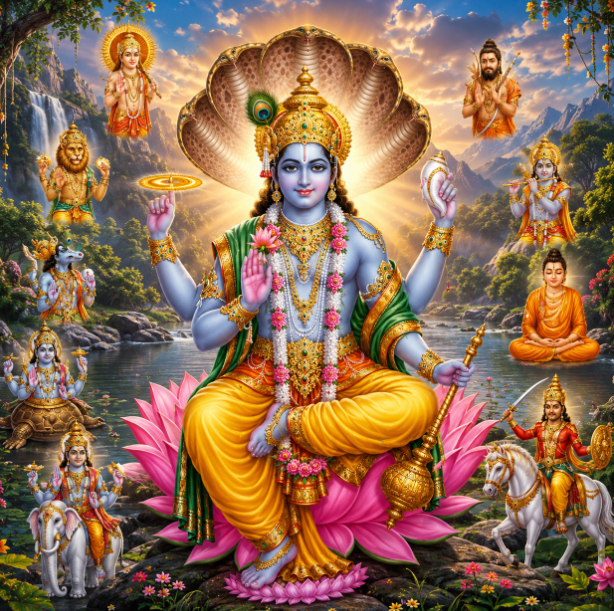
Table of Contents
1. Matsya Avatar – The Fish Incarnation
Matsya Avatar is considered the very first incarnation of Lord Vishnu. In this form, Lord Vishnu appeared as a gigantic divine fish to save life and sacred knowledge during a great cosmic flood. According to Hindu mythology, a king named Manu was performing penance near a river when he found a tiny fish asking for protection. Manu compassionately placed the fish in a pot, but the fish continued growing larger and larger. Soon Manu realized that the fish was none other than Lord Vishnu himself. Lord Vishnu warned Manu that a massive flood would soon destroy the world. He instructed Manu to build a huge boat and gather sages, seeds, medicinal plants, and different forms of life inside it. When the flood arrived, Matsya Avatar pulled the boat safely through the dangerous waters using a giant serpent as a rope. During the same time, a demon named Hayagriva stole the sacred Vedas and hid them in the ocean. Matsya Avatar defeated the demon and restored the Vedas, thereby preserving divine wisdom for humanity. Matsya Avatar symbolizes protection, guidance, intelligence, and the preservation of spiritual knowledge. It teaches that God protects those who live with faith and righteousness even during the most difficult situations.
2. Kurma Avatar – The Tortoise Incarnation
Kurma Avatar was the second incarnation of Lord Vishnu, where he took the form of a giant tortoise. This avatar is closely connected with the famous event called Samudra Manthan, the churning of the cosmic ocean. The Devas (gods) had lost their strength because of a curse and approached Lord Vishnu for help. Vishnu advised the Devas to join hands with the Asuras (demons) and churn the ocean of milk to obtain Amrit, the nectar of immortality. For the churning process, Mount Mandara was used as the churning rod, and the serpent Vasuki became the rope. However, as the churning began, the mountain started sinking into the ocean because there was no support beneath it. Lord Vishnu then appeared as Kurma, a gigantic tortoise, and supported the mountain on his strong back. With this support, the churning continued successfully, and many divine treasures emerged from the ocean, including Goddess Lakshmi, Kamadhenu, Airavata, Kaustubha gem, and finally the nectar of immortality Kurma Avatar symbolizes patience, stability, endurance, and support. Just as the tortoise carries its burden calmly, this avatar teaches people to remain steady during difficult times and support noble efforts without expecting rewards.
3. Varaha Avatar – The Boar Incarnation
Varaha Avatar was the third incarnation of Lord Vishnu. In this form, he appeared as a mighty wild boar to rescue Mother Earth from destruction. A powerful demon named Hiranyaksha became extremely arrogant after receiving blessings that made him difficult to defeat. Filled with pride, he attacked the heavens and eventually dragged the Earth deep into the cosmic ocean, causing chaos throughout creation. To save the world, Lord Vishnu manifested as Varaha, a gigantic boar with immense strength. A fierce battle took place between Varaha and Hiranyaksha that lasted for many days. Finally, Lord Vishnu defeated the demon with his divine power. After the victory, Varaha carefully lifted the Earth on his tusks and restored it to its rightful place in the universe. This avatar demonstrates divine courage and the responsibility of protecting the world from destructive forces. Varaha Avatar symbolizes strength, determination, protection of nature, and the triumph of righteousness over arrogance. The story also conveys an important spiritual message that whenever darkness tries to overpower goodness, divine forces arise to restore harmony and order.
4. Narasimha Avatar – The Half Man, Half Lion Incarnation
Narasimha Avatar is one of the most powerful and dramatic incarnations of Lord Vishnu. This avatar appeared to protect the great devotee Prahlada and destroy the cruel demon king Hiranyakashipu. Hiranyakashipu had received a special boon that made him nearly impossible to kill. He could not be killed by man or animal, during day or night, inside or outside, on land or in the sky, and not by any weapon. Because of this boon, he considered himself invincible and demanded that everyone worship him as God. However, his own son Prahlada remained devoted to Lord Vishnu. Despite repeated torture and attempts to kill him, Prahlada never abandoned his faith. Enraged by this devotion, Hiranyakashipu challenged Prahlada and asked whether Vishnu existed inside a palace pillar. When Prahlada answered yes, the demon struck the pillar. At that moment, Lord Vishnu emerged in the terrifying form of Narasimha — half lion and half man. At twilight, which was neither day nor night, Narasimha placed Hiranyakashipu on his lap at the palace doorway, which was neither inside nor outside, and killed him using his claws, which were not traditional weapons. Narasimha Avatar symbolizes the protection of true devotees, destruction of ego, and the limitless nature of divine power. It teaches that sincere faith always receives divine protection.
5. Vamana Avatar – The Dwarf Brahmin Incarnation
Vamana Avatar was the fifth incarnation of Lord Vishnu and appeared during the reign of the generous demon king Mahabali. Bali was a noble and charitable ruler, but his growing power began threatening the balance of the universe. To restore harmony, Lord Vishnu took birth as a small Brahmin boy named Vamana. During a grand sacrificial ceremony conducted by King Bali, Vamana approached the king and humbly requested only three steps of land. Bali laughed at the tiny request and agreed immediately. Suddenly, Vamana transformed into a gigantic cosmic form called Trivikrama. With his first step, he covered the entire Earth. With the second step, he covered the heavens. There was no place left for the third step. Realizing that the divine visitor was Lord Vishnu himself, Bali bowed down and offered his own head for the final step. Vishnu placed his foot on Bali’s head and sent him to the netherworld while blessing him for his devotion and humility. Vamana Avatar teaches that pride must be controlled even in good people. It symbolizes humility, surrender to God, generosity, and the importance of keeping one’s promises.
6. Parashurama Avatar – The Warrior Sage
Parashurama was the sixth avatar of Lord Vishnu and is considered a unique combination of sage and warrior. He was born to Sage Jamadagni and Mata Renuka and was blessed with extraordinary strength and devotion. During that period, many kings and warriors had become corrupt and abusive. They misused their power to oppress innocent people and disrespect spiritual values. To restore justice, Lord Vishnu incarnated as Parashurama. He received a divine axe from Lord Shiva after intense penance and became an unstoppable warrior. According to legends, Parashurama defeated evil kings multiple times and freed society from tyranny. Despite his fierce nature, he was deeply devoted to righteousness and spiritual discipline. Parashurama is also believed to be immortal and appears in several Hindu scriptures, including the Ramayana and Mahabharata. He is regarded as the teacher of many great warriors. This avatar symbolizes discipline, justice, courage, and the importance of using power responsibly. It teaches that strength should always be guided by morality and wisdom.
7. Rama Avatar – The Ideal King
Lord Rama, the seventh avatar of Vishnu, is one of the most worshipped deities in Hinduism. His life and teachings are beautifully described in the epic Ramayana. Rama was born in Ayodhya to King Dasharatha and Queen Kaushalya. He was known for his truthfulness, discipline, compassion, and obedience. Even when unfairly sent into exile for fourteen years, Rama accepted his father’s promise without anger. During exile, the demon king Ravana kidnapped Rama’s wife, Sita. With the help of Lakshmana, Hanuman, and the Vanara army, Rama traveled to Lanka and fought a great battle against Ravana. Eventually, he defeated Ravana and rescued Sita, restoring righteousness. Lord Rama is called “Maryada Purushottam,” meaning the perfect man who follows moral values and duties perfectly. His rule in Ayodhya is remembered as Ram Rajya, an ideal kingdom filled with peace, justice, and prosperity. Rama Avatar teaches honesty, loyalty, sacrifice, respect for relationships, and dedication to Dharma. His life remains an inspiration for people seeking to live with integrity and honor.
8. Krishna Avatar – The Divine Guide
Lord Krishna is the eighth avatar of Vishnu and one of the most beloved figures in Hindu tradition. His life combines divine playfulness, wisdom, love, and supreme spiritual teachings. Krishna was born in Mathura to Devaki and Vasudeva during the reign of the cruel king Kansa. Since a prophecy declared that Devaki’s eighth son would destroy him, Kansa imprisoned his sister and killed her children. However, Krishna was secretly taken to Gokul, where he was raised by Yashoda and Nanda. As a child, Krishna performed many miraculous deeds. He defeated dangerous demons, protected villagers from disasters, and enchanted everyone with his flute and divine charm. His playful relationship with the Gopis and Radha symbolizes pure devotion and divine love. Later, Krishna killed Kansa and became a central figure in the Mahabharata. During the Kurukshetra war, he served as Arjuna’s charioteer and delivered the Bhagavad Gita, one of the greatest spiritual texts in the world. Krishna taught the principles of Karma Yoga, devotion, duty, detachment, and surrender to God. His teachings continue to guide millions toward spiritual wisdom and inner peace.
9. Buddha Avatar – The Enlightened One
In many Hindu traditions, Gautama Buddha is regarded as the ninth avatar of Lord Vishnu. Buddha was born as Prince Siddhartha in a royal family, but he renounced worldly comforts after witnessing suffering, old age, sickness, and death. He spent years meditating and searching for truth. Finally, under the Bodhi tree, Siddhartha attained enlightenment and became Buddha, meaning “the awakened one.” Buddha taught compassion, non-violence, self-control, mindfulness, and freedom from suffering. He encouraged people to follow the middle path instead of extreme luxury or harsh asceticism. His teachings focused on overcoming desire, anger, ignorance, and attachment. Through wisdom and meditation, Buddha showed humanity the path toward peace and spiritual awakening. Buddha Avatar symbolizes mercy, wisdom, kindness, and spiritual transformation. It teaches that true happiness comes from inner peace rather than material possessions.
10. Kalki Avatar – The Future Warrior
Kalki Avatar is believed to be the future incarnation of Lord Vishnu who has not yet appeared. According to Hindu scriptures, Kalki will arrive at the end of Kali Yuga, the current age filled with corruption, greed, dishonesty, violence, and spiritual decline. Kalki is described as a powerful warrior riding a white horse and carrying a blazing sword. He will destroy evil forces, remove injustice, and restore purity and righteousness in the world. After the destruction of negativity, a new Satya Yuga — the age of truth and virtue — will begin. Thus, Kalki Avatar represents hope, renewal, and the eternal victory of Dharma. This final avatar reminds humanity that no matter how dark the times become, divine justice eventually prevails. It encourages people to remain righteous and spiritually aware even during difficult periods.
Why Dashavatara Still Matters Today
Even in modern times, the teachings of Dashavatara remain deeply relevant. The stories encourage people to: Remain truthful and disciplined Protect nature and moral values Stand against injustice Develop compassion and humility Balance material success with spirituality In an age filled with stress, conflict, and uncertainty, these timeless teachings continue inspiring millions toward ethical and spiritual living.
Conclusion
The Dashavatara of Vishnu beautifully demonstrate how divine power manifests in different forms to guide humanity through changing ages and challenges. Each avatar carries unique lessons about courage, humility, devotion, justice, wisdom, and spiritual awakening. Together, they remind humanity that while darkness and negativity may rise temporarily, Dharma and truth ultimately prevail. This timeless message continues making Dashavatara one of the most profound and spiritually significant concepts in Hinduism.
Author
Dedicated to sharing authentic spiritual knowledge, temple heritage, and Vedic traditions across India.