
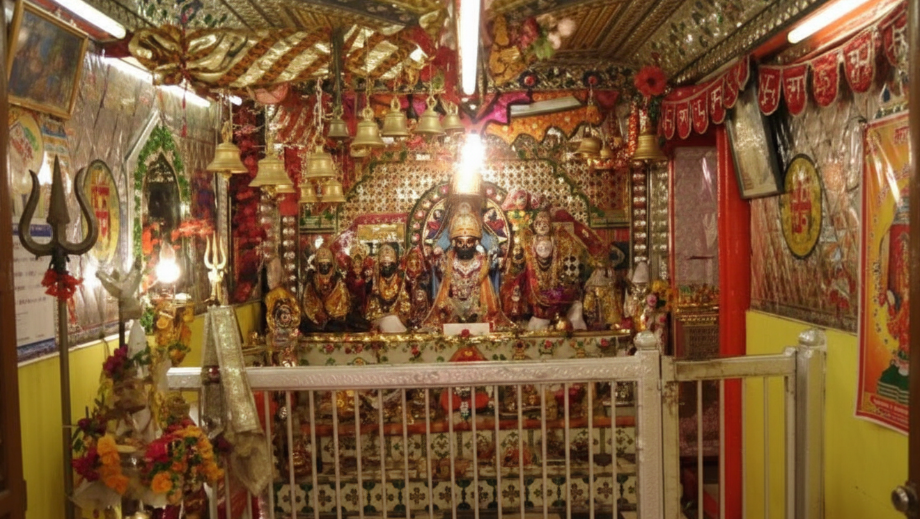
About Badrinath Temple, Badrinath, Uttarakhand
Badrinath Temple is dedicated to Lord Vishnu, worshipped here as Badrinarayan, and is one of the four all-India Char Dham pilgrimage sites. It is also one of the 108 Divya Desams of Vaishnavism and the principal shrine of the Panch Badri tradition.
The temple stands at about 3,133 metres in the Garhwal Himalayas, beside the Alaknanda River and between the Nar and Narayan ranges. Badrinath is not only a destination reached after a long Himalayan journey; its identity is tied to Badarikashram, Nara-Narayana, the Badrinarayan murti, seasonal worship and the sacred places that surround the temple.
Story of Badrinath Temple
The sacred history of Badrinath is older than the present temple building. The shrine and the surrounding region are associated with Badarikashram in Hindu religious literature, including traditions connected with the Bhagavata Purana, Skanda Purana and Mahabharata. The temple is also praised in the Vaishnava tradition of the Alvars and is counted among the 108 Divya Desams dedicated to Vishnu.
The history of the present shrine is closely associated in temple tradition with Adi Shankaracharya. According to the Shri Badarinath Kedarnath Temple Committee, Shankaracharya recovered the image of Badrinarayan from Narad Kund and re-established worship at Badrinath in the eighth century. The account belongs to the traditional history of the shrine and forms an important part of how Badrinath understands its own continuity.
The Badrinarayan murti was later moved to the present temple location under the Garhwal rulers in the 16th century. The temple was expanded in later periods and suffered substantial damage during the 1803 Garhwal earthquake; historical accounts record major rebuilding associated with the King of Jaipur and continued restoration into the 19th century.
The administration of the shrine also changed over time. The Shri Badarinath Kedarnath Temple Committee was constituted under the 1939 Act and today administers Badrinath and Kedarnath under the Uttarakhand government framework.
Badrinath's importance therefore has several layers. It is a Vaishnava shrine, a Divya Desam, the northern Dham of the all-India Char Dham tradition and the principal Vishal Badri of the Panch Badri group. Within Uttarakhand's Himalayan pilgrimage circuit, it stands alongside Kedarnath, Gangotri and Yamunotri as one of the Chota Char Dham shrines.
Deities and Architecture of Badrinath Temple
The main deity is Lord Badrinarayan, the form of Vishnu worshipped at Badrinath. The temple committee describes the principal image as a black-stone Shaligram image, approximately one metre high, seated in a meditative posture. Two raised hands hold the conch and chakra, while the other two rest in a yogic position.
The sanctum contains more than the central image. Badrinarayan is traditionally shown beneath the Badri tree, with Kubera, Narada, Uddhava, Nara and Narayana associated with the main shrine. Garuda is placed before the deity, and the wider temple complex contains other images including Lakshmi and other Vaishnava and associated figures. The temple committee describes the complex as containing 15 idols.
The Three Parts of the Temple
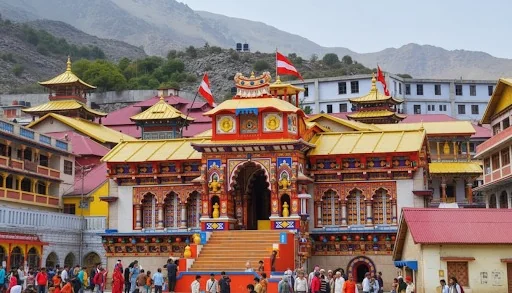
Badrinath Temple is divided into three principal sections: the Garbha Griha, the Darshan Mandap and the Sabha Mandap.
The Garbha Griha is the sanctum where Badrinarayan is worshipped. The canopy above the sanctum is covered with gold, while the temple's main entrance, the Singhdwar, is brightly painted and forms the most recognisable approach to the shrine.
The Darshan Mandap is the space associated with worship and ritual activity, while the Sabha Mandap provides an assembly space for pilgrims. The walls and pillars of the mandapa contain intricate decorative work. The temple rises approximately 50 feet and has a small cupola with a gilt roof.
The architecture of Badrinath is inseparable from its location. The colourful façade stands against the high Himalayan landscape, with the Alaknanda flowing nearby and the Nar and Narayan ranges surrounding the town. The building has also been repaired and rebuilt several times because of the difficult environment in which it stands.
The Rawal Tradition
Badrinath has a distinctive priestly tradition. The chief priest, known as the Rawal, comes from the Nambudiri Brahmin tradition of Kerala. The association of a Kerala priestly lineage with a Himalayan Vishnu shrine is traditionally connected with the wider religious organisation attributed to Adi Shankaracharya.
What Makes Badrinath Temple Sacred for Devotees
Badrinath is surrounded by stories in which the deity, the mountains, the river and the sacred sites around the temple are treated as parts of one religious landscape.
Why Badrinath is Associated with the Badri Tree
One of the best-known traditions explains the name Badrinath through the badri, or berry tree.
The story holds that Lord Vishnu performed penance in the Himalayas. Seeing him exposed to the harsh elements, Goddess Lakshmi took the form of a badri tree and sheltered him. The place therefore became associated with Badri and came to be known as Badarikashram or Badrinath in the religious tradition.
This is a sacred tradition rather than a historical explanation established through archaeology. Its importance lies in the relationship it creates between Vishnu's meditation and Lakshmi's protection.
Nara and Narayana at Badarikashram
Badrinath is also closely associated with Nara and Narayana, the two figures of Vishnu's tradition whose names are carried by the mountains surrounding the shrine.
According to religious tradition, Nara and Narayana performed penance at Badarikashram for the welfare of the world. This association gives Badrinath a place in the Vaishnava understanding of Vishnu not only as a deity receiving worship, but also as the ascetic presence of Narayana in the Himalayas.
Narad Kund and the Badrinarayan Image
Narad Kund is a sacred pool in the Alaknanda near the temple. Temple tradition associates it with the recovery of the Badrinarayan image by Adi Shankaracharya.
The story of the image being recovered from the waters and restored to worship is central to Badrinath's traditional history. The temple committee continues to identify Narad Kund as one of the important sacred places immediately around the shrine.
The Pandavas and Mana
The sacred geography continues beyond the temple town into Mana and the surrounding Himalayas. Local and religious traditions connect the Pandavas and Draupadi with their final journey northward, including the ascent toward Swargarohini.
Mana is associated with Bhim Pul, a natural rock formation over the Saraswati, and Vyas Gufa, traditionally connected with Sage Ved Vyasa and the Mahabharata. These accounts belong to the religious and local traditions of the region rather than serving as archaeological proof of the events described.
The Winter Tradition of Badrinath
Badrinath is a seasonal shrine because of the Himalayan winter. When the temple closes, worship does not simply disappear from the religious geography of Badrinath.
The winter tradition is associated with Joshimath, where the Narasimha Temple serves as the winter seat connected with Badrinath worship. Temple tradition also speaks of the Akhanda Jyoti continuing through the winter and of Narada's association with worship during the closed months. These are religious traditions surrounding the seasonal life of the shrine.
Annual Festivals & Rituals at Badrinath Temple, Badrinath, Uttarakhand
The ritual calendar of Badrinath is shaped by the Himalayan seasons. Opening the temple in spring and closing it before winter are not simply administrative dates; they are major parts of the annual religious cycle.
Daily Worship at Badrinath Celebrations at the Temple
The daily worship includes rituals such as Mahabhishek, Abhishek, Vedic recitation, Gita Path, Bhagavat Path, bhog and aarti. The exact sequence and timings are governed by the temple's ritual schedule and can change during the season. For this reason, the Temple page gives the ritual cycle rather than treating a single timetable as permanent. Current puja and darshan timings belong on the dedicated Badrinath Darshan page.
Kapat Udghatan Celebrations at the Temple
The annual opening of the portals, or Kapat Udghatan, marks the return of the pilgrimage season. The shrine is prepared through traditional ceremonies before the first darshan of the season. In 2026, the Badrinath portals opened on 23 April at 6:15 AM.
Badri Kedar Utsav Celebrations at the Temple
The Badri Kedar Utsav is associated with Badrinath and Kedarnath and brings religious observance together with music and cultural performances. It is traditionally held during the pilgrimage season and has included artists from different parts of India.
Mata Murti Ka Mela Celebrations at the Temple
The Mata Murti shrine near Badrinath is associated with the mother of Nara and Narayana in local tradition. The annual festival at the shrine is held on Vaman Dwadashi, when the Rawal performs worship and the local community participates in the observances.
Kapat Band Celebrations at the Temple
The annual closing of the portals marks the beginning of the winter period. The date is determined each year according to the religious calendar and current temple announcements. The closing ceremony includes special worship and the lighting of the Akhanda Jyoti. The winter continuation of Badrinath worship is then associated with the shrine's winter seat at Joshimath.
Sacred Places to Visit Near Badrinath Temple
Tapt Kund : Tapt Kund lies between Badrinath Temple and the Alaknanda River. It is a natural hot spring and has traditionally formed part of the pilgrimage sequence before entering the temple.
Narad Kund : Narad Kund is closely associated with the traditional recovery of the Badrinarayan image by Adi Shankaracharya. It lies near Tapt Kund and forms part of the sacred landscape immediately below the temple.
Brahma Kapal : Brahma Kapal is situated beside the Alaknanda and is associated with ancestral rites such as tarpan and shraddha. It is one of the important ritual sites around Badrinath.
Charan Paduka : Charan Paduka is a sacred rock on Narayan Parvat associated in tradition with the footprints of Lord Vishnu. Reaching it involves an uphill walk from Badrinath.
Mana Village : Mana lies a few kilometres from Badrinath and forms an important part of the sacred geography of the region. Its traditions include Bhim Pul, Vyas Gufa, Ganesh Gufa and the Saraswati River.
Mata Murti Temple : Mata Murti Temple stands on the right bank of the Alaknanda and is associated with the mother of Nara and Narayana. The annual Mata Murti observance gives this otherwise quiet shrine a special place in the Badrinath pilgrimage calendar.
Yogadhyan Badri : Yogadhyan Badri at Pandukeshwar is one of the Badri shrines connected with the wider Panch Badri tradition. It lies on the route between Joshimath and Badrinath and forms part of the broader religious geography of Vishnu worship in the region.
Joshimath : Joshimath is closely connected with Badrinath's winter worship and with the wider Shankaracharya tradition. The town is therefore more than a stopping point on the road; it forms part of the seasonal religious life of Badrinath.
Plan Badrinath Darshan
Badrinath darshan needs a little more planning than a normal temple visit because the shrine is seasonal and stands at about 3,133 metres in the Himalayas. Naman Darshan provides independent Guided Darshan Assistance for devotees who want help understanding the temple and organising their visit. The service is not an official temple pass, does not create a guaranteed priority queue and does not replace the temple committee's rules or Uttarakhand's yatra requirements. For current darshan windows, puja availability, registration requirements and visit-day guidance, continue to the dedicated Badrinath Darshan page.
Common Questions About Visiting Badrinath Temple
Visitor Information
Address
Badrinath Temple, Badrinath Town, Chamoli District, Uttarakhand – 246422, India
Notable Events
Traditional sacred history – Badrinath is associated with Badarikashram, Nara-Narayana and Vishnu worship in the Himalayan region. • 8th century tradition – Adi Shankaracharya is traditionally associated with recovering the Badrinarayan image from Narad Kund and re-establishing worship at the shrine. • 16th century – The Badrinarayan murti was moved to the present temple location under the Garhwal rulers, according to the temple's traditional history. • 17th century – Historical accounts describe expansion of the temple under the Garhwal rulers. • 1803 – The Garhwal earthquake caused major damage to the temple, followed by substantial rebuilding. • 1939 – The statutory framework leading to the Shri Badarinath Kedarnath Temple Committee was established. • 23 April 2026 – The Badrinath portals opened at 6:15 AM for the 2026 pilgrimage season. • 2026 – The Uttarakhand government continued work under the Badrinath development/master-plan programme, including plans for Dev Darshani Point and Badrinarayan Chowk as part of the wider development of Badrinath.
How to Reach the Temple
By Air: Jolly Grant Airport, Dehradun is the nearest major airport. The road journey from Dehradun continues through the Garhwal Himalayas to Badrinath. The temple committee lists the airport at approximately 314 km from Badrinath.
By Rail: Rishikesh is the nearest major railway connection used for the road journey to Badrinath. Pilgrims can continue from Rishikesh through Devprayag, Rudraprayag, Karnaprayag, Chamoli and Joshimath before reaching Badrinath.
By Road: Badrinath is connected by road with Rishikesh, Haridwar, Joshimath and other major towns of Uttarakhand. The route follows the Alaknanda valley and passes through several important pilgrimage towns before reaching the shrine.
Within Badrinath: Tapt Kund, Narad Kund and Brahma Kapal are close to the main temple. Mana, Charan Paduka and Mata Murti require additional local travel or walking, depending on the site and current road conditions.
SEO Title: Mahakaleshwar Jyotirlinga: History, Bhasma Aarti & Guide
Meta Description: Explore Mahakaleshwar Jyotirlinga in Ujjain, its history, south-facing Jyotirlinga, Bhasma Aarti, architecture, legends, festivals and sacred places.
Ujjain, Madhya Pradesh