
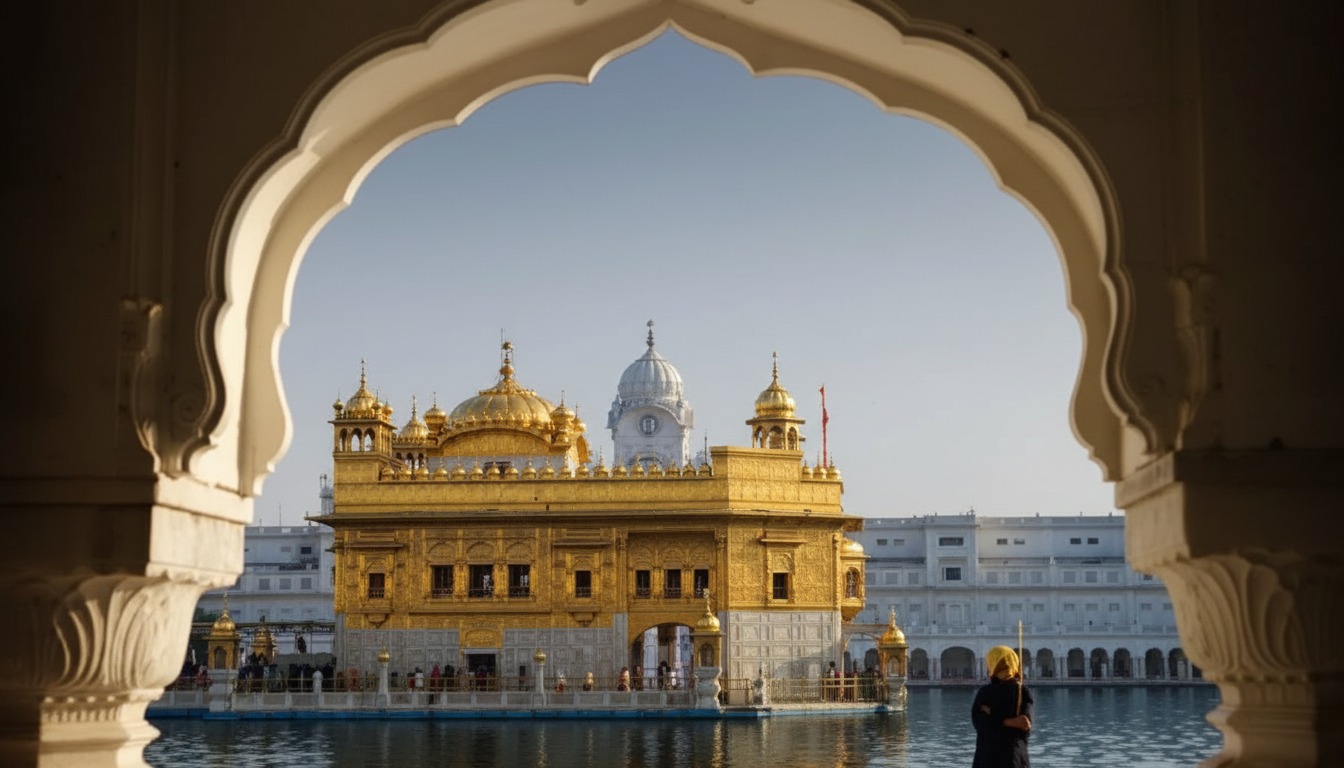
About The Golden Temple, Amritsar, Punjab
The Golden Temple, also known as Sri Harmandir Sahib or Sri Darbar Sahib, is the central religious shrine of Sikhism in Amritsar. The gurdwara stands in the middle of the Amrit Sarovar, with a marble causeway connecting it to the surrounding parikrama.
The complex is known for the presence of the Guru Granth Sahib, continuous Gurbani Kirtan, the Akal Takht and the tradition of Guru Ka Langar. Its history runs from the establishment of Amritsar by Guru Ram Das to the construction of Harmandir Sahib under Guru Arjan and the later rebuilding and gilding associated with Maharaja Ranjit Singh.
Story of The Golden Temple
The history of Harmandir Sahib begins with the development of Amritsar under Guru Ram Das, the fourth Sikh Guru. Work on the sacred pool began in the 16th century, and the settlement that grew around it became known as Ramdaspur before taking the name Amritsar. Guru Arjan, the fifth Guru, later established the central place of Sikh worship in the middle of the sarovar. Construction of Harmandir Sahib began in the late 16th century, with the foundation dated to 1588 in the official SGPC and Government of Punjab accounts. In 1604, Guru Arjan installed the Adi Granth in the shrine and appointed Baba Buddha as its first Granthi.
The shrine was damaged and rebuilt several times during the 18th century. The rebuilding of the complex continued under Sikh leadership, and Maharaja Ranjit Singh later supported major work in marble and copper before the sanctum was covered with gold in the 19th century. The present form therefore reflects several periods of Sikh history rather than a single construction phase.
The architecture is centred on the Amrit Sarovar, with Harmandir Sahib placed at its centre and reached by a single causeway. The shrine is built lower than the surrounding level and has entrances on all four sides. Marble decoration, pietra dura-style inlay, engraved and gilded copper work, the domed upper structure and the surrounding parikrama give the complex its distinctive appearance. The SGPC describes the building as an important example of a Sikh architectural tradition incorporating Hindu and Islamic construction influences.
What Makes The Golden Temple Sacred for Devotees
Guru Granth Sahib at Harmandir Sahib
The central religious focus of Harmandir Sahib is the Guru Granth Sahib, regarded by Sikhs as the eternal Guru. Guru Arjan installed the Adi Granth at the shrine in 1604, with Baba Buddha serving as its first Granthi. The daily life of the shrine continues to revolve around the reading and singing of Gurbani.
The Four Entrances
Harmandir Sahib has four entrances, one on each side of the shrine. Guru Arjan's decision to open the complex in this way is traditionally understood as expressing the principle that the Guru's house is open to people from every direction and background. The Government of Punjab also records that the four doors were intended to make the shrine accessible without distinction of caste, creed, sex or religion.
Amrit Sarovar
The Amrit Sarovar, or Pool of Nectar, is the sacred tank around Harmandir Sahib and gave Amritsar its name. It was developed during the time of Guru Ram Das and later expanded as the central shrine took shape. Devotees perform ishnaan, or ceremonial bathing, at designated areas of the sarovar as part of Sikh devotional practice.
Langar and Seva
Guru Ka Langar is one of the defining institutions of the Golden Temple complex. Meals are prepared and served to visitors without discrimination, and participation in cooking, serving and cleaning is an important expression of seva, or selfless service. The Government of Punjab notes that the langar operates throughout the day and serves people through the practice of pangat, communal dining.
Akal Takht
The Akal Takht stands opposite Harmandir Sahib and is one of the five Takhts of Sikhism. It was established by Guru Hargobind in the early 17th century and became a major seat of Sikh authority. Its position opposite the shrine is closely associated with the Sikh understanding of spiritual and temporal responsibility.
Annual Festivals & Rituals at The Golden Temple, Amritsar, Punjab
Prakash and Sukhasan Celebrations at the Temple
The daily cycle of Harmandir Sahib includes the ceremonial Prakash of the Guru Granth Sahib in the morning and Sukhasan at night, when the scripture is respectfully taken to its resting place. The exact timings vary through the year and around special observances.
Gurbani Kirtan and Hukamnama Celebrations at the Temple
Gurbani Kirtan forms the central musical and devotional tradition of the shrine. The daily programme includes readings, prayers and Hukamnama, through which a passage from the Guru Granth Sahib is taken for guidance.
Guru Ka Langar Celebrations at the Temple
Langar is part of the continuing daily life of the complex rather than a festival activity. Volunteers prepare and serve vegetarian meals, with people sitting together in pangat without distinction of social or religious background.
Bandi Chhor Divas and Diwali Celebrations at the Temple
Bandi Chhor Divas is observed in Amritsar alongside Diwali. The festival recalls the release of Guru Hargobind from Gwalior, traditionally together with 52 other detained rulers. At Harmandir Sahib, the occasion is marked by prayers, devotional programmes and illumination of the complex.
Gurpurabs Celebrations at the Temple
Gurpurabs mark important anniversaries in the Sikh calendar, including the birth anniversaries of the Sikh Gurus. At the Golden Temple, these occasions are observed through Gurbani Kirtan, Akhand Path, processions, langar and other religious programmes.
Vaisakhi Celebrations at the Temple
Vaisakhi is an important Sikh festival and is observed through prayers, kirtan, congregational gatherings and seva. Amritsar becomes particularly active around major Sikh religious occasions.
Guru Arjan Dev Ji's Shaheedi Gurpurab Celebrations at the Temple
The martyrdom anniversary of Guru Arjan Dev is an important occasion in the Sikh religious calendar. Special congregations, kirtan, katha and langar are held to remember the fifth Guru and his contribution to Sikh scripture and institutions.
Sacred Places to Visit Near The Golden Temple
Jallianwala Bagh : Jallianwala Bagh is a historic memorial located close to the Golden Temple. It commemorates the civilians killed during the 1919 massacre and forms an important part of Amritsar's modern history.
Partition Museum : The Partition Museum documents personal histories and material connected with the Partition of India in 1947. It provides historical context for the experience of Punjab and the wider region during Partition.
Durgiana Temple : Durgiana Temple is a Hindu temple dedicated principally to Goddess Durga. Its temple tank and some architectural features make it a notable religious landmark in Amritsar.
Gobindgarh Fort : Gobindgarh Fort is a historic fort in Amritsar associated with the later history of Punjab. The complex now includes museums and exhibitions dealing with the region's military and cultural past.
Ram Bagh Palace : Ram Bagh Palace and its surrounding garden are associated with Maharaja Ranjit Singh and the history of the Sikh Empire. The site adds another perspective on the period when Amritsar developed as an important centre under Sikh rule.
Plan Golden Temple Darshan
For current darshan planning, daily schedule, queue guidance and Naman Darshan's Guided Darshan Assistance, continue to the dedicated Golden Temple Darshan page.
Common Questions About Visiting The Golden Temple
Visitor Information
Entry Fee
No general entry fee – The shrine itself is open without an admission charge.
Darshan Timing
Address
Sri Harmandir Sahib, Golden Temple Road, Atta Mandi, Katra Ahluwalia, Amritsar, Punjab – 143006, India
Notable Events
1574–1577 — Establishment of Amritsar – Guru Ram Das developed the settlement that grew into Amritsar and worked on the sacred pool that became the Amrit Sarovar. • 1588 — Foundation of Harmandir Sahib – The foundation of the central shrine is dated to 1588 in official SGPC and Government of Punjab accounts. • 1604 — Installation of the Adi Granth – Guru Arjan installed the Adi Granth at Harmandir Sahib and appointed Baba Buddha as the first Granthi. • 1609 — Establishment of the Akal Takht – Guru Hargobind established the Akal Takht opposite Harmandir Sahib as a major seat of Sikh authority. • 18th century — Repeated destruction and rebuilding – Harmandir Sahib was repeatedly attacked and rebuilt during periods of conflict in Punjab. The rebuilding of the shrine became an important part of Sikh history. • 1762–1764 — Major destruction and reconstruction – The shrine suffered severe destruction during Ahmad Shah Durrani's campaigns. Sikh communities subsequently began rebuilding the complex. • 1809–1830 — Ranjit Singh-era reconstruction and gilding – Major work in marble and copper was undertaken during the reign of Maharaja Ranjit Singh, followed by the addition of gold to the sanctum in the 19th century. • 1984 — Damage during Operation Blue Star – The Golden Temple complex, particularly the Akal Takht, suffered severe damage during the June 1984 military operation.
How to Reach the Temple
By Air: Sri Guru Ram Dass Jee International Airport is the nearest airport, approximately 13 kilometres from the Golden Temple according to the District Administration of Amritsar.
By Rail: Amritsar Railway Station is approximately 2 kilometres from the Golden Temple. The station connects Amritsar with major cities across India.
By Road: The Amritsar bus stand is approximately 1.7 kilometres from the Golden Temple, with local buses, taxis and auto-rickshaws serving the city.
Within Amritsar: The Golden Temple lies in the historic central part of the city. During major festivals and high-footfall periods, road restrictions and pedestrian movement around the complex can change, so the final approach may take longer than on an ordinary day.
SEO Title Lingaraj Temple: History, Harihara, Architecture & Guide
Meta Description Learn about Lingaraj Temple in Bhubaneswar, its history, Harihara deity, Kalinga architecture, rituals, festivals, sacred places and visitor information.
Bhubaneswar, Odisha