
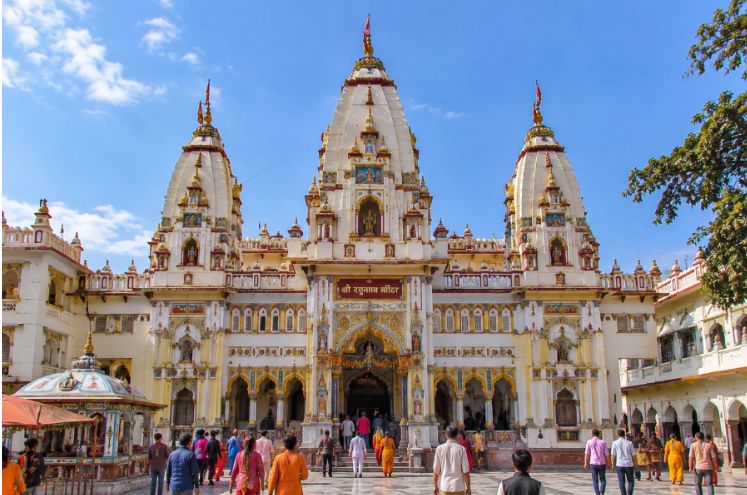
About Raghunath Temple, Jammu, Jammu and Kashmir
Raghunath Temple is a major shrine dedicated to Lord Rama in the old city of Jammu. The central shrine is associated with Rama, Mata Sita and Lakshmana, and the wider complex contains seven shrines built under Dogra royal patronage.
The temple is known for its tall shikharas, gilded interior walls, painted panels from Hindu epics, collections of Shaligrama stones and Shiva lingams, and a Sanskrit manuscript library associated with Maharaja Ranbir Singh.
Story of Raghunath Temple
The present Raghunath Temple complex took shape under the Dogra rulers in the 19th century. Maharaja Gulab Singh initiated its development, and his son Maharaja Ranbir Singh continued and completed the work. Accounts differ on the earliest construction date, but the temple is firmly associated with the Dogra period of Jammu's history.
The principal deity is Lord Rama, also known as Raghunath. The main shrine houses Rama with Mata Sita and Lakshmana, while the six other shrines broaden the complex to include different forms of Vishnu and other Hindu deities. The complex also contains images associated with Surya and Shiva, along with galleries where Shaligrama stones and Shiva lingams are kept.
Each of the seven shrines has its own shikhara, giving the temple its distinctive skyline. Inside the main shrine, gold sheets cover three sides of the interior. The painted panels include scenes and figures from the Ramayana, Mahabharata and Bhagavad Gita, including the Sita Swayamvara. The building also has arched and stucco details that reflect the architectural vocabulary of 19th-century Jammu.
Raghunath Temple is also known for its Sanskrit learning tradition. Under Maharaja Ranbir Singh, the complex became associated with a school and a library that grew to hold more than 6,000 manuscripts covering subjects such as Vedic literature, philosophy, grammar, epics and Puranas. The manuscript collection remains an important part of the temple's historical and cultural significance.
What Makes Raghunath Temple Sacred for Devotees
Lord Rama in Jammu
The temple is a centre of Rama devotion in the region, and the main sanctum is dedicated to Raghunath, a name of Lord Rama.
A Complex of Shrines
Each shrine in the complex is dedicated to a different deity or episode from the epics, so the temple offers a wide devotional experience.
Annual Festivals & Rituals at Raghunath Temple, Jammu, Jammu and Kashmir
Daily worship follows a regular sequence of puja and aarti. Morning and evening aarti are reported as part of the temple's routine, although exact timings may change during special observances.
Ram Navami
Ram Navami marks the birth of Lord Rama and is the festival most directly associated with the temple's presiding deity. Special prayers and worship draw devotees to the main shrine.
Janmashtami
Janmashtami celebrates the birth of Lord Krishna. Its observance reflects the wider Vaishnava presence within the temple complex, which includes images beyond the principal shrine of Rama.
Diwali
Diwali is associated in the Ramayana tradition with Rama's return to Ayodhya. The festival is observed with prayers and lamps, and the temple area may be busier than on an ordinary day.
Festival arrangements and ritual timings may vary from year to year. Visitors should check current information before travelling on a major festival date.
Sacred Places to Visit Near Raghunath Temple
Ranbireshwar Temple
Ranbireshwar Temple is a major Shiva shrine in Jammu. It is a useful nearby stop for visitors who want to explore the city's different temple traditions.
Mubarak Mandi Palace
Mubarak Mandi was a royal complex associated with the Dogra rulers. Its buildings and heritage spaces offer context for the dynasty that patronised Raghunath Temple.
Bahu Fort and Bagh-e-Bahu
Bahu Fort overlooks the Tawi River and contains the Bawey Wali Mata temple. Bagh-e-Bahu, the terraced garden nearby, is another recognised place to visit while exploring Jammu.
Plan Your Visit to Raghunath Temple
NamanDarshan is a technology platform that arranges darshan and related services on your behalf through independent service providers.
Common Questions About Visiting Raghunath Temple
Raghunath Temple was developed under Maharaja Gulab Singh and his son Maharaja Ranbir Singh during the 19th century. Published sources differ on the earliest construction date, while government tourism pages place the main building period in the mid-19th century.
It is in Jammu city, about 50 km from Katra, the base for the Vaishno Devi yatra.
Ram Navami and Diwali draw the largest crowds.
Photography is restricted in some areas. Follow the temple's instructions.
NamanDarshan is a technology platform that arranges darshan and related services on your behalf through independent service providers. We are not the temple or its management, and the temple's rules always apply.
Visitor Information
Darshan Timing
Address
Raghunath Temple, Raghunath Bazaar, Jammu, Jammu and Kashmir, India
Notable Events
Early to mid-19th century — Construction under Dogra patronage
Maharaja Gulab Singh and Maharaja Ranbir Singh are associated with the development of the temple complex. Published sources give different starting dates, so the exact foundation year should not be presented as undisputed.
1850s–1860 — Main building period
The District Jammu administration gives 1853–1860 as the building period, while other tourism accounts refer to 1857. The principal complex belongs to the mid-19th-century Dogra era.
Late 19th century — Sanskrit library and learning tradition
The temple's school and manuscript library developed under royal patronage. More than 6,000 manuscripts were recorded in the collection by the end of Maharaja Ranbir Singh's life.
1894 — Manuscript catalogue
Scholar Aurel Stein prepared an early catalogue of the Sanskrit manuscripts, bringing wider scholarly attention to the collection.
2002 — Attacks on the temple
The temple was attacked in March and November 2002. Devotees and security personnel were killed or injured. These events form part of the temple's recent history.
Present day — Preservation of the manuscript heritage
The temple's manuscript legacy continues through cataloguing and digital-library initiatives associated with the Shri Maharaja Ranvir Singh Sanskrit Research Institute.
How to Reach the Temple
By Air:
Jammu Airport is the nearest airport. The District Jammu administration lists it at approximately 8 km from Raghunath Temple; actual travel time depends on traffic and the approach route.
By Rail:
Jammu Tawi is the main railway station serving the city. The district administration lists it at approximately 7 km from the temple.
By Road:
The temple is in Raghunath Bazaar in central Jammu. Local buses, taxis and auto-rickshaws serve the city, but the final approach can be busy because the temple is beside an active market area.
From the Bus Stand:
The District Jammu administration lists the main bus stand at approximately 0.5 km from the temple. Confirm the best drop-off point locally, particularly during busy periods or when traffic arrangements change.