
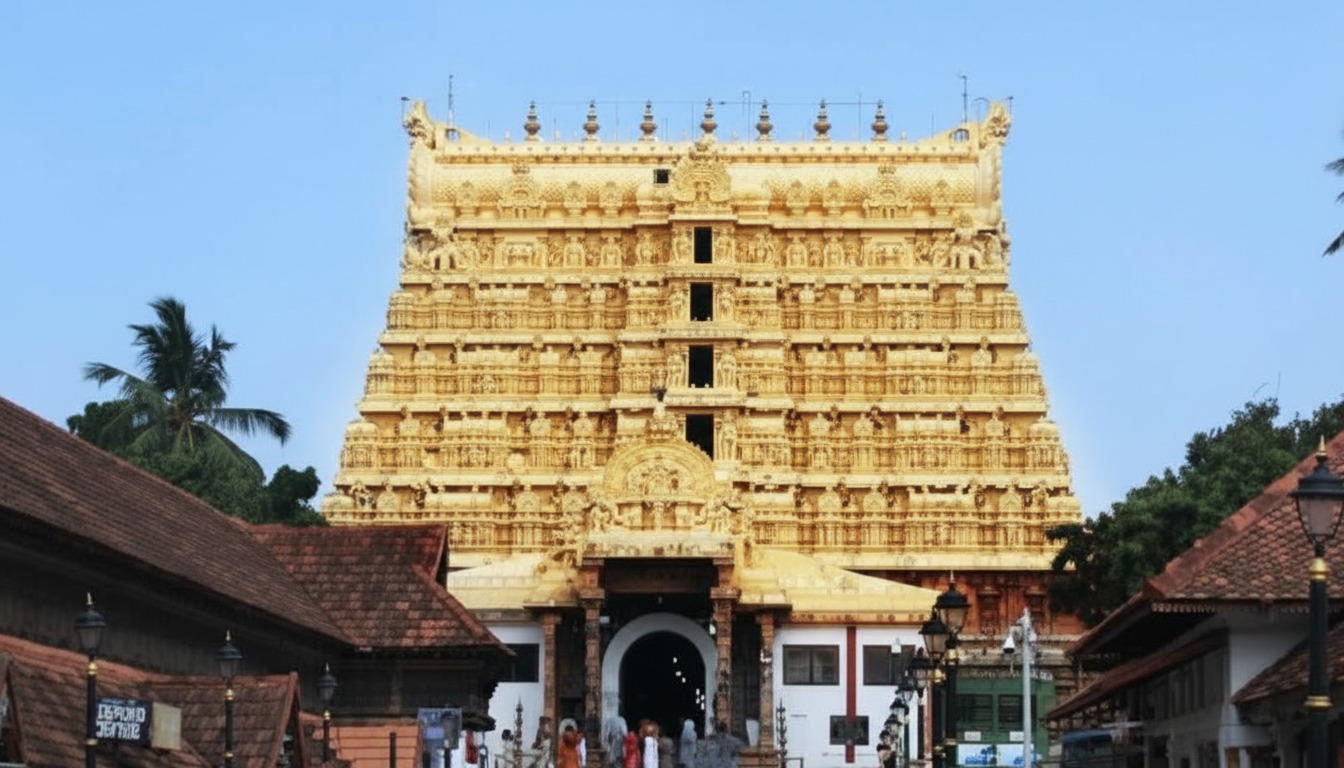
About Padmanabhaswamy Temple, Thiruvananthapuram, Kerala
Padmanabhaswamy Temple is dedicated to Lord Padmanabhaswamy, a form of Lord Vishnu reclining on the serpent Anantha. The temple is one of the 108 Divya Desams of the Sri Vaishnava tradition and stands within the historic East Fort of Thiruvananthapuram.
The shrine is known for its Ananthasayanam form of Vishnu, its Kerala and Dravidian architectural features, the daily temple rituals and its close connection with the former Travancore royal family. The name Thiruvananthapuram itself is associated with Anantha, the serpent on whom the Lord reclines.
Story of Padmanabhaswamy Temple
The exact origin of the temple cannot be established with certainty. The shrine is mentioned in religious literature, including the works of Nammalwar, and temple tradition also preserves accounts linking it with Divakara Muni and Vilwamangalam Swamiyar. Records show important phases of the temple's development over the centuries, including a major fire in 1686 and the reconstruction that followed. The present form of the temple took shape largely during the reign of Marthanda Varma after he became ruler of Travancore in 1729. The idol was reinstalled after the reconstruction, and in 1750 Marthanda Varma dedicated the kingdom of Travancore to Lord Padmanabha in the ceremony known as Thrippadidanam.
The principal deity is about 18 feet long and is shown reclining on Anantha in the Ananthasayanam posture. The image is traditionally made using Katusarkara Yogam and contains 12,008 Salagramas. Because of its length, devotees see the deity through three openings, taking in the head and upper body, the central portion with the lotus from which Brahma emerges, and the feet. The temple combines Kerala and Dravidian architectural traditions, with its seven-storey eastern gopuram, long stone corridors, carved mandapas, murals, the Ottakkal Mandapam and the sacred Padma Theertham tank forming its most recognisable features.
The Story of Divakara Muni
According to temple tradition, Divakara Muni was a devoted worshipper of Lord Vishnu. One day, a young boy appeared before him and asked to stay with the sage. Divakara Muni agreed, on the condition that he would treat the child with respect.
The story says that the boy eventually disappeared after the sage became angry with him. Before leaving, he told Divakara Muni that he could be found at Ananthankadu. The sage followed the child and reached a wooded area, where he saw the boy disappear into an Ilappa tree.
The tree then fell and revealed the form of Lord Vishnu reclining in the Ananthasayanam posture. The divine form was described as immense, stretching across the landscape. Divakara Muni prayed to the Lord to appear in a form he could properly worship, and the tradition says that the deity then assumed a smaller form.
The same account is connected with one of the temple's distinctive offerings. Divakara Muni is said to have offered a raw mango in a coconut shell, and the offering of mango in a coconut shell continues as part of the temple tradition.
Another tradition associates the same story with Vilwamangalam Swamiyar. The accounts differ in detail, but both place the appearance of the reclining form of Vishnu at Ananthankadu and connect the shrine with a long-established Vaishnava tradition.
What Makes Padmanabhaswamy Temple Sacred for Devotees
Ananthasayanam and the Three-Door Darshan
The central image of the temple is not presented as a conventional standing form of Vishnu. Lord Padmanabhaswamy reclines on Anantha, with the divine composition extending across the sanctum.
The three-door arrangement is therefore an important part of the darshan. Through the first opening devotees see the Lord's face and upper body, through the second they see the lotus rising from the navel with Brahma, and through the third they see His feet.
A Major Vaishnava Shrine
Padmanabhaswamy Temple is one of the 108 Divya Desams, the sacred Vishnu shrines praised in the Tamil devotional tradition. Nammalwar is associated with hymns in praise of Padmanabha, giving the temple a place in the historical development of Sri Vaishnava pilgrimage in Kerala.
Temple traditions also refer to Balarama's visit to the shrine and his bathing at Padma Theertham. Such references belong to the religious and literary tradition of the temple.
The Travancore Connection
Padmanabhaswamy Temple has a distinctive relationship with the Travancore royal family. In 1750, Marthanda Varma dedicated the kingdom of Travancore to Lord Padmanabha and adopted the title Padmanabha Dasa, meaning servant of Padmanabha.
The relationship continued as an important part of Travancore's political and religious history. It also explains why the temple cannot be separated from the history of Thiruvananthapuram and the royal establishments of East Fort.
Temple Records and Mathilakam
The history of Padmanabhaswamy Temple is preserved not only through religious traditions but also through extensive temple records known as the Mathilakam records. These records document aspects of temple administration, finances, property and the wider history of Travancore.
A substantial collection of these palm-leaf records is preserved by the Kerala State Archives, making the temple important not only for worship but also for the documentary history of Kerala.
The Temple Vaults
The temple also became internationally known after the opening and inventory of its known underground vaults in 2011 revealed large quantities of gold, jewellery, coins and other objects.
The vaults are part of the temple's assets and administration, not a public museum collection. Their contents are not available for ordinary viewing, and the long-running legal and administrative history surrounding the temple should be distinguished from the temple's religious traditions.
Annual Festivals & Rituals at Padmanabhaswamy Temple, Thiruvananthapuram, Kerala
Daily Rituals Celebrations at the Temple
The temple follows a traditional sequence of daily worship, beginning with Nirmalya Darshanam and continuing through morning poojas, offerings, midday worship, evening Deeparadhana and the final night rituals. Darshan is organised around these rituals. The sanctum may therefore close for periods during the day while worship is being performed.
Alpasi Utsavam Celebrations at the Temple
Alpasi Utsavam is one of the temple's two principal annual festivals and is held during the Malayalam month of Thulam, generally falling in October or November. The ten-day festival includes processions, special worship, Pallivetta and concludes with Arattu.
Painkuni Utsavam Celebrations at the Temple
Painkuni Utsavam is the second major annual festival and takes place during the Malayalam month of Meenam, generally in March or April. The festival begins with the ceremonial flag hoisting and includes processions, Pallivetta and Arattu. Large figures of the Pandavas are traditionally displayed near the eastern entrance during the festival, adding a distinctive feature to the temple's annual celebrations.
Navaratri Celebrations at the Temple
Navaratri is observed at the temple during the autumn season. The celebrations are closely connected with the Navaratri Mandapam, where traditional music forms an important part of the cultural programme.
Murajapam and Lakshadeepam Celebrations at the Temple
Murajapam is a major six-yearly ritual of continuous Vedic recitation. Its cycle culminates in Lakshadeepam, when one lakh oil lamps are lit in and around the temple. Both the ritual sequence and the final lamp ceremony are important parts of the temple's long religious calendar.
Sacred Places to Visit Near Padmanabhaswamy Temple
East Fort : East Fort grew around the temple and remains the historic centre of the old Travancore capital. Its gates, palace buildings and streets form part of the larger heritage setting of the shrine.
Kuthiramalika Palace : Kuthiramalika, also called Puthenmalika, was built by Maharaja Swathi Thirunal. The palace is known for its traditional Kerala architecture, detailed woodwork and its collection of royal artefacts.
Pazhavangadi Ganapathy Temple : Pazhavangadi Ganapathy Temple is a well-known Ganesha shrine in the East Fort area and is commonly visited alongside the Padmanabhaswamy Temple.
Attukal Bhagavathy Temple : Attukal Bhagavathy Temple is dedicated to Goddess Bhagavathy and is particularly known for the annual Attukal Pongala festival.
Shankhumugham Beach and Arattu Mandapam : Shankhumugham Beach is associated with the Arattu procession of Padmanabhaswamy Temple. During the festival, the processional images are taken to the seashore for the ritual bath.
Napier Museum : Napier Museum is one of Thiruvananthapuram's principal museums and houses collections connected with Kerala's art, history and cultural heritage.
Plan Padmanabhaswamy Temple Darshan
For current darshan timings, entry preparation and Naman Darshan's date-specific Guided Darshan Assistance, continue to the dedicated Padmanabhaswamy Temple Darshan page.
Common Questions About Visiting Padmanabhaswamy Temple
Visitor Information
Entry Fee
Restricted to Hindu devotees under the temple's prevailing rules – Confirm current requirements before travel.
Darshan Timing
Address
Sree Padmanabhaswamy Temple, West Nada, East Fort, Pazhavangadi, Thiruvananthapuram, Kerala 695023, India
Notable Events
9th century — Divya Desam tradition – Nammalwar's hymns place Padmanabha within the early medieval Vaishnava devotional tradition. • 1375 — Recorded festival tradition – Temple records indicate that Alpasi Utsavam was being conducted by this period. • 1686 — Major temple fire – A major fire caused extensive damage to the temple, leading to later reconstruction. • 1729–1730s — Marthanda Varma's reconstruction – Marthanda Varma undertook the major rebuilding that shaped the temple's present form, including the reconstruction of the sanctum and development of the surrounding complex. • 1750 — Thrippadidanam – Marthanda Varma dedicated Travancore to Lord Padmanabha and adopted the title Padmanabha Dasa. • 1936 — Temple Entry Proclamation – Travancore issued the Temple Entry Proclamation, extending temple entry to Hindus across caste distinctions. • 2011 — Vault inventory – The opening and inventory of known vaults brought the temple's stored assets to international attention. • 2020 — Present administrative framework – The Supreme Court directed an administrative structure for the temple while preserving its religious customs and the traditional roles of the temple's religious authorities.
How to Reach the Temple
By air: Thiruvananthapuram International Airport is about 6 kilometres from the temple area.
By rail: Thiruvananthapuram Central Railway Station is about 1 kilometre from the temple and provides connections to major cities across Kerala and India.
By road: The temple stands inside the East Fort area and is connected to the rest of Thiruvananthapuram by city buses, taxis and auto-rickshaws. Road access can change during major festival processions.
Within Thiruvananthapuram: The temple is surrounded by the historic East Fort precinct, with the Kuthiramalika Palace, Pazhavangadi Ganapathy Temple and other heritage sites within the wider area.
Tirumala, Tirupati, Andhra Pradesh