
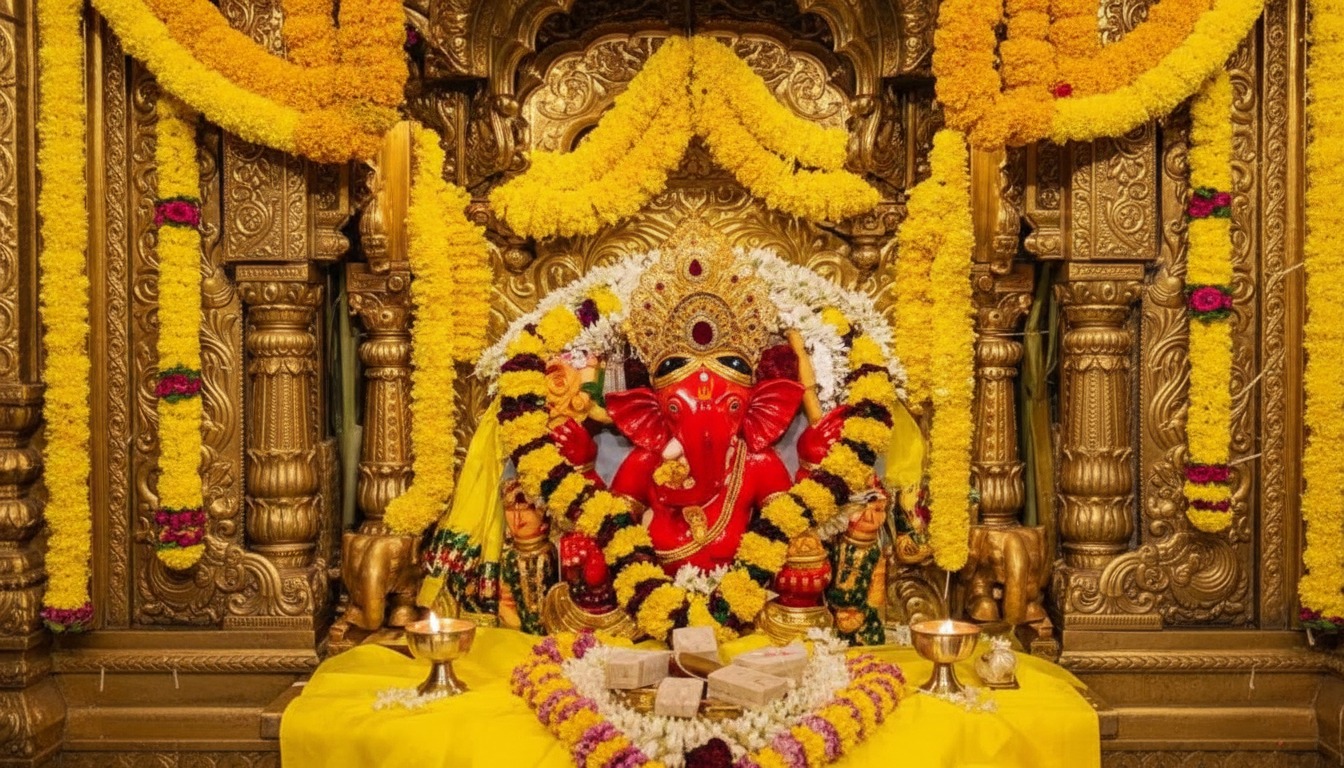
About Siddhivinayak Temple, Mumbai, Maharashtra
Siddhivinayak Temple is dedicated to Lord Ganesha in Prabhadevi, Mumbai. The shrine was first consecrated on 19 November 1801 and grew from a small temple into an important centre of Ganapati worship in the city.
The temple is known for its black-stone Siddhivinayak image, whose trunk curves to the right, with Riddhi and Siddhi beside the deity. The present temple complex grew through major reconstruction in the 1990s, while the original deity remained at the centre of worship.
Story of Siddhivinayak Temple
The shrine's documented history begins in 1801, when it was established by Laxman Vithu and Deubai Patil at Prabhadevi. The early temple was a small structure built around the Siddhivinayak image. Regular arrangements for puja and worship were formally developed in 1936, and the temple later came under the statutory framework of the Shree Siddhivinayak Ganapati Temple Trust (Prabhadevi) Act, 1980.
As the number of devotees increased, the small structure could no longer accommodate the temple's growing worshipping community. The foundation stone for the expansion project was laid on 27 April 1990, and the rebuilt temple was completed with a multistoreyed design, marble and pink granite, a central gold-plated dome and smaller crowns. The Kalas Pratishthapana and Kumbhabhishek took place on 13 June 1994. The sanctum was preserved during the reconstruction, and the distinctive Siddhivinayak idol remains the centre of the temple.
The deity is carved from black stone and is about 2.5 feet high and 2 feet wide. The trunk turns to the right, while the four hands hold a lotus, a small axe, a japamala and a bowl of modaks. Riddhi and Siddhi stand on either side, and the forehead carries an eye resembling Shiva's third eye. The sanctum also has carved wooden doors featuring the eight Ashtavinayak forms associated with Maharashtra's Ganesha tradition.
What Makes Siddhivinayak Temple Sacred for Devotees
Siddhivinayak and Lord Ganesha's place in worship
Ganesha is traditionally worshipped before the beginning of a new work, ceremony or undertaking. At Siddhivinayak, this wider Ganesha tradition is expressed through the worship of Siddhivinayak, the form of Ganapati associated with the removal of obstacles and the successful completion of a task.
The tradition associated with Laxman Vithu and Deubai Patil
A widely repeated tradition connects the founding of the temple with Deubai Patil's wish to have a child. According to this devotional account, the shrine was established so that other devotees with similar hopes could also pray to Lord Ganesha.
This is part of the temple's religious tradition rather than a documented explanation for the shrine's foundation. The temple's significance should therefore be understood through its continuing worship and history rather than as a promise of a particular worldly result.
Siddhivinayak and the Mandar-tree tradition
Another tradition associated with the temple links Saint Jambhekar Maharaj and a Mandar tree with an earlier form of worship at the site. Accounts of this tradition describe sacred images and their later association with the present Siddhivinayak shrine.
These accounts belong to the religious lore of the temple and are best presented as tradition rather than archaeological history.
Siddhivinayak and the Ashtavinayak tradition
The wooden doors of the sanctum are carved with the eight Ashtavinayak forms of Lord Ganesha. This connects the temple visually with Maharashtra's wider Ganapati tradition, but Siddhivinayak Temple in Mumbai is not one of the eight Ashtavinayak pilgrimage temples.
Annual Festivals & Rituals at Siddhivinayak Temple, Mumbai, Maharashtra
Daily Worship and Aarti Celebrations at the Temple
The daily temple cycle includes Kakad Aarti, periods of Shree Darshan, Naivedhya, Dhup Aarti, the evening Aarti and Shejaarti. Additional puja and seva arrangements are conducted through the temple's established worship system.
Ganesh Chaturthi Celebrations at the Temple
Ganesh Chaturthi is one of the principal festivals associated with Siddhivinayak. Special worship and ceremonies are held during the festival, and the temple area sees a substantial increase in devotees.
Maghi Ganesh Jayanti Celebrations at the Temple
Maghi Ganesh Jayanti marks the traditional birthday observance of Lord Ganesha during the month of Magha. Special prayers and religious ceremonies form part of the temple's annual calendar.
Sankashti Chaturthi Celebrations at the Temple
Sankashti Chaturthi is observed every lunar month in honour of Lord Ganesha. Angarki Chaturthi, when Sankashti falls on a Tuesday, is traditionally regarded as a particularly important observance and can bring much heavier crowds.
Sacred Places to Visit Near Siddhivinayak Temple
Mahalakshmi Temple : Mahalakshmi Temple is a historic Hindu shrine in south Mumbai dedicated principally to Goddess Mahalakshmi. It is one of the city's established religious landmarks.
Haji Ali Dargah : Haji Ali Dargah is a well-known religious landmark on the Mumbai coastline and is approached across a causeway that becomes surrounded by water at high tide.
Bandra-Worli Sea Link : The Bandra-Worli Sea Link is one of Mumbai's best-known modern landmarks, connecting Bandra and Worli across Mahim Bay.
Shivaji Park : Shivaji Park in Dadar is a major open space and an important part of Mumbai's sporting and civic landscape.
Chhatrapati Shivaji Maharaj Terminus : Chhatrapati Shivaji Maharaj Terminus is a historic railway terminus in central Mumbai and a UNESCO World Heritage Site, known for its Victorian Gothic architecture.
Plan Siddhivinayak Temple Darshan
For current darshan windows, queue and entry information, and Naman Darshan's Guided Darshan Assistance, continue to the dedicated Siddhivinayak Temple Darshan page.
Common Questions About Visiting Siddhivinayak Temple
Visitor Information
Entry Fee
General temple darshan is available without a separate admission ticket. – Individual pooja or seva arrangements are separate.
Darshan Timing
Address
Shree Siddhivinayak Ganapati Mandir, S.K. Bole Marg, Prabhadevi,, Mumbai, Maharashtra 400028, India
Notable Events
1801 — First consecration – The Siddhivinayak shrine was first consecrated on 19 November 1801 at Prabhadevi. • 1936 — Regular puja arrangements established – Regular puja and associated temple arrangements came into practice under Govindrao Phatak following the instructions of Jambhekar Maharaj. • 1980 — Siddhivinayak Ganapati Temple Trust Act – The temple's management was placed under an independent statutory framework through the Shree Siddhivinayak Ganapati Temple Trust (Prabhadevi) Act, 1980. • 27 April 1990 — Foundation stone for expansion – The foundation stone was laid for the project that would replace the small original structure with a much larger temple complex. • 13 June 1994 — Kalas Pratishthapana and Kumbhabhishek – The present temple complex reached its major ritual completion with the Kalas Pratishthapana and Kumbhabhishek ceremony. • 1996 — Temple library opened – The temple's library and study facilities became part of the Trust's wider institutional work.
How to Reach the Temple
By rail: Dadar Railway Station is approximately 2.5 kilometres from the temple. Taxis and local buses can be used for the onward journey to Prabhadevi.
By road: The temple is in Prabhadevi and is connected to central and western Mumbai by local buses, taxis and private vehicles. Road conditions can change during festival periods.
By air: Chhatrapati Shivaji Maharaj International Airport is approximately 12 kilometres from the temple, depending on the route taken.
Within Mumbai: The final approach to the temple is through the busy Prabhadevi area, so additional time may be required during Tuesday and festival crowds.
Pathanamthitta, Kerala